

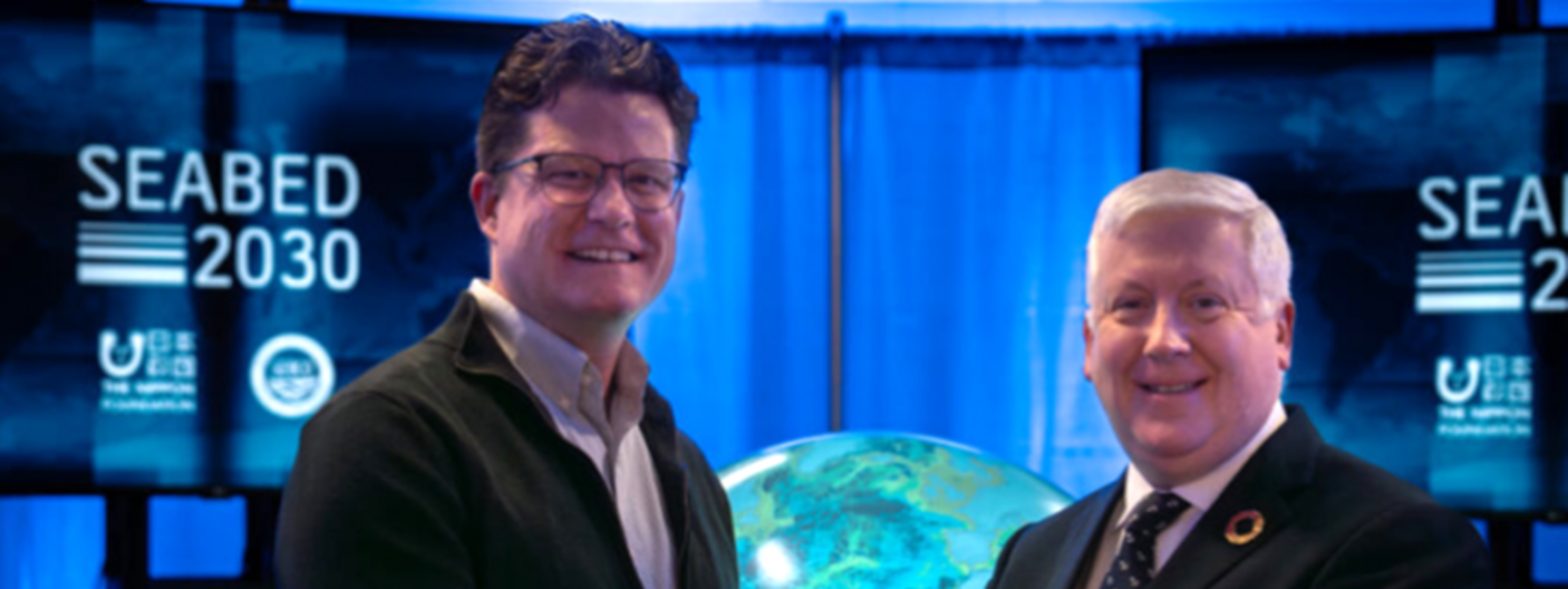
Mr. Brandt Brown (left) of Raymarine of the United Kingdom with Seabed 2030 Director Jamie McMichael-Phillips, formalizing their partnership to accelerate global ocean mapping. They met on the sidelines of the Ocean Floor Explore symposium held in Victoria, Canada, from October 26 to 29, 2025.
(Image credit: Seabed 2030)
The Nippon Foundation-GEBCO Seabed 2030 Project, which aims to complete the mapping of the world’s entire ocean floor by 2030, has entered into a new strategic partnership with Raymarine, a U.K.-based leader in high-performance marine electronics.
Marking another step forward in expanding industry engagement in global ocean mapping, the collaboration was announced at the Ocean Floor Explore symposium hosted by Map the Gaps and COAST in Victoria, Canada, in late October. The event brought together industry, technology and philanthropy to share knowledge, form new collaborations, and explore ways of advancing our understanding of the ocean floor with a view to promoting cross-sector collaboration to overcome the obstacles to deep ocean discovery.
Headquartered in Portsmouth, the United Kingdom, Raymarine is part of Teledyne FLIR and a leading developer of marine electronics, offering a range of systems for both recreational boating and light commercial marine applications. The company’s portfolio includes radar, autopilots, GPS (Global Positioning System) instruments, fishfinders, communications and fully integrated navigation solutions.
Launched in 2017, Seabed 2030 is a collaborative project between The Nippon Foundation and the General Bathymetric Chart of the Oceans (GEBCO), which seeks to inspire the complete mapping of the world’s oceans by 2030, and to compile all the data into the freely available GEBCO Ocean Map.
The project is formally endorsed as a Decade Action of the UN Ocean Decade. GEBCO is a joint program of the International Hydrographic Organization (IHO) and the Intergovernmental Oceanographic Commission (IOC), and is the only organization with a mandate to map the entire ocean floor.
As part of the collaboration, Raymarine will contribute a substantial dataset of crowdsourced bathymetric measurements gathered from thousands of vessels equipped with its sonar systems.
Collected through routine, real-world operations across global waters, this dataset offers valuable density and geographic breadth. Its inclusion will strengthen the resolution and coverage of existing seafloor maps, particularly in coastal and offshore areas that remain comparatively under-surveyed.
Raymarine's collaboration with the Seabed 2030 project highlights the importance of partnerships between technology companies and scientific initiatives. Such collaborations are crucial for advancing our understanding of the natural world and addressing global challenges related to marine environments.
Mr. Grégoire Outters, general manager at Raymarine, commented: “We’re proud to support Seabed 2030 in its mission to accelerate the complete mapping of the world’s oceans. This collaboration reflects our commitment to safer navigation, better science and a more sustainable future for the maritime industry.”
“Raymarine’s contribution of crowdsourced bathymetric data is a powerful example of how industry can accelerate our understanding of the ocean floor,” said Mr. Jamie McMichael-Phillips, director of the Seabed 2030 project, adding: “We welcome their support and look forward to the impact this data will have on our global mapping efforts.”
All data collected and shared with the Seabed 2030 project is included in the free and publicly available GEBCO global grid.
To date, 27.3% of the world’s ocean floor has been mapped to modern standards. Seabed 2030 aims to close this gap by 2030 through international collaboration, open data sharing, and innovative partnerships like this one.
|
Seabed 2030 Project Collaborates with Raymarine to Advance Global Seafloor Mapping
Published on December 24, 2025