
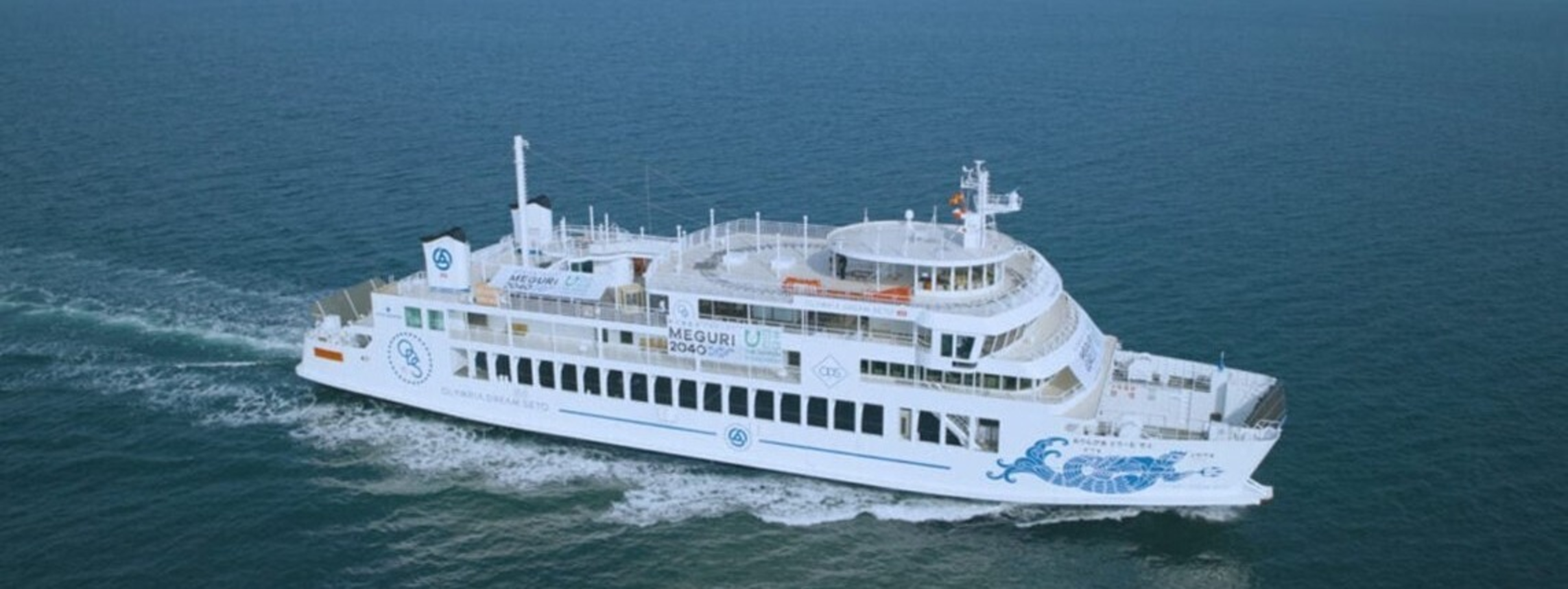
World’s First Fully Autonomous Passenger Ferry to Start Commercial Service in Japan Under the “MEGURI2040” Project (1)
Published on January 15, 2026

A Japanese consortium will shortly start fully autonomous operations of a passenger ferry on a regular commercial route in western Japan under the MEGURI2040 fully autonomous ship project financed and administered by The Nippon Foundation.
This was announced by the foundation at a press conference on December 10, 2025, when it hosted a demonstration of the crewless navigation technology in the Seto Inland Sea.
The announcement came after the Japanese Ministry of Land, Infrastructure, Transport and Tourism (MLIT) formally certified the vessel’s autonomous navigation system on December 5 based on the safety standards and inspection methods for unmanned shipping established in 2024.
The autonomous technology enables the vessel to sense navigational conditions, adjust course, and manage steering and propulsion automatically under defined conditions, while experienced crew remain on board with manual override capabilities for emergencies.
The foundation said the Olympia Dream Seto will be the world’s first ferry of its kind to start Level 4-equivalent autonomous navigation-allowing fully automated voyages without human intervention in designated waters-on a commercial route by the end in March 2026 as the crew becomes more familiar with the workings of the autonomous navigation system. (A Level 5 vessel can pilot itself anywhere under all conditions.).
Developed by a four-entity group, led by Japan Marine Science Inc., the 942 gross-ton 65.56-meter vessel, operated by Ryobi Ferry Co., can carry up to 500 passengers and 60 cars or 10 buses.
For the demonstration, the ferry proceeded along a 70-minute route between Shin-Okayama Port in Okayama Prefecture and Tonosho Port on Shodoshima Island in Kagawa Prefecture. The vessel makes four round trips per day on the route.
Olympia Dream Seto’s regular commercial service would mark an important step in the second phase in the MEGURI2040 project, launched by the foundation in February 2020 with the ambitious goal of making half of Japan’s domestic coastal shipping fleet crewless by 2040.
In the first stage of the project, five groups of companies successfully conducted voyages by six vessels between January and March 2022, demonstrating autonomous shipping technologies
More than 50 Japanese businesses are now involved, comprising the country’s leading shipping and shipbuilding companies, as well as equipment manufacturers, communications, IT, insurance and other firms, to form what they claim to be an “All Japan” team.
Japan’s domestic coastal shipping industry is currently grappling with the twin problems of an ageing seafarer population and a decline in crew numbers.
Under the circumstances, autonomous ships are expected to go a long way in reducing workloads and trimming operating costs. Besides, crewless navigation can also contribute to safety by reducing human error, which accounts for about 80% of marine accidents.
Autonomous ships will be of particular benefit to residents of over 400 islands in Japan who depend heavily on daily ferry routes to stay connected with the main islands of Honshu, Hokkaido, Kyushu and Shikoku.
(To be continued)
