
42nd Sasakawa Health Prize Awarded to Banconi Community Health Association of Mali
Published on July 16, 2026
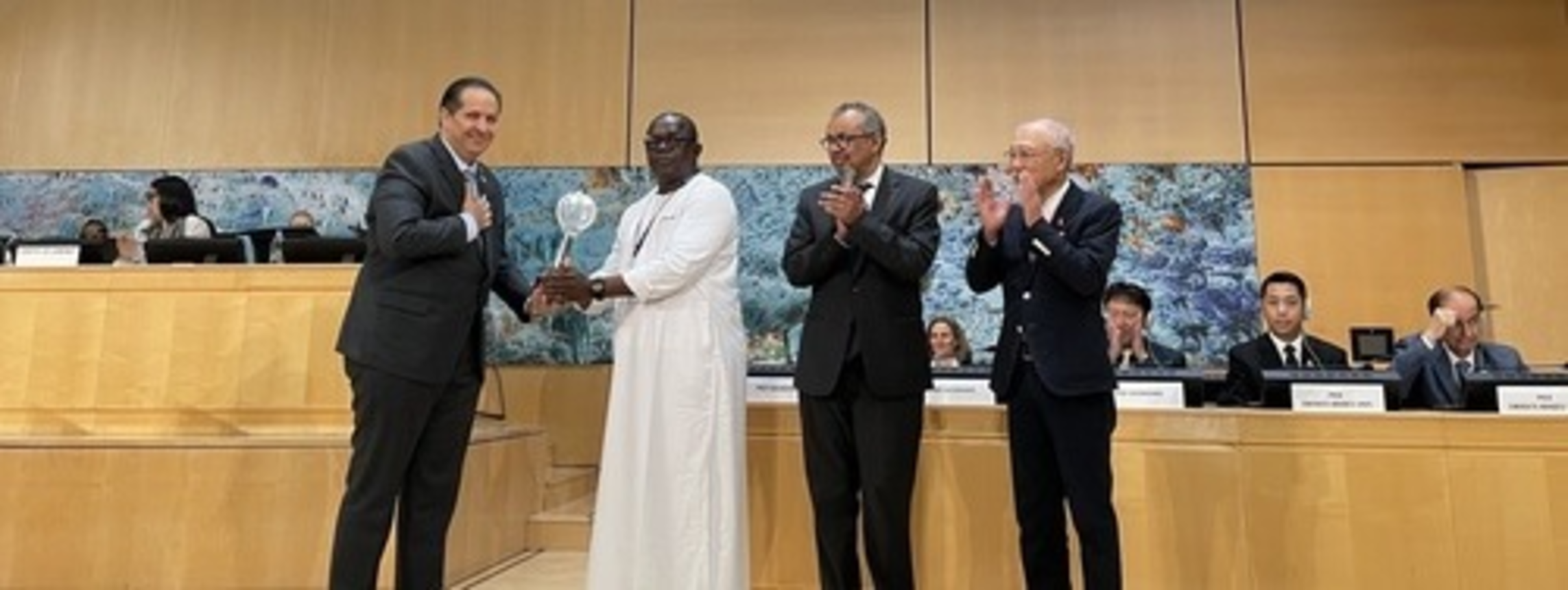
On May 20, at a ceremony held during the World Health Assembly (the WHO’s decision-making body) in Geneva, I presented the 42nd WHO Sasakawa Health Prize to the Banconi Community Health Association (ASACOBA) of Mali for its outstanding and innovative work in health development.
The prize was established by my late father, Ryoichi Sasakawa, in 1984 to recognize individuals and organizations that are engaged in innovative efforts to improve people’s health and establish greater health equity through the promotion of primary healthcare.
The ceremony took place at the historic Palais des Nations, which houses the U.N. Office in Europe, in the presence of WHO Director-General Tedros Adhanom Ghebreyesus and the president of the 79th World Health Assembly, Dr Víctor Elias Atallah Lajam of the Dominican Republic.
ASACOBA was established in 1988 in Banconi in the capital Bamako in response to the Bamako Initiative, a strategy for enhancing primary healthcare adopted by WHO in 1987.
The association, the first of its kind in the land-locked west African nation, supported the establishment of a community health center to bring dispensary and maternity services closer to local communities and make affordable treatment accessible to underserved populations in the district. This approach combines community leadership and empowerment, equitable approaches and social innovation to meet the populations’ essential needs.
The Banconi Health Centre partners with the Ministry of Health and with education authorities, communities and technical partners abroad to provide strengthened prevention, diagnosis, treatment and rehabilitation services.
Thanks to its academic partnerships, the center offers internships to medical students and community-medicine research and training opportunities to resident doctors. The ASACOBA model has been widely replicated across Africa, with more than 1,950 community health associations now active in Mali alone.
Speaking at the ceremony, Mr. Amadou Ouattara, president of ASACOBA, stated: "This award is a tribute to the tireless work of field health workers. It rewards the belief that the solution does not come solely from urban hospitals, but also and above all from community engagement."
Congratulating the association on receiving the award, I said: “Since its founding it has built a pioneering model of community-based healthcare through community participation. Under the leadership of women, ASACOBA has steadily supported basic healthcare services including prevention, diagnosis, treatment, maternal and child health and vaccination. At the same time, it has developed a framework for cooperation linking local residents, healthcare workers, government authorities and universities.”
“Their experience offers significant insights not only within Mali but also across other African nations,” I added.
