
The Nippon Foundation Presents Latest Update on “MEGURI2040” Fully Autonomous Ship Program to IMO’s Maritime Safety Committee
Published on August 24, 2026
The Nippon Foundation has provided some 300 delegates from around the world with the latest update on the “MEGURI2040” fully autonomous ship project at a meeting of the Maritime Safety Committee (MSC) of the International Maritime Organization (IMO).
At the 111th MSC meeting at the IMO’s headquarters in London on May 15, the foundation’s Executive Director Mitsuyuki Unno presented the update alongside representatives of partner companies and institutions who highlighted the achievements of the second stage of the project-fully autonomous operations by four vessels on regular commercial routes.
The start of these vessels’ commercial operations marked an important step in the MEGURI2040 project financed and administered by The Nippon Foundation. It was launched in February 2020 with the ambitious goal of making half of Japan’s domestic coastal shipping fleet crewless by 2040.
Mr. Unno reported that from late 2025 to early 2026, ClassNK (Nippon Kaiji Kyokai), Japan’s non-governmental ship classification society, formally certified the four vessels for autonomous operations one by one following a series of successful demonstration voyages.
Subsequently, the Japanese Ministry of Land, Infrastructure, Transport and Tourism (MLIT) formally certified these ships’ autonomous navigation systems based on the safety standards and inspection methods for unmanned shipping established in 2024.
Upon receiving the official go-ahead, the passenger ferry Olympia Dream Seto became the world’s first ferry of its kind to start Level 4-equivalent autonomous navigation-allowing a fully automated voyage without human intervention in designated waters-on a scheduled commercial route in the Seto Inland Sea, western Japan. (A Level 5 vessel can pilot itself anywhere under all conditions.).
The 942 gross-ton 65.56-meter vessel can carry up to 500 passengers and 60 cars or 10 buses.
It was followed by the newly-built 5,689 gross-ton 134.9-meter-long containership Genbu, which started to serve a regular commercial route linking Kobe, Osaka, Nagoya, Yokohama and Tokyo, linking the major commercial hubs on the Pacific coastline.
Launched in April 2025, Genbu is the only newly-built vessel designed and built as a full-packaged autonomous ship under the MEGURI2040 project. The three others are existing vessels retrofitted with unmanned operating systems.
Next, the 11,413 gross-ton 173.8-meter-long Roll-on/Roll-off (RORO) cargo ship Hokuren Maru No. 2 started operating on a commercial sea route of approximately 1,600 kilometers round trip between Hitachi, some 140 kilometers northeast of Tokyo, and Kushiro in Hokkaido, Japan’s northernmost prefecture.
The route is known for heavy fishing boat traffic and thick fog. RORO ships are cargo ships designed to carry wheeled cargo, such as cars, motorcycles and trucks, which are driven on and off the ship on their own wheels
Lastly, the 749 gross-ton 65-meter-long containership Mikage started fully autonomous navigation on a commercial route between Kobe, western Japan, and Nagoya, central Japan.
Containerships of roughly the Mikage’s size play an important role in coastal transport in Japan, accounting for some 10% of coastal vessels in operation.
The presentation to the MSC was followed by a Q&A session that was marked by lively exchanges of opinions, demonstrating the degree of attention being placed on autonomous navigation in global maritime transport and the high level of interest in the MEGURI2024 project specifically.
In the first stage of the project, five groups of companies successfully conducted demonstration voyages by six vessels between January and March 2022, displaying autonomous shipping technologies.
In the second stage, 53 Japanese businesses, comprising the country’s leading shipping and shipbuilding companies, as well as equipment manufacturers, communications, IT, insurance and other firms, have come together to form what they describe as an “All Japan” team.
Presenting the latest update on the “MEGURI2040” fully autonomous ship project at the 111th meeting of the Maritime Safety Committee (MSC) of the International Maritime Organization (IMO), Executive Director Mitsuyuki Unno of The Nippon Foundation also reported that the commercial operations of the four vessels were supported by fixed and mobile Fleet Operation Centers (FOCs) financed and administered by The Nippon Foundation
The two FOCs are the world’s first to be capable of providing remote navigation support to multiple fully autonomous ships simultaneously from ashore. They leverage Japan's advanced information and communications technologies (ICT) and artificial intelligence (AI) expertise to overcome longstanding hurdles to autonomous navigation, including communications, obstacle detection and costs.
The fixed FOC was established in July 2024 at the headquarters of Furuno Electric Co., a major manufacturer of maritime and industrial electronic products in Nishinomiya, western Japan.
Completed in February 2025, the mobile FOC, housed in a cargo trailer, can be moved anywhere, meaning that in the event of a disaster or other emergencies, it can be transported to a safe location and continue to provide remote navigational support to multiple ships.
The MSC’s 111th meeting also adopted a new non-mandatory International Code of Safety for Maritime Autonomous Surface Ships (MASS Code) to support the safe integration of AI-enabled and remotely operated commercial ships into global shipping.
The MASS Code sets out a comprehensive, goal-based framework to ensure that remotely controlled or autonomous ships are designed and operated to a level of safety, security and environmental protection that is expected of a conventional ship. They will also be required to comply with the International Convention for the Safety of Life at Sea (SOLAS) and other applicable mandatory IMO instruments.
The MASS Code took effect on July 1. As it is a non-mandatory instrument, member states are given the opportunity to test its use while paving the way for making it mandatory under the SOLAS Convention.
The first mandatory MASS Code is expected to be adopted by July 2030 for entry into force in January 2032, according to the IMO.
We hope the verification data collected by the MEGURI2040 project will also form a foundation for Japan to take the lead in creating international rules on autonomous ships at IMO when the MASS Code becomes binding.
Following the presentation, Mr. Unno attended a ceremony to mark The Nippon Foundation’s additional donation to the IMO Technical Cooperation Program administered by the Japan Ship Technology Research Association.
At the event, he was joined by Japanese Ambassador to the United Kingdom Hiroshi Suzuki and the IMO’s Maritime Safety Division Director Damien Chevallier, who expressed appreciation for the contributions being made by the foundation.
This fund uses Japanese expertise to train ship crew members from developing countries on international marine transport, the operation of LNG-fueled vessels, autonomous vessels and hydrogen-fueled vessels.
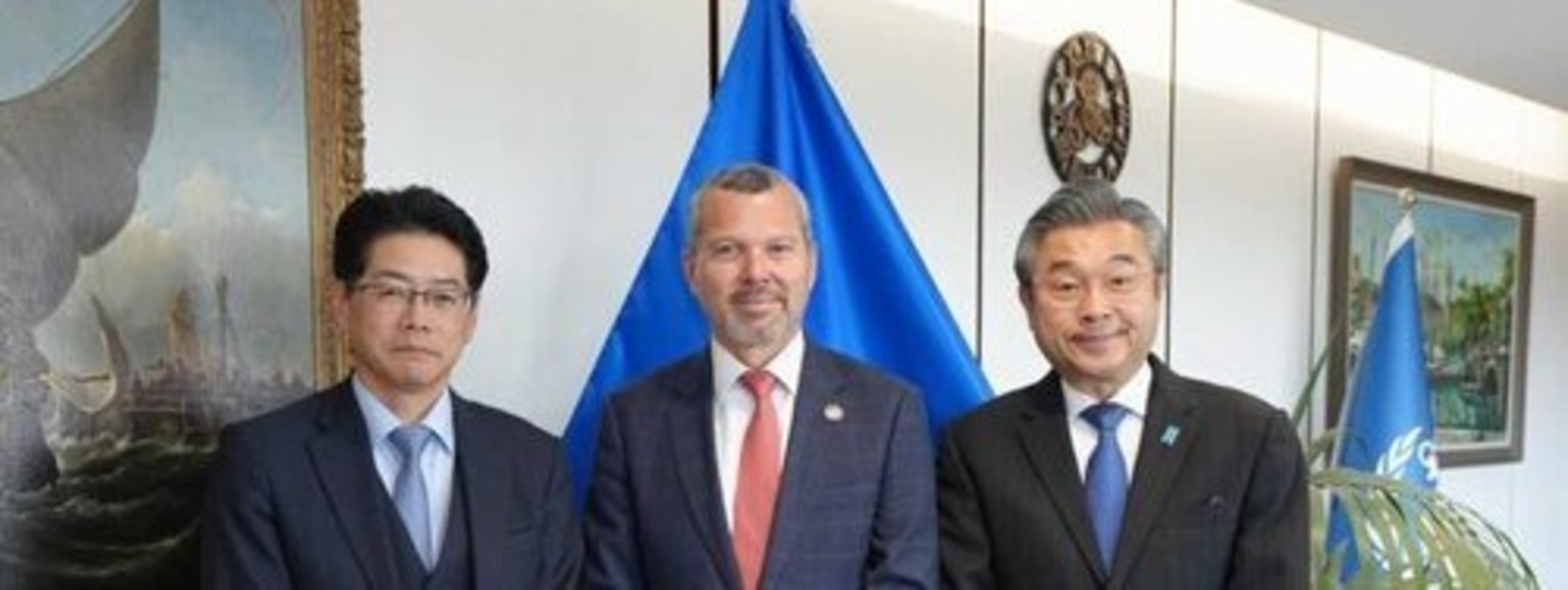
Afterward, Mr. Unno and Ambassador Suzuki paid a courtesy call on IMO Secretary-General Arsenio Dominguez, where they discussed the MEGURI2040 project, the current international situation, including the situation in the Strait of Hormuz, the IMO’s recent activities and other maritime issues.
In addition to sharing their common approaches to various maritime issues, they confirmed their intention to work even more closely together going forward.
The IMO is a specialist UN organization established in 1958 to promote international cooperation related to maritime issues including navigation safety and the prevention of marine pollution from ships. As of January 2026, the IMO’s membership comprised 176 member states and three associate members.
Japan’s domestic coastal shipping industry is currently grappling with the twin problems of an ageing seafarer population and a decline in crew numbers.
Under the circumstances, autonomous ships are expected to go a long way in reducing workloads and trimming operating costs. Besides, crewless navigation can also contribute to safety by reducing human error, which accounts for about 80% of marine accidents.
The Nippon Foundation is determined to support the MEGURI 2040 project for years to come with a view to achieving the ambitious goal of making half of Japan’s domestic coastal shipping fleet crewless by 2040.