
40% of Japanese Women Want 2 Children Barring Any Constraints: Nationwide Poll

Before the Japanese government established the Children and Families Agency on April 1, The Nippon Foundation conducted an awareness survey of 10,000 women to look into their attitudes toward having and raising children against a backdrop of the declining birthrate in this country.
Reversing the country’s declining birthrate is a top priority for Prime Minister Fumio Kishida, who, despite high levels of public debt, is planning to double the budget for childcare and other measures to support parents by the early 2030s.
The online poll covering 10,000 women aged 18 to 69, conducted from March 20 to 22, asked the women what their ideal number of children would be if they had no constraints and could have as many children as they wanted. It found that 39.9% said two and 24.5% three, while 20.5% said they did not want any children.
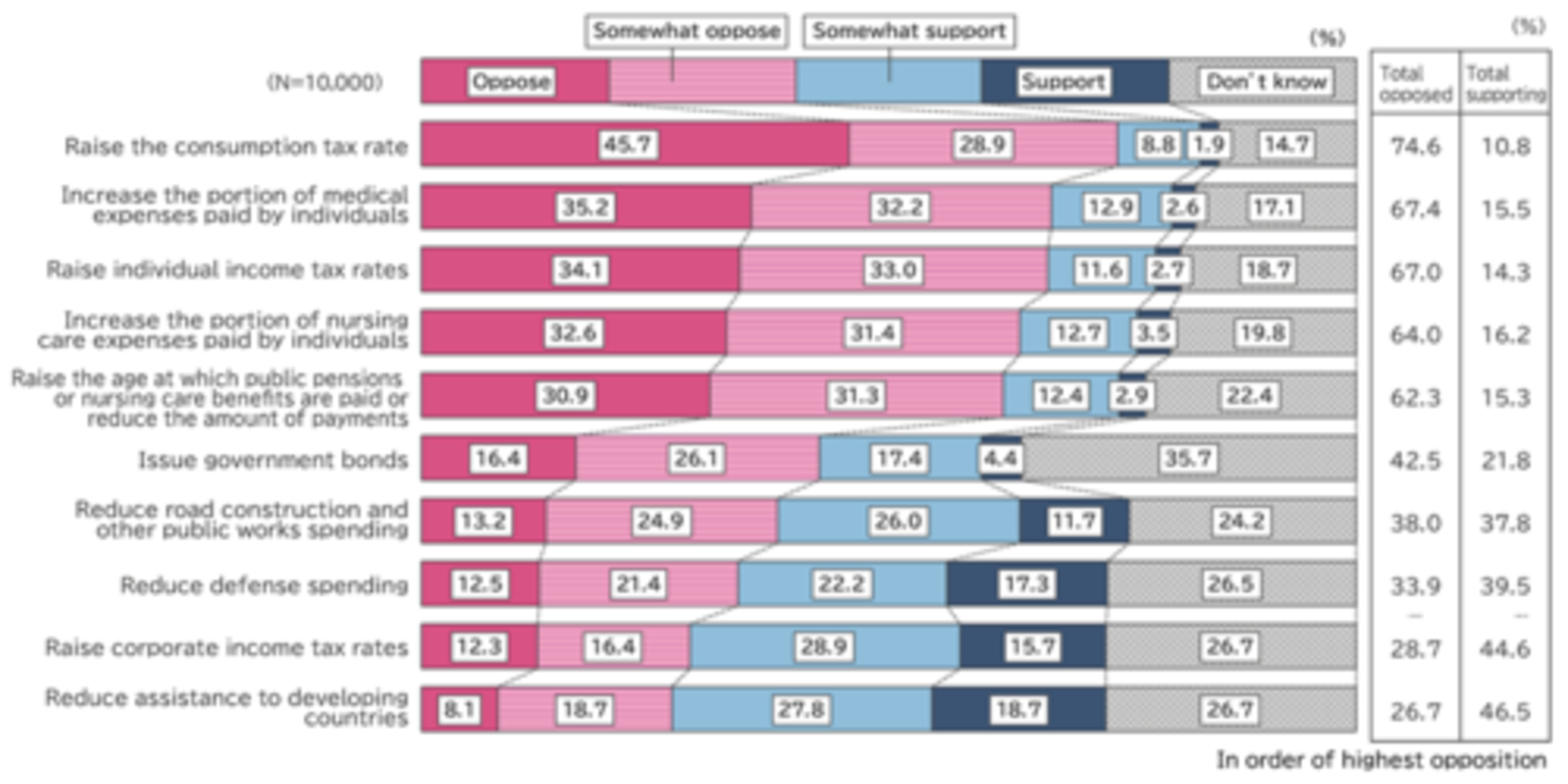
When asked how funds should be secured to pay for increased public spending on childcare, three in four (74.6%) were opposed to raising the consumption tax, while two in three were against increasing medical expenses paid by individuals (67.4%) and raising individual income tax rates (67.0%).
On the other hand, almost half (46.5%) favored reducing aid to developing countries to pay for child-related measures, followed by raising corporate income tax rates (44.6%) and reducing defense spending (39.5%).
According to the statistics announced by the Ministry of Health, Labour and Welfare on June 2, Japan’s fertility rate, or the average number of children born to a woman in her lifetime, in 2022 declined for the seventh consecutive year to tie the record low of 1.26 posted in 2005. The figure is far below the rate of 2.07 considered necessary to maintain a stable population.
When asked what national and local governments and businesses should do to reverse the falling birthrate, a third of the respondents (33.4%) want them to raise wages, followed by those who want to see free education or more financial assistance (30.0%) and more public support for childbirth and child rearing (28.2%).
When asked whether recognizing the rights of children born outside marriage would lead to an increase in Japan’s birthrate, almost a third (30.9%) said yes, a quarter (23.9%) said no, and 45.2% said they didn’t know.
Queried about their specific expectations of the new Children and Families Agency, around one in five (20.3%) want it to tackle child poverty, while less than 20% expect it to tackle the declining birthrate (18.4%) and child abuse (16.9%).
Asked about their concerns regarding Japanese society in terms of children’s future, topping the list was the collapse of the public safety net, including the medical and pension systems, due to the nation’s huge public debt (41.8%), followed by the shrinking labor force due to population decline (32.3%) and increasingly violent earthquakes and other natural disasters (27.5%).
In analyzing the findings of the survey, one of the things that struck me was that only 6.0% of those surveyed said that government measures to counter the falling birthrate would have some effect, while 33.6% said that they would have little and 21.0% said that they would have no effect at all. Another 39.4% said they could not say.
One reason for people’s low expectations seemed to be the government’s failure so far to come up with a plan for how to pay for the doubling of the child-related spending.
In June, about three months after the poll was taken, Prime Minister Kishida unveiled a package of measures aimed at reversing the declining birthrate, including, among other things, removing an income ceiling on childcare allowances, increasing paternity leave payments and providing homes for hundreds of thousands of such households. But he said he would work out the details of securing sources of funding by the end of the year.
I sincerely hope that the government will work seriously on a stable funding plan and take every opportunity to promote the childcare package so that young Japanese will be more inclined to have as many babies as they want.
