
Japan Taking Significant Strides Toward Commercialization of Fully Autonomous Ships by 2025

Japan is taking significant strides toward putting crewless ships into commercial service in 2025 under a project financed and administered by The Nippon Foundation.
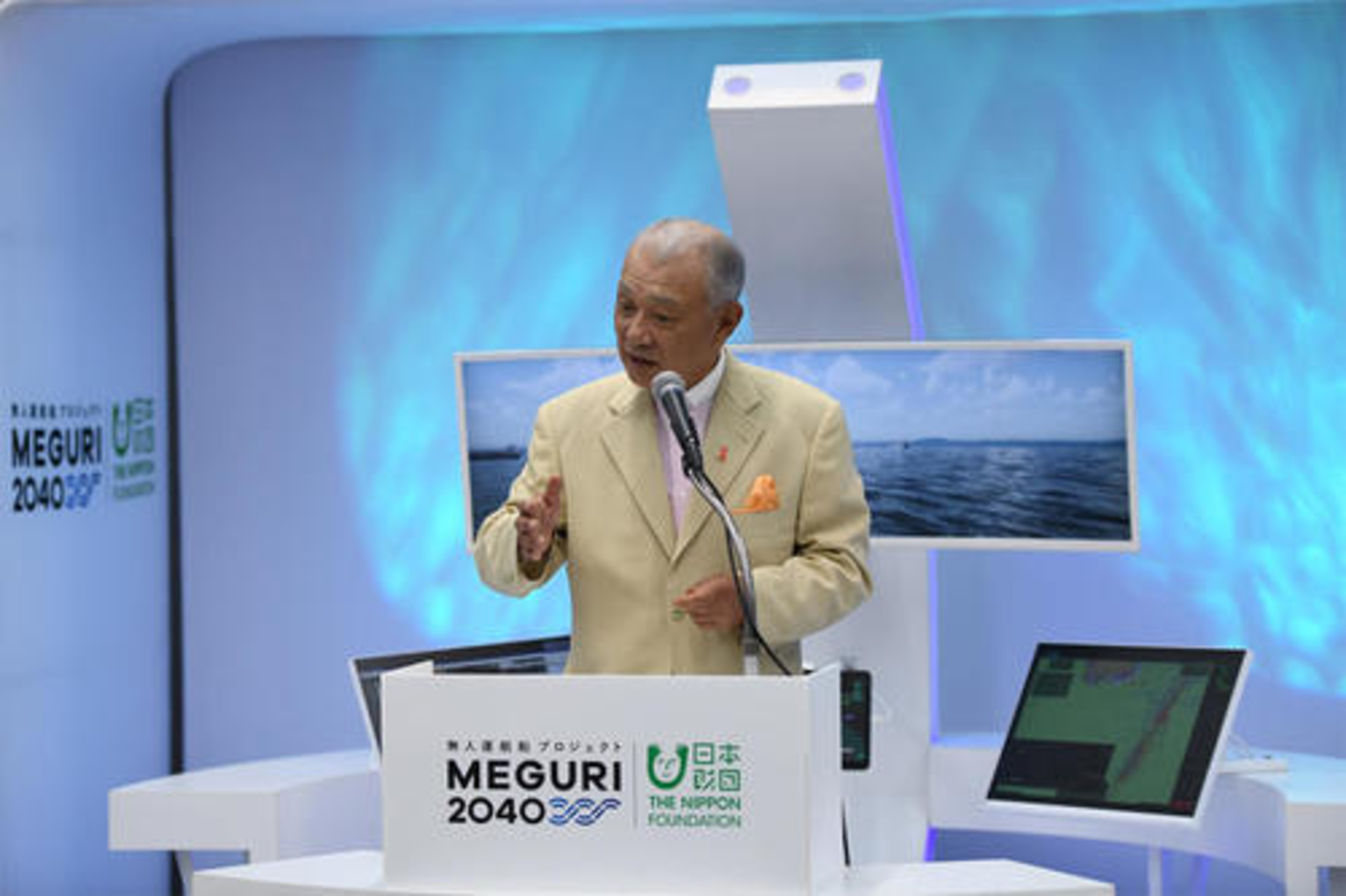
This forms the second stage of the Joint Technological Development Program for the Demonstration of Unmanned Ship, dubbed “MEGURI 2040,” the foundation announced at a seminar in Tokyo on July 20.
In the first stage of the initiative launched by the foundation in February 2020, five consortia, comprising 51 Japanese companies, successfully conducted voyages through March 2022 demonstrating autonomous shipping technologies. Ultimately, the “MEGURI 2040” initiative aims to make half of Japan’s domestic coastal shipping fleet crewless by 2040.
Building upon the advancements made during the first stage, the 51 companies, comprising the country’s major shipping and shipbuilding as well as equipment manufacturing, communications, IT, insurance, research and other firms, will join forces as a single group in the second stage for what they claim to be an “All Japan” team.
Speaking at the seminar, Mr. Mitsuyuki Unno, executive director of The Nippon Foundation, said what the second stage aims to achieve is equivalent to so-called “Level 4 autonomous vehicles,” which can conduct driving tasks without human intervention within a limited area. (A Level 5 vehicle can drive itself anywhere under all conditions.)
The foundation outlined four primary goals of the second stage to achieve commercialization of fully autonomous ships by 2025.
1. Demonstration Test: Conducting a demonstration of ship-land operations to simulate the future coastal shipping industry supported by fully autonomous technologies. The group will conduct demonstrations using four different types of ship: a newly built full-package container ship with fully autonomous navigation; an existing container ship; a Roll-on/Roll-off (RORO) cargo ship; and a remote island route ship retrofitted with some autonomous navigation capabilities. Additionally, two Fleet Operation Centers will be set up to monitor and support these crewless vessels from onshore.
2. Standardization of Developed Technologies: Further refine the autonomous ship technologies developed in the first stage and bring them in line with international standards. The aim is to strengthen Japan’s maritime industry and position it as a leader in fully autonomous ship technology on the international stage.
3. Reinforcement of Development Process Infrastructure: Upgrade the development process infrastructure established in the first stage. This includes enhancing simulation technology, generalizing risk assessment procedures, and other improvements. These steps aim to ensure the robustness and reliability of fully autonomous ship technology.
4. Social Implementation: Establish a certification scheme necessary for commercialization of the autonomous navigation function, including land-based monitoring. The project also focuses on improving the environment for social implementation, including the establishment of international and domestic rules for fully autonomous ships, human resource requirements and training methods to accommodate new working styles, deregulation strategies to support continuous commercial use, and assessing insurance and freight rates for autonomous ships.
Currently, Japan’s domestic coastal shipping industry is grappling with the problem of an aging population of seafarers, more than half of whom are aged 50 and older, as well as a declining number of crew members working in the industry.
Under the circumstances, autonomous ships are expected to go a long way in reducing workloads and trimming operating costs. Besides, crewless navigation can also contribute to safety by reducing human error, which accounts for about 80% of marine accidents.
I told the seminar participants that given the high levels of Japan’s IT and AI technologies combined with the country’s years of experience as a leading shipping and shipbuilding country, I strongly hoped that the team would come up with innovations that see Japan pioneer the use of unmanned vessels.
As the Japanese team designs and demonstrates autonomous technologies in the second stage, I hope it will play a leading role in creating international rules governing unmanned shipping in international waters, led by the International Maritime Organization (IMO), an arm of the United Nations that sets rules for international shipping operations.


MEGURI2040 logo