
One Third of Japanese Youths Have Used Generative AI, But Only 10% for Summer Homework: The Nippon Foundation Poll

The Nippon Foundation conducted a survey on generative artificial intelligence (AI), covering 1,000 Japanese aged 17 to 19 across the country on August 19 and 20.
ChatGPT developed by Microsoft-backed OpenAI and other generative AI apps are trained using massive amounts of data from the internet and can generate anything from essays to mathematical calculations with just a few lines of prompts.
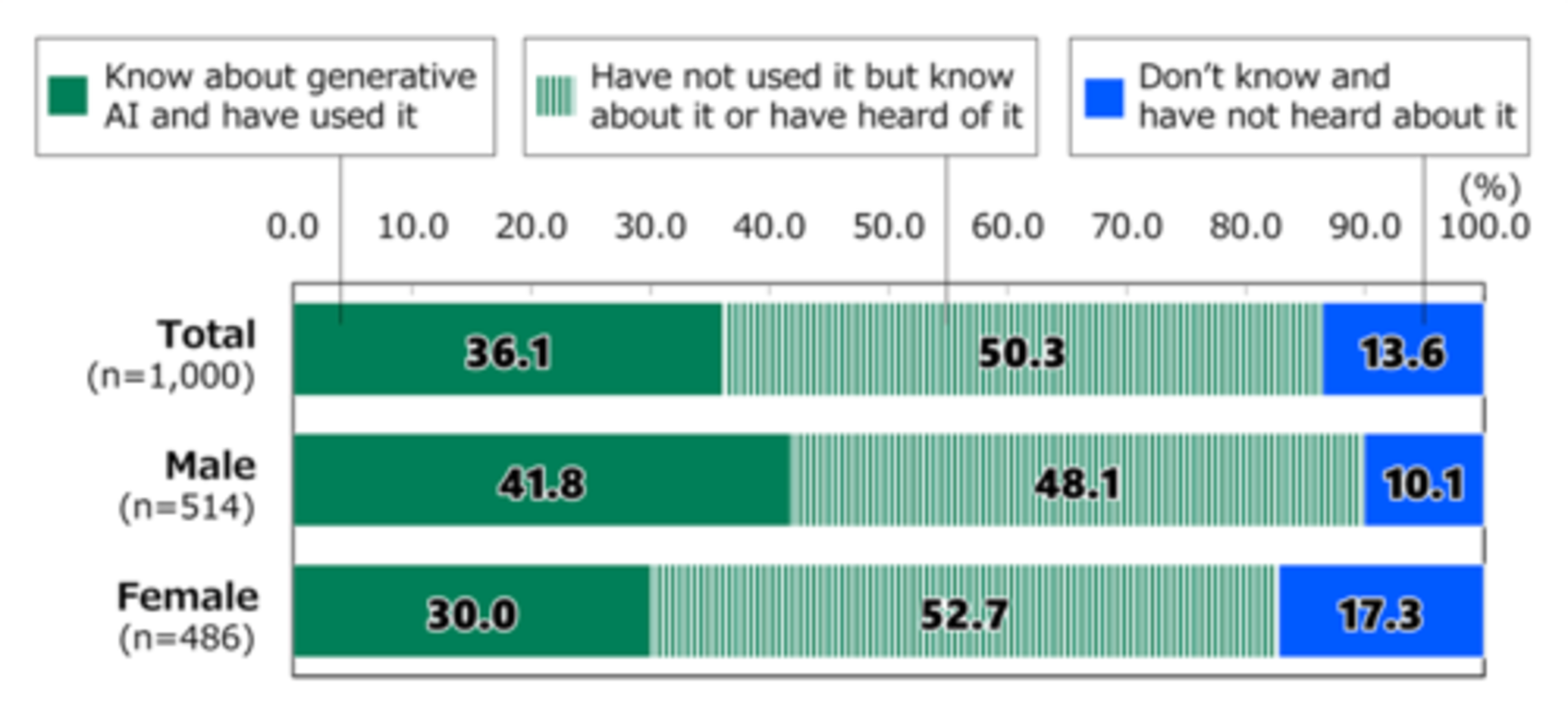
The online poll found that close to nine out of ten respondents (86.4%) were aware of generative AI and more than one in three (36.1%) have used it. By gender, many more males (41.8%) than females (30.0%) have used AI programs.
Of those who have not used AI, roughly 60% (60.4%) said they would like to try generative AI, indicating a strong interest among Japanese youths in engaging with the new technology. Only one in ten (13.6%) didn’t know or hadn’t heard about it.
However, just one in ten (10.4%) used AI systems for this year’s summer homework, with almost two thirds (63.2%) saying they hadn’t used them or didn’t intend to; one in four (26.4%), had no summer homework.
Asked about the handling of generative AI in high school or university classes or extracurricular activities, almost one third (31.8%) said they have been taught about the framework, features and risks of generative AI in classes, with one in five (21.8%) saying their high schools or universities have rules in place on the use of this new technology.
When those who had used generative AI were asked what they had used it for, over 90% (92.8%) said generating text, followed by images (31.3%), videos (5.5%), sound (4.7%) and music (3.0%).
Asked about why they use generative AI tools, two thirds (63.2%) said “to pass the time,” followed by to create text for school homework or work materials (38.5%), to better understand school lessons (27.4%), to generate ideas that they and people around them can’t think of (27.1%), collecting information faster than by using traditional search engines (19.1%), practicing foreign languages, learning and understanding multiple languages (18.0), improving efficiency in creating works such as music and illustrations (10.0%), and learning about the story and themes of books and movies (4.4%).
The poll also found that close to 20% said AI’s advent has affected or changed their future dreams or plans for jobs (17.7%) and the subjects they want to study (19.3%).
In early July, Japan’s Ministry of Education, Culture, Sports, Science and Technology unveiled provisional guidelines allowing limited use of generative AI while imposing some restrictions to prevent copyright infringement, personal information leaks and plagiarism.
Like many other countries, Japan’s governance of AI technology has not kept pace with its growth. I sincerely hope that the government’s guidelines will be properly updated to minimize the risks while maximizing the use of generative AI for the greater good.

