
With Japan’s GDP Ranking Slipping, 70% of Its Youths Concerned About Future: Poll

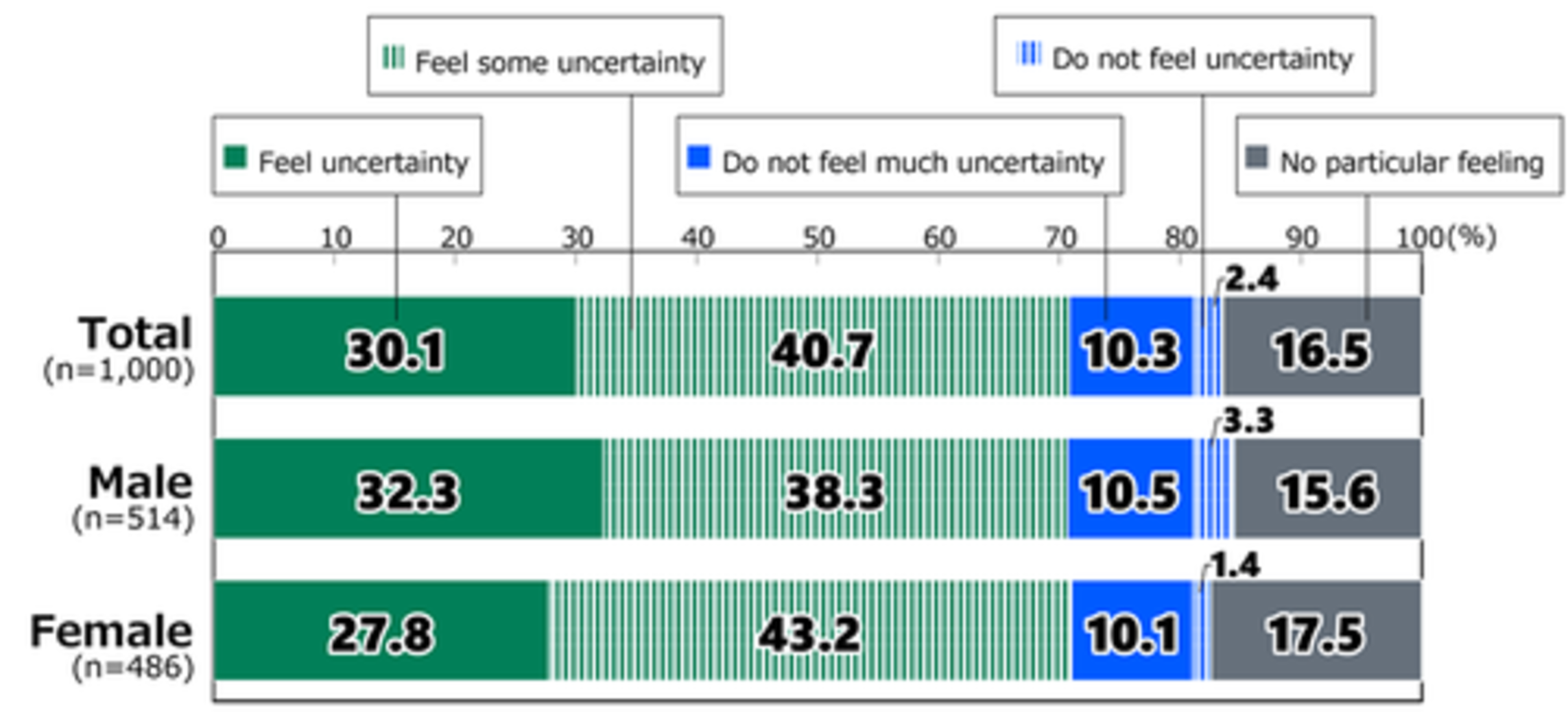
Last October, the International Monetary Fund (IMF) forecast in its World Economic Outlook that Germany would dislodge Japan as the world’s third largest economy on a U.S. dollar basis in 2023. This was 13 years after Japan was overtaken by China as the second largest economy in 2010. Japan’s continued fall in the world GDP rankings drew a chorus of pessimistic comments on mainstream and social media about the future of the nation’s economy. Against this background, The Nippon Foundation conducted a survey from December 1 to 4 to look into how young Japanese see their own and their country’s future, covering 1,000 men and women aged between 17 and 19. The nationwide online poll also asked about their views on building assets through investment and on cars and the mobility of people and goods. Asked whether they were aware of the IMF forecast, about one fourth (26.4%) responded in the affirmative. By gender, roughly twice as many males (34.8%) as females (17.5%) said yes. The poll showed that over 70% (70.8%) were concerned about Japan’s uncertain future while over one in 10 (12.7%) said they were not. 16.5% said they had no particular feeling about the future direction of the country. Regarding their own future, more than 60% (62.9%) were worried and one in five (19.9%) were not, with 17.2% saying they did not feel anything in particular. Two thirds (66.7%) expected Japan’s world ranking in terms of nominal GDP to either “fall further” (16.9%) or be “more likely to fall further” (49.8%) in the future. By gender, males (22.4%) were more pessimistic than females (11.1%) that it would “fall further”. On February 15, Japan’s Cabinet Office announced that the nation’s nominal GDP in U.S. dollars was $4,210.6 billion, compared to Germany’s $4,456.1 billion, dropping it to fourth place in the world’s GDP rankings. The survey also asked the respondents about their views on investing in financial instruments mainly in the context of the Nippon Individual Savings Account (NISA), a Japanese government tax-free stock investment program for individuals that was set for a major overhaul in January 2024. Japan launched NISA in 2014, modeled after the U.K.'s Individual Savings Account (ISA) system. Among other things, the revised NISA raises from 1.2 million yen (about $8,000) to 3.6 million yen (about $24,000) the annual ceiling on equity investments that are exempt from the 20% capital gains tax, and extends the tax-exempt period from five years to an indefinite term. For months, Japanese Prime Minister Fumio Kishida flagged this makeover of NISA as part of his pet policy of "new capitalism" aimed at boosting household wealth and asset holdings by encouraging individuals to shift from savings to investments in the equities market. In responding to the survey, more than 40% (44.0%) said they had been aware of the NISA overhaul in January with the remaining 56.0% saying they had not. A little over 40% (41.4%) said they were interested in building wealth through investing. One in five (19.4%) saw domestic stocks as the most attractive market, followed by stocks in developed countries (13.2%) and those in emerging markets (5.7%). But about half of men (50.2%) and almost two thirds of women (63.6%) said they didn’t know or had nothing concrete in mind at this stage. On the subject of automobiles and the mobility of people and goods, the top hopes of young Japanese were to see a reduction in accidents (41.6%), followed by a reduction in road congestion (26.8%), a reduction in environmental impact (25.4%), more efficient logistics (22.0%), a reduction in transport costs (21.8), and an increase in the use of autonomous cars (18.7%). Topping the list of their concerns about cars and mobility were the increasing number of accidents involving older drivers (39.3%), followed by the possibility of vehicles becoming uncontrollable due to driver error (24.2%), the increasing cost of vehicle ownership (16.8%), the increasing impact on the environment (16.6%), and the increasing cost of mobility (14.6%). Asked about the advisability of requiring older drivers to give up their license when they reach a certain age, almost 80% (77.2%) approved of the idea. When asked at what age, close to 30% (29.5%) said 70, followed by 65 (24.5%), 75 (21.9%), 80 (15.0%) and 85 (2.8%). 

|