
I Send “Don’t Forget Leprosy” Message from the Top of Mt. Kilimanjaro, Africa’s Highest Peak (3)

The following is a day-to-day report on the last two days of our ascent and descent of Kilimanjaro:
Day 6 (February 12):
Battling low oxygen levels and cold temperatures, we began the final leg of the ascent, leaving Kibo Hut (Altitude: 4,720m) at 11:25 p.m. (February 11).
My progress was relatively smooth, punctuated by intermittent two-minute standing breaks.
But at an altitude of around 5,400 meters, I found I was slowing down and taking more frequent breaks, resting my weight on my hiking sticks. I felt drowsy.
Aware of how I was doing, Dr. Tomoya Ikeda, a physician and experienced mountaineer, told me that if my condition worsened, he would have to consider calling off the expedition. I told him: “It would be unfortunate if we had to give up at this point.”
Then I took a longer break and had hot tea with sugar that a porter brought to me. I resumed climbing, more steadily than before.
Before long, I heard songs being sung by porters in support of other climbing parties that were going through tough times. Then I realized the porters were singing “Kaicho,” the Japanese word for “chairman”, to encourage me.
The magic of hot tea and the porters’ songs of encouragement inspired me mentally and physically to keep going.
About six hours after we left Kibo Hut, we reached Gilman’s Point (5,685 meters), one of Mount Kilimanjaro’s three summits, at 5:33 a.m. It was here that I unfurled the “Don’t Forget Leprosy” banner.
We then began our descent, reaching Kibo Hut in 2.5 hours and Horombo Hut (3,720 meters) four hours later. The average temperature was 5 degrees below zero during the daytime and 14 degrees below zero at night. On this day we walked for 12.5 hours, covering 21 kilometers.

Day 7 (February 13):
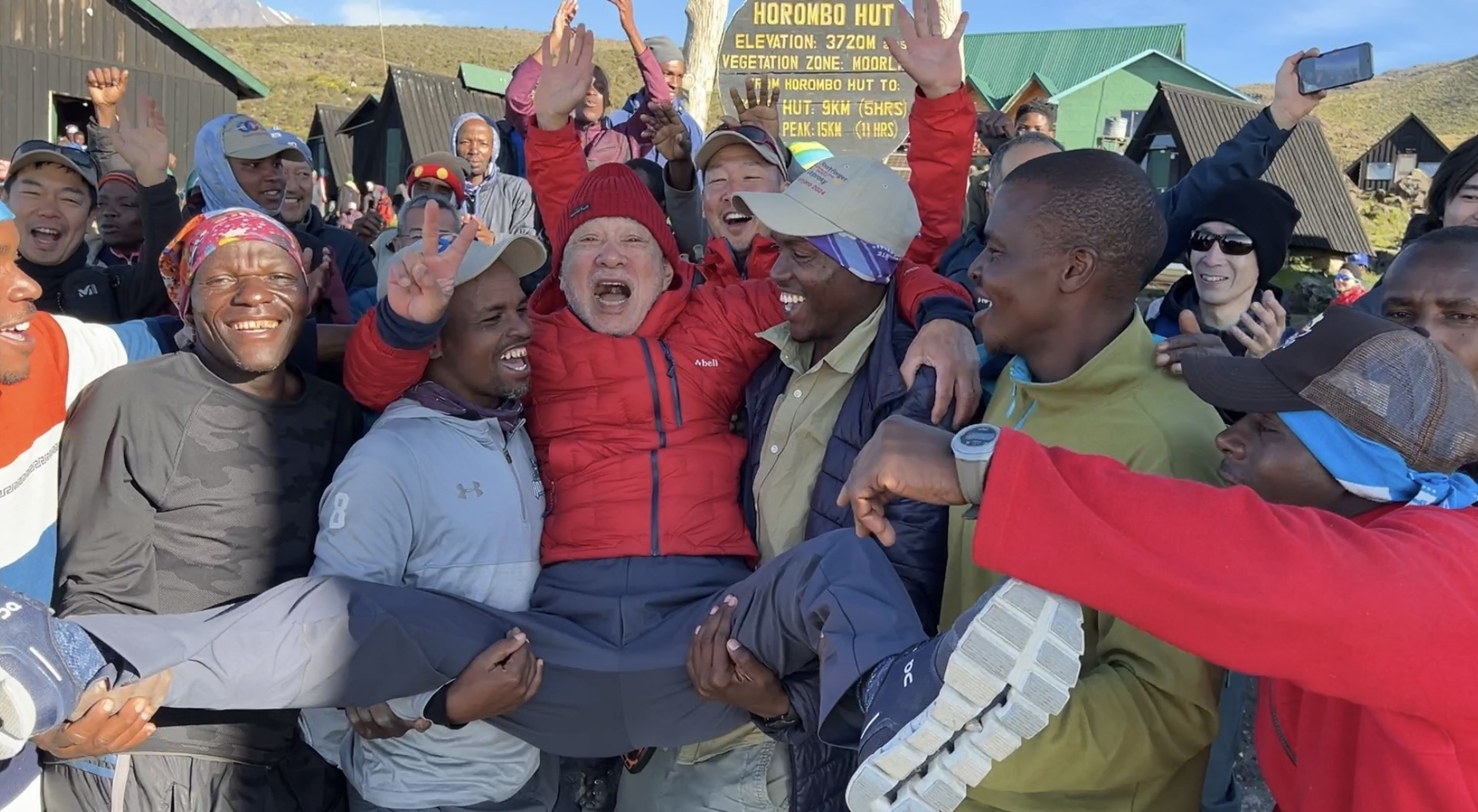
At 8:00 a.m., we held a ceremony to celebrate our successful climb at Horombo Hut campsite (Altitude: 3,720 meters). At 3:30 p.m., some of our party, myself included, left by rescue car on doctor’s advice after the long expedition and reached the Kilimanjaro Wonders Hotel at 7:30 p.m.
“I did this to provide inspiration to everyone around the world who is involved in eliminating leprosy. I hope this will encourage people to become even more involved going forward,” I said in a statement issued upon completing the climb.
I have learned that for an 85-year-old senior citizen with a Grade 1 disability-I have a pacemaker implanted in my chest-reaching the top of Kilimanjaro would merit a place in the Guinness World Records. An application is being considered
(End)


