
The Nippon Foundation, 4 Prefectures Extend “Setouchi Oceans X” Project By 3 Years to Achieve the World’s Most Beautiful Inland Sea

The Nippon Foundation and four prefectures that encircle the Seto Inland Sea in western Japan have agreed to extend the “Setouchi Oceans X” project, which aims at achieving the world’s most beautiful inland sea, by three years to March 2028.
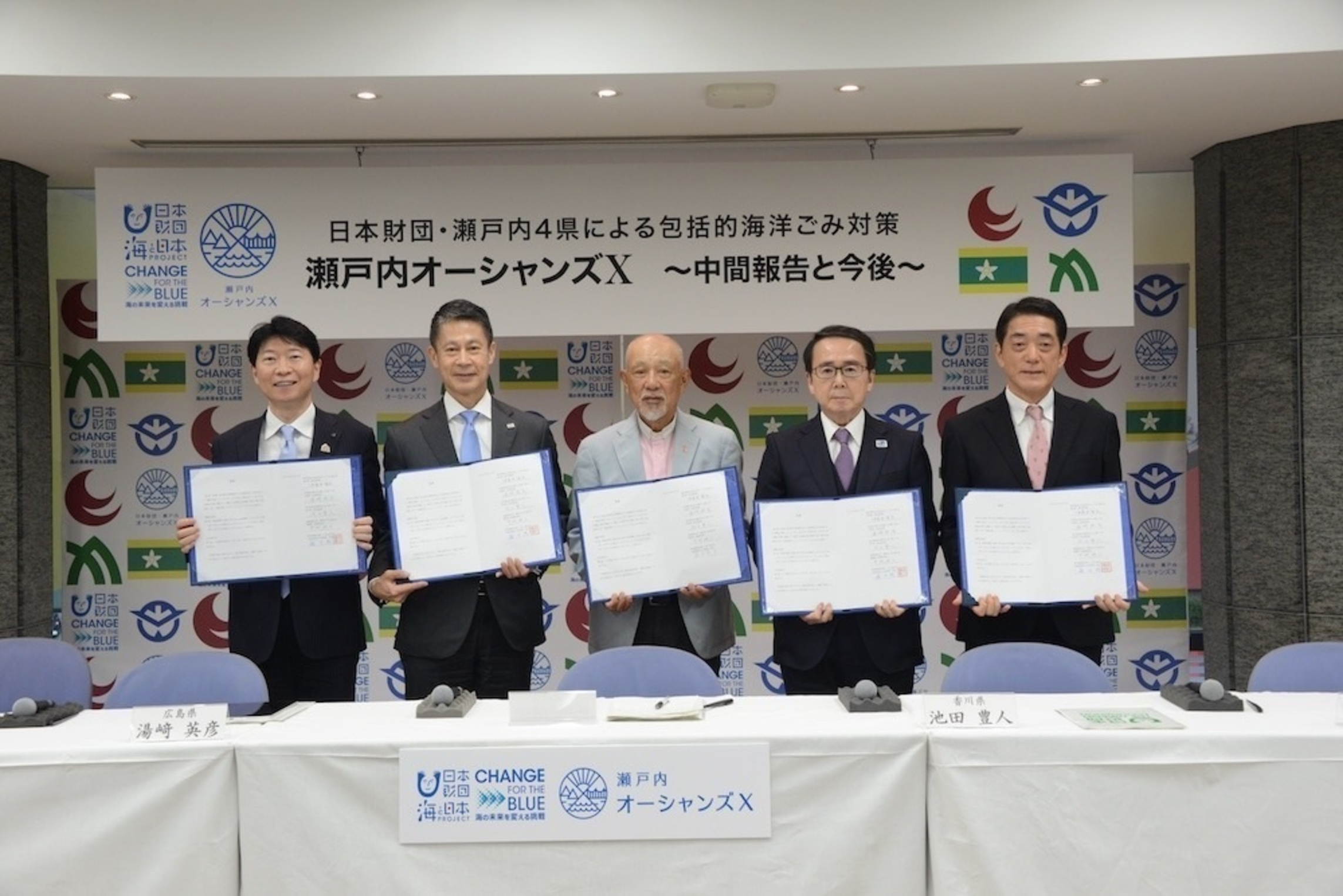
The accord came at a meeting of the author and the governors of the four prefectures-Governor Ryuta Ibaragi of Okayama, Governor Hidehiko Yuzaki of Hiroshima, Governor Toyohito Ikeda of Kagawa and Governor Tokihiro Nakamura of Ehime-in Tokyo on April 15 to review the progress of the project and discuss how to proceed.
This was the first in-person meeting between us following a virtual ceremony in December 2020, in the midst of the COVID-19 pandemic, when we signed an agreement on launching the project, which was originally scheduled to last for roughly five years from fiscal 2020 to fiscal 2024 ending in March 2025.
The Seto Inland Sea was chosen for the project as it is typically known for having a relatively small inflow of marine litter from outside oceans.
Under the project, The Nippon Foundation, working with local governments, business circles, universities, think tanks and other partners, conducted research into the origins and flows of marine litter, using a supercomputer, satellites and drones-both aerial and underwater-to draw wide-area maps of marine debris and scientifically visualize the seriousness and extent of the marine debris problem.
According to the Journal of Coastal Zone Studies, Vol. 36, Issue 2 (2023), the research found that the amount of plastic debris flowing into the Seto Inland Sea from the four prefectures totaled approximately 388 tons annually.
On the other hand, the amount collected by the local governments and other entities was about 302 tons, and by Setouchi Oceans X was some 26 tons, for a total of approximately 328 tons.
This meant that each year roughly 60 tons of plastic ended up as marine debris in the inland sea.
Given this situation, the four governors told me at the April 15 meeting that even though the “Setouchi Oceans X” project has made a certain amount of progress, we need to redouble our efforts to attain our goal.
Impressed and encouraged by their resolve, I agreed. Thus, together with the four governors, I signed an agreement to extend the project by three years through fiscal 2027 ending March 2028.
Under the agreement, the foundation, which provided 1.45 billion yen (about $9.4 million) for the initial project, will earmark 1.52 billion yen (about $9.8 million) more to cover the cost of the project during the extended period.
Going forward, the project aims to establish a framework to collect the additional 60 tons of debris, recovering a total of 86 tons from rivers and the sea across the four prefectures annually on an ongoing basis.\
At the same time, the project will work to curtail inflows of floats and other fishing equipment, with the aim of achieving a situation where the amount of debris decreases every year.
As part of this effort, the four prefectures agreed to hold a large-scale cleanup event in the summer of 2025.
As of March 2024, the project had collected a total of roughly 78 tons of debris with 120,000 participants in the cleanup rallies on an aggregate basis. From April 2024 through the extended period to March 2028, the project expects to collect approximately 344 tons of debris with roughly 200,000 people participating.
Japan is a maritime nation that cannot exist without the ocean. That is why we have a Marine Day national holiday and are the only country in the world to do so.
Japan is also said to be the cleanest country in the world. But we have found tons of garbage hidden along the coastal lines and on remote islands in the four prefectures.
I sincerely hope that Japan will lead the way in fighting the problem of ocean debris by successfully carrying out this project, making the Seto Inland Sea a role model for the rest of the world.
