
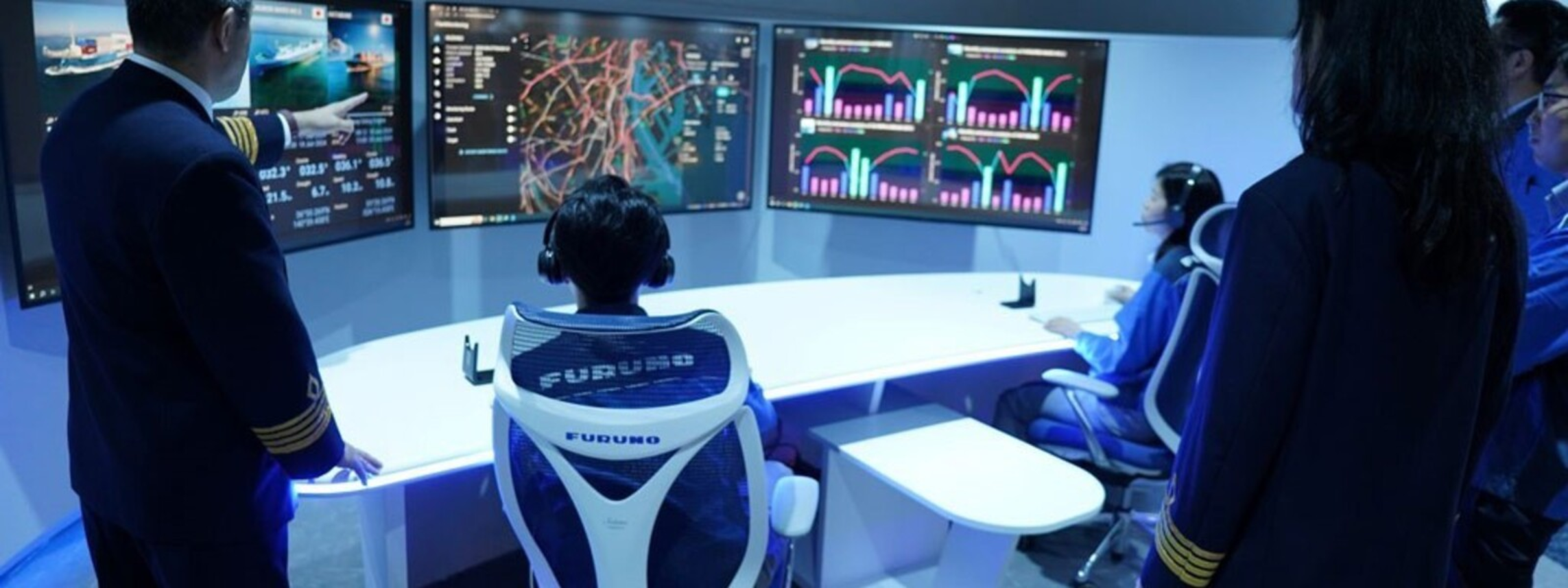
Fleet Operation Center Completed to Provide Remote Navigation Support for Multiple Autonomous Ships from Land

Under the “MEGURI 2040” fully autonomous ship program financed and administered by The Nippon Foundation, a Fleet Operation Center has been completed to provide remote navigation support for multiple crewless ships from shore. The remote center, set up in the headquarters of Furuno Electric Co., a major manufacturer of maritime and industrial electronic products, in Nishinomiya, Hyogo Prefecture, western Japan, is the world’s first to be capable of supporting multiple fully autonomous ships simultaneously. At a press conference at the company’s head office on July 18, Executive Director Mitsuyuki Unno of the foundation, said: “The completion of the world’s first Fleet Operation Center for multiple ships is a major step forward. We will bring together all-Japan technologies to put autonomous ships into practical use by 2025.” In a series of demonstration tests starting in July 2025, the Fleet Operation Center and a mobile remote center, which is scheduled for completion in October, will offer remote navigation support for four autonomous ships simultaneously. This forms an important part of the second phase in the MEGURI 2040 project, launched by the foundation in February 2020 and formally called the Joint Technological Development Program for the Demonstration of Unmanned Ship. Ultimately, the initiative aims to make half of Japan’s domestic coastal shipping fleet crewless by 2040. The fully autonomous navigation system consists of (1) “Ships” that perform autonomous functions; (2) “Land-based fleet operation support” (permanent and mobile) that assists ships from land; and (3) “Communications via satellites” that handle communication lines and information management and control. In the first stage of the program, five consortia, comprising more than 50 Japanese companies, successfully conducted voyages of six vessels between January and March 2022, demonstrating autonomous shipping technologies. These involved a mix of car ferries and container ships, large and small, as well as tourist boats, in a bid to maximize their applications to commercial shipping. In one of the voyages, a round-trip of 790 kilometers, the system achieved impressive system operation rates of 97.4% on the onward journey and 99.7% on the return trip. A few areas for possible operational improvement remained however, including the fact that a single operation center supported only one ship at a time. Building upon the advancements made in the first stage, we are currently planning to conduct demonstration tests and remote island passenger ships that serve remote islands in the Seto Inland Sea in western Japan as well as of Roll-on/Roll-off (RORO) cargo ships carrying raw milk and agricultural and livestock products. Currently, Japan’s domestic coastal shipping industry is grappling with the issue of an aging population of seafarers, more than half of them aged 50 and older, as well as a declining number of crew members working in the industry. Under the circumstances, autonomous ships are expected to go a long way in reducing workloads and trimming operating costs. Besides, crewless sailing can also address safety issues by reducing human errors, which account for about 80% of marine accidents. Given the high levels of Japan’s IT and AI technologies combined with its years of experience as a leading shipping and shipbuilding country, I hope strongly that Japan will become the pioneer of unmanned vessels. 
|


