
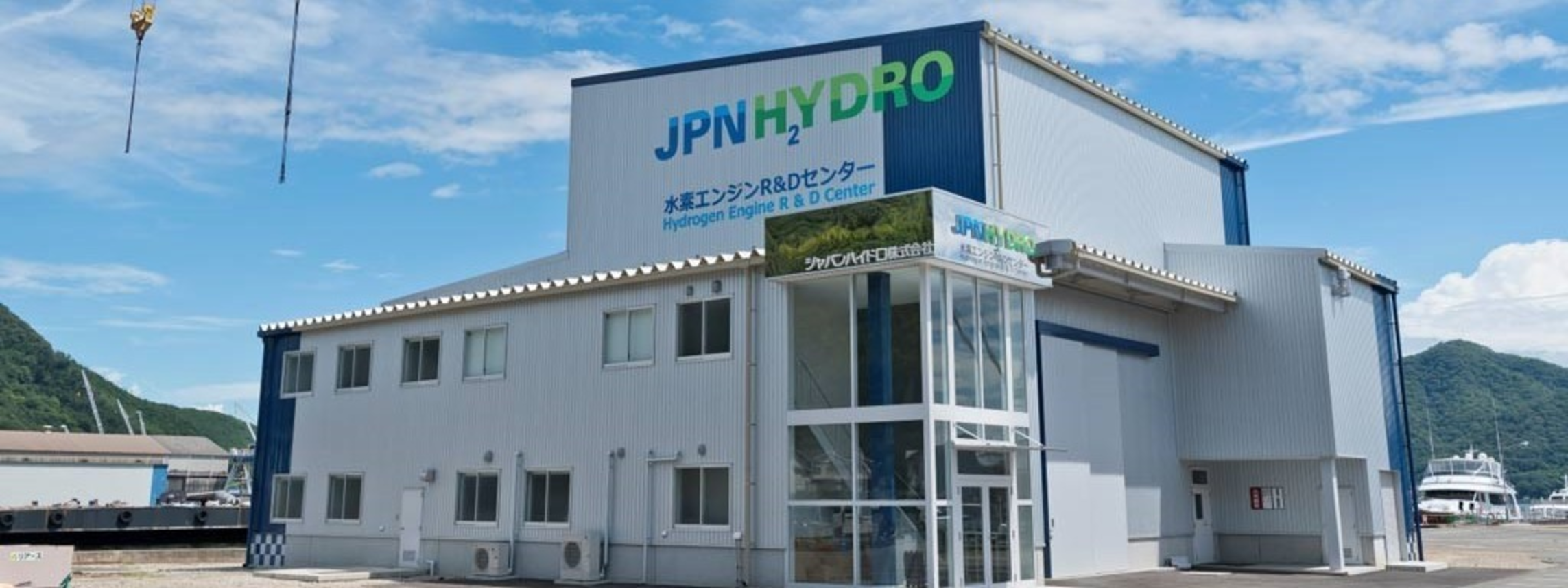
Hydrogen Engine R&D Center Completed Under The Nippon Foundation’s Zero Emission Ship Project
Published on September 25, 2024

A Hydrogen Engine R&D Center has been established in a shipyard in Fukuyama, Hiroshima Prefecture, western Japan, under The Nippon Foundation’s Zero Emission Ship project.
The foundation launched the project in January 2022 with the aim of prioritizing the development of hydrogen-fueled ships as the driving force for Japan’s efforts to achieve carbon neutrality in its coastal shipping sector by 2050.
This is the world’s first research and development center for hydrogen engines located within a shipyard, according to the foundation.
Speaking at a press conference on September 4, the foundation’s Managing Director Mitsuyuki Unno said: “The development of zero emission ships could pave the way for the revival of Japan’s maritime industries. To power their international competitiveness, let’s make the most of the technology that we have and successfully demonstrate zero emission vessels.”
The R&D center will be operated by JPN H₂YDRO CO., a joint venture between the Tsuneishi Group, a Fukuyama-based major Japanese shipbuilding group, and CMB (Compagnie Maritime Belge), a shipbuilding and logistics company headquartered in Antwerp, Belgium.
JPN H₂YDRO CO. leads a consortium joined by 11 other firms charged with developing a hydrogen-fueled passenger vessel under the zero emission ship project. The ship is designed to operate only on hydrogen, emitting no carbon dioxide (CO2) during combustion.
The center has a full range of capabilities, from the designing of hydrogen-fueled ships to hydrogen-engine testing, certification and loading of hydrogen onto actual ships.
Going forward, the facility is seen being used for a broad range of applications, including hydrogen engines for large trucks, heavy machinery, and other equipment requiring large output.
The two-storied center has an engine test bench in place for testing hydrogen engine functionality and obtaining certifications.
The facility will also be made available to research institutions and companies pursuing hydrogen engine development, with the aim of promoting Japan’s development of hydrogen engines
For hydrogen loading, a hydrogen station designed specifically for ships is slated to be completed in the dockyard facing the Seto Inland Sea around January 2025. When completed, it would be the world’s first hydrogen station for ships, with facilities for loading large amounts of hydrogen fuel, mooring equipment, and equipment to maintain the ship’s stability during loading.
The consortium also plans to install a floating hydrogen fuel loading station on the wharf and the world’s first offshore hydrogen bunkering system.
The JPN H₂YDRO consortium will develop and demonstrate two zero-emission ships fueled solely by hydrogen as well as floating hydrogen fuel loading systems by the end of fiscal 2026 (March 2027).
There are two other consortia joining the Zero Emission Ship project.
Already, a consortium of five companies, led by MOTENA-Sea, Ltd. under the aegis of Mitsui O.S.K. Lines, Ltd., successfully conducted a demonstration test of a hydrogen fuel cell ship system that emits no CO2 during combustion in April 2024.
A group consisting of Yanmar Power Technology Co. (YPT), a subsidiary of Yanmar Holdings, and five other companies is aiming to build and demonstrate a tanker equipped with a hydrogen-fueled combustion engine by March 2027.
With Japan’s advanced technological capabilities, I sincerely hope that the consortia will overcome all the challenges involved and continue to lead the global campaign to make the world’s shipping industry carbon neutral in the fight against climate change.
For our part, the foundation is resolved to support the nation’s fledgling fleet of zero emission ships for decades to come.

Testing equipment for hydrogen engine functionality at the Hydrogen Engine R&D Center, completed in Fukuyama, Hiroshima Prefecture, western Japan, on September 4, 2024.


*2. According to The Nippon Foundation’s research (as of September 4, 2024), this will be the “world’s first” floating offshore hydrogen station. |