
Only 30% of Japanese Youths See U.S. Military Coming to Their Country’s Aid When Under Attack from Other Nation: Poll
Published on December 11, 2024

Ahead of the U.S. presidential election on November 5, The Nippon Foundation conducted a survey on October 19-20 to gauge young Japanese people’s awareness of the U.S. election, their views on the U.S.-Japan relationship in the event of a change of the U.S. administration, and their thinking regarding Japan’s national security.
The online poll, covering 1,000 men and women aged between 17 and 19 across the country, found that less than 40% (39.8%) were aware that the U.S. presidential election would be held in November 2024. By gender, many more males (51.1%) than females (27.9%) knew the election date.
Regarding the presidential candidates of the two major political parties, over half (55.1%) knew that the Democratic candidate was Vice President Kamala Harris while more than 80% (82.0%) knew that the Republican nominee was former President Donald Trump.
Asked about the vice-presidential nominees, only one in 10 knew that the Democratic candidate was Minnesota Governor Tim Walz (12.6%) and the Republican nominee was Ohio Senator J.D. Vance (12.0%).
On U.S.-Japan relations under the administration of President Joe Biden, nearly half (46.6%) said that bilateral ties were either “good” (7.9%) or “somewhat good” (38.7%).
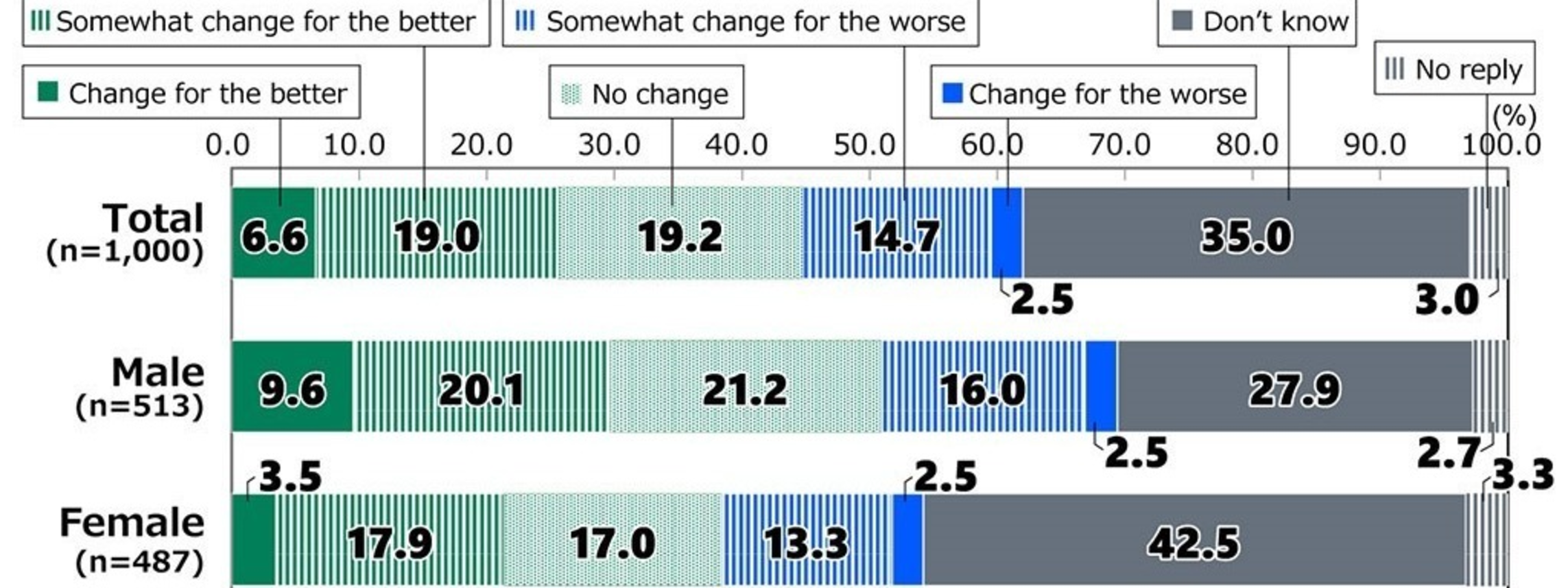
Asked about bilateral ties under a new U.S. administration, only one in four (25.6%) expected a “change for the better,” while 17.2% anticipated a “change for the worse” and 19.2% expected “no change.” (When the poll was taken, the respondents did not know Mr. Trump would go on to win the election.)
When asked to select up to three important issues for U.S.-Japan relations in the future from a list of multiple choice answers, the most frequently chosen were as follows: Roughly 30% (32.6%) cited how the two countries jointly deal with North Korea, followed by resolving issues arising from U.S. military bases in Japan (28.7%), expanding bilateral economic cooperation (24.2%), maintaining the U.S.-Japan security treaty (18.8%), strengthening bilateral cooperation in dealing with China (15.7%) and strengthening military cooperation between the Japan Self-Defense Forces and the U.S. armed forces (15.5%).
When asked about their image of U.S. bases in Japan, almost 40% (38.1%) felt they were “dangerous” because their presence was linked to many crimes and accidents, while a little over 30% (31.5%) cited their negative impact due to noise from military exercises and environmental effects.
Meanwhile, less than a third (31.4%) expected the U.S. military to come to Japan’s aid in the event of a military attack by another country.
The findings seemed to indicate that Japanese youths feel uneasy about the presence of the U.S. military in Japan and that they are skeptical about the U.S. commitment to defend Japan under the bilateral security treaty.
Article V of the bilateral security treaty commits the United States to defend Japan if it is attacked by a third party. For example, U.S. Secretary of Defense Lloyd J. Austin III said at his meeting with then Japanese Defense Minister Minoru Kihara at the Pentagon in October 2023 that Article V of the U.S.-Japan Security Treaty states the United States' "ironclad" commitment to defend all of Japan, including the Senkaku Islands and other territories. The Senkaku Islands in the East China Sea are also claimed by China.
Regarding how they feel about the nation’s treatment of the members of the Japan Self-Defense Forces in terms of salary and working conditions, less than one in 10 (7.6%) considered they were “treated well,” while roughly 30% (29.4%) said they were “treated appropriately.” On the other hand, one fourth (25.0%) felt they were “treated poorly” and 7.7% “treated too poorly.” Roughly one in four (26.5%) said they didn’t know with 3.8% giving no reply.
Regarding Japanese Prime Minister Shigeru Ishiba’s idea of creating a NATO-style collective security framework in Asia, more than 40% (43.7%) said it was “necessary” while less than one in five (17.1%) said it was “not necessary”. A third (34.4%) said they didn’t know.
During his campaign to become the president of the ruling Liberal-Democratic Party in September, Mr. Ishiba proposed the creation of an Asian version of NATO. But after becoming prime minister on October 1, Mr. Ishiba, known as a defense policy wonk, said he would not broach the idea at a series of regional meetings, including the ASEAN (Association of Southeast Asian Nations)-Japan summit and the East Asia Summit, in Laos later that month, apparently because of skepticism at home and abroad.

