
The Nippon Foundation Opens Offshore Wind Power Human Resource Training Center in Nagasaki (2)
Published on December 11, 2024

Speaking at a ceremony to open The Nippon Foundation Offshore Wind Power Human Resource Training Center in Nagasaki, southwestern Japan, on November 7, Mr. Mitsuyuki Unno, managing director of the foundation, said that Nagasaki is a hub of Japan’s marine industry with the expertise it has gained to date, and expressed his hope that it will become a “leading model for human resource training in offshore wind power generation.”
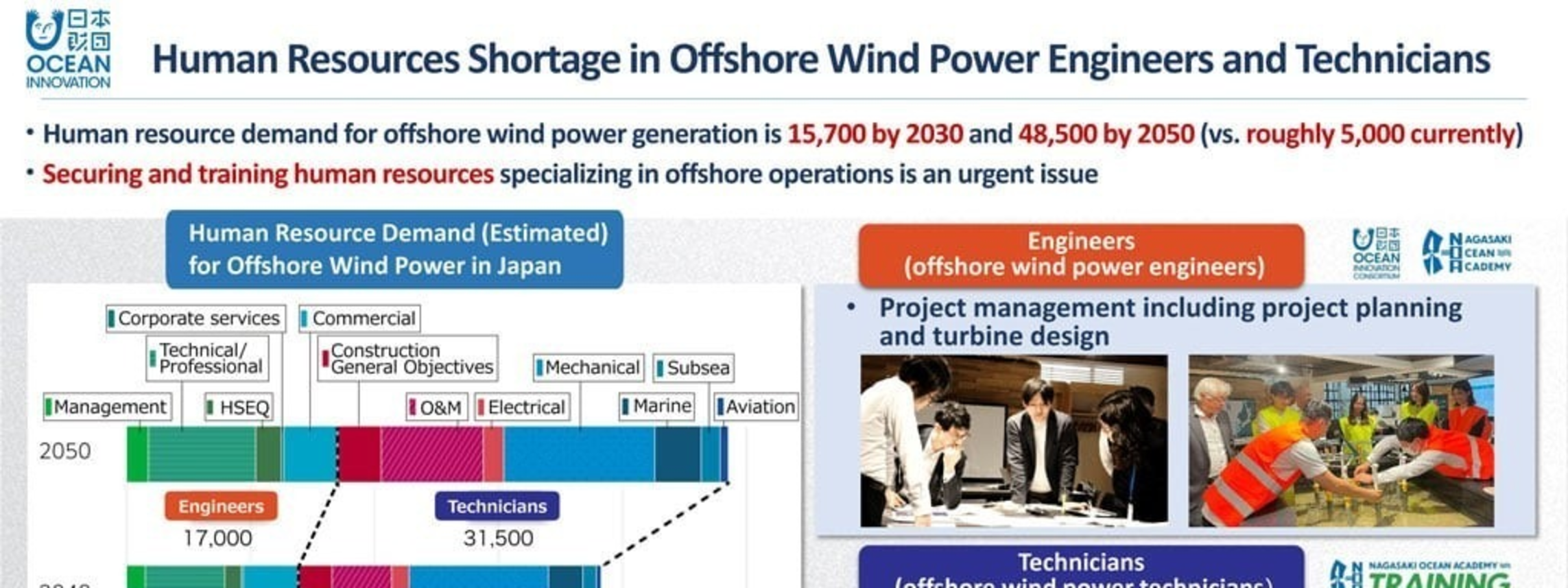
The Nippon Foundation has set aside 3 billion yen (about $19 million) for the training center over the coming five years, including 800 million yen (about $5 million) for the newly opened safety training building. The aim is to cultivate engineers and technicians who will develop, install and operate offshore wind power turbines In 2016, in collaboration with the Japanese government, we established The Nippon Foundation Ocean Innovation Consortium to train human resources in ocean development, including offshore renewable energy, as a platform that brings together universities, public institutions, and companies across the country. Then, in 2020, the Nagasaki Ocean Academy (NOA) opened in Nagasaki with the support of The Nippon Foundation and the Nagasaki Marine Industry Cluster Promotion Association, an NPO comprising some 70 local construction, engineering and machine manufacturing companies in Nagasaki Prefecture, as well as the prefectural government, Nagasaki University and Nagasaki Institute of Applied Science. To date, NOA has trained roughly 7,200 university students and company employees who have taken such courses as offshore wind power project development (general theory and business development), site selection and offshore installation, construction management, and project certification, insurance and finance. Japan lags far behind other countries, especially Europe, in offshore wind power generation. To achieve Japan’s offshore wind power capacity targets of 10GW by 2030 and 35-45GW by 2040, it is estimated that 15,700 engineers and technicians will be needed by 2030 and 48,500 by 2050, according to 2023 statistics compiled by the Japan Wind Power Association, an industry group. However, there are only roughly 5,000 such people in Japan as of today, making the training of personnel to support the promotion of offshore wind power generation an urgent matter for the nation. The 2011 Fukushima nuclear disaster, in which a huge earthquake and tsunami badly damaged a coastal nuclear facility, forced Japan to totally suspend operation of its nuclear power plants. As of October 2024, nine nuclear reactors are back in operation, but 23 reactors are still offline with some 20 in the process of being closed, according to the Nuclear Regulatory Authority. Under the circumstances, renewable sources of energy, especially offshore wind power, are set to have a crucial role in Japan’s energy mix. The foundation is ready to support the nation’s efforts to cope with a shortage of marine development engineers with practical experience and technical know-how for years to come with an eye to contributing to the realization of a carbon-neutral society by 2050. (End) |