
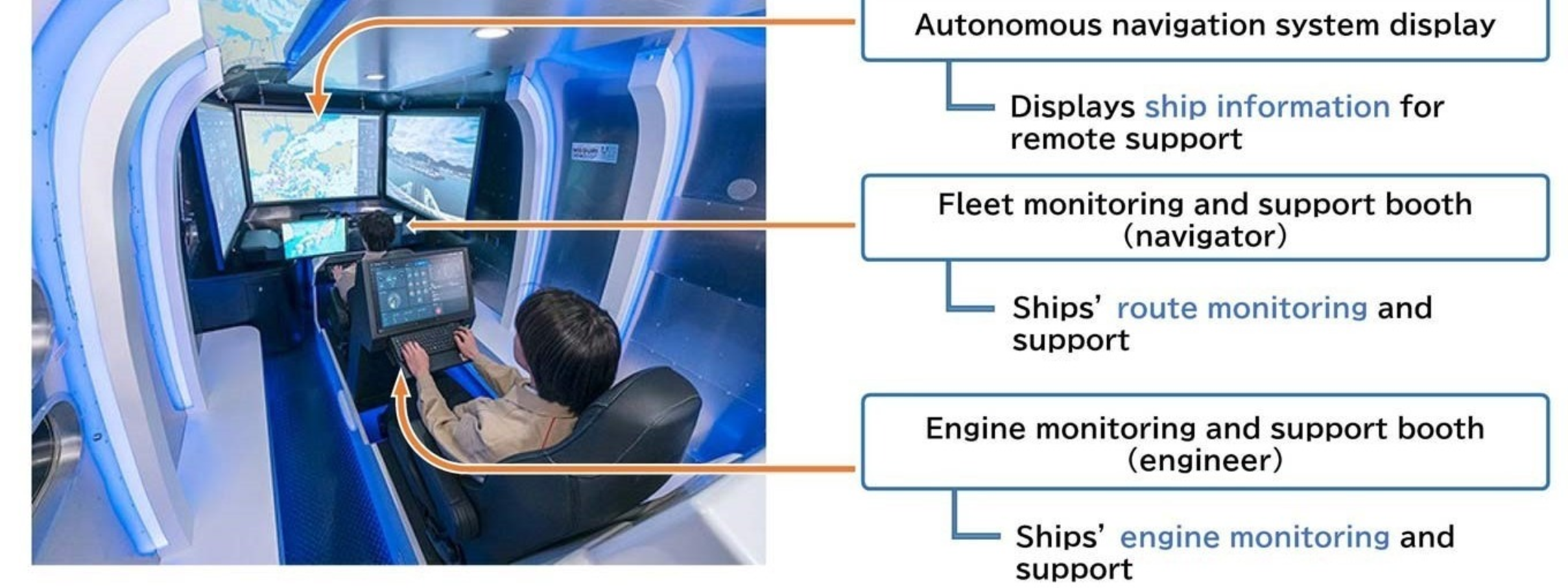
World’s First “Mobile Fleet Operation Center” Completed to Provide Remote Navigational Support for Unmanned Ships from Land (2)
Published on March 11, 2025

In the first stage of the “MEGURI2040” fully autonomous ship program financed and administered by The Nippon Foundation, voyages of six vessels were successfully conducted between January and March 2022, demonstrating autonomous shipping technologies. These involved a mix of car ferries and container ships-both large and small-as well as tourist boats to maximize the application of the technologies to commercial shipping.
In one of the voyages, a round-trip of 790 kilometers between Tokyo Bay and Ise, a coastal city in Mie Prefecture in central Japan, the system achieved impressive system operation rates of 97.4% on the onward journey and 99.7% on the return trip. This was another world-first, despite the fact that Tokyo Bay is one of the world’s busiest maritime channels, with up to 500 vessels passing through daily.
However, a few areas for possible operational improvement remained, including what to do in the event that the permanent fleet operation center is damaged in a disaster.
To meet such needs, the MEGURI2040 consortium developed the mobile fleet operation center. It is located in a cargo trailer that can be towed to a safe location so that it can provide continued support in the event of a disaster or other emergencies.
We also designed the mobile operation center with a compact layout to pack all the functions needed for remote support into a space seven meters in length, with a view to encouraging more widespread use in the future. The cost of the equipment installed inside the trailer for the remote navigational support system has been held down to some 30 million yen (about $200,000),
Currently, Japan’s domestic coastal shipping industry is grappling with the issue of an aging population of seafarers, more than half of them aged 50 and older, and a declining number of crew members working in the industry.
Under the circumstances, autonomous ships are expected to go a long way in reducing workloads and trimming operating costs. Besides, crewless sailing can also address safety issues by reducing human errors, which account for about 80% of marine accidents.
Armed with advanced information and communications technologies (ICT) and artificial intelligence (AI), Japan has been using its globally renowned technologies to promote research and development in fully autonomous shipping.
Expectations are particularly high in the Japanese marine transport sector, where autonomous shipping is seen as a way to solve the so-called “2024 problem” in logistics, caused by the Japanese government’s introduction of new limits on overtime, with the new technology expected to alleviate the shortage of ship’s crews in supply chains.
To contribute to national and international rulemaking on autonomous ship building and navigation, we have shared the autonomous navigation development process and the results of demonstration testing with the Japanese Ministry of Land, Infrastructure, Transport and Tourism (MLIT) and the International Maritime Organization (IMO) member states.
The Nippon Foundation is ready to support the development and implementation of fully autonomous navigation technologies and promote greater social understanding in Japan to address issues in coastal shipping, which accounts for about 40% of the nation’s total domestic logistics, according to 2023 MLIT statistics.
(End)
