
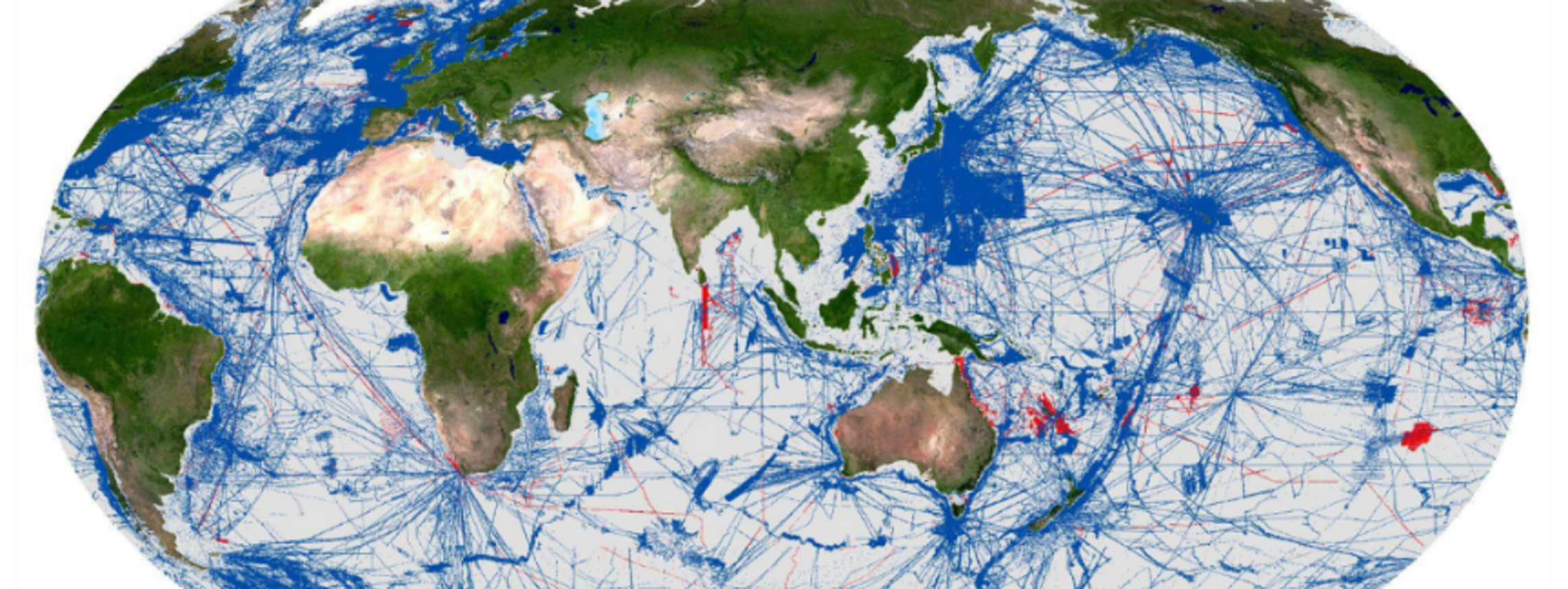
27.3% of World’s Ocean Floor Now Mapped in Seabed 2030 Project
Published on August 4, 2025

The Nippon Foundation-GEBCO Seabed 2030 Project, which aims to complete the mapping of the world’s ocean floor by 2030, has announced that 27.3% of the world’s ocean floor has now been mapped to modern standards.
The latest GEBCO Grid figure represented an increase of four million square kilometers of new bathymetric data from the previous year, which equates to an area roughly equivalent to the entire Indian subcontinent.
This announcement on World Hydrography Day on June 21 came amid growing global momentum for mapping the ocean floor. At the third UN Ocean Conference held in Nice, France, on June 9-13, world leaders and marine experts called for bold, collaborative action, recognizing the ocean’s central role in addressing some of the planet’s greatest challenges, from climate resilience to food security.
Seabed 2030 is a collaborative project launched in 2017 between The Nippon Foundation and the General Bathymetric Chart of the Oceans (GEBCO) to inspire the complete mapping of the world's ocean by 2030, and to compile all bathymetric data into the freely available GEBCO Ocean Map.
GEBCO itself is a joint program of the International Hydrographic Organization (IHO) and the Intergovernmental Oceanographic Commission of UNESCO (IOC-UNESCO), and is the only initiative with a mandate to map the entire ocean floor.
Over the past 12 months, Seabed 2030 has welcomed data contributions from 14 new organizations, including first-time contributions from five new countries-Comoros, Cook Islands, Kenya, Mozambique and Tanzania. With data now contributed by over 185 organizations worldwide, the project continues to galvanize global support toward a fully mapped ocean floor.
Commenting on the latest milestone, Seabed 2030 Project Director Jamie McMichael-Phillips said: “Mapping the seafloor is not just a scientific exercise-it’s a global imperative, foundational to everything from climate action and coastal resilience to sustainable development. As we reach the midpoint of the UN Ocean Decade-a defining moment for ocean action-I urge governments, industry, research institutions and individuals alike to contribute to this global effort. Together, we can deepen our scientific understanding of the ocean and help secure the future of the blue planet.”
Mr. Mitsuyuki Unno, executive director of The Nippon Foundation, said the foundation “is committed to building on the achievements made through Seabed 2030 by continuing to support global collaboration to acquire bathymetric data, the promotion of innovative ocean mapping technologies, and the training of future ocean mappers.”
Chair of GEBCO Evert Flier added: “The progress captured in this update reflects the extraordinary value of global collaboration. Every contribution strengthens the GEBCO Grid, helping to complete the picture of the ocean and deliver benefits for science, society and the planet.”
When The Nippon Foundation launched Seabed 2030 at the UN Ocean Conference in 2017, only 6% of the world's seabed had been mapped to modern standards. All data collected and shared with the Seabed 2030 project is included in the free and publicly available GEBCO global grid.
We remain humbly aware, of course, that the latest achievement leaves more than 70% of the world’s seabed still to be mapped. The goal is ambitious yet entirely achievable if we can fully mobilize the global community to participate. I sincerely hope that everyone with a link to the ocean will do as much as they can to help map the entire seafloor by the end of the decade.