
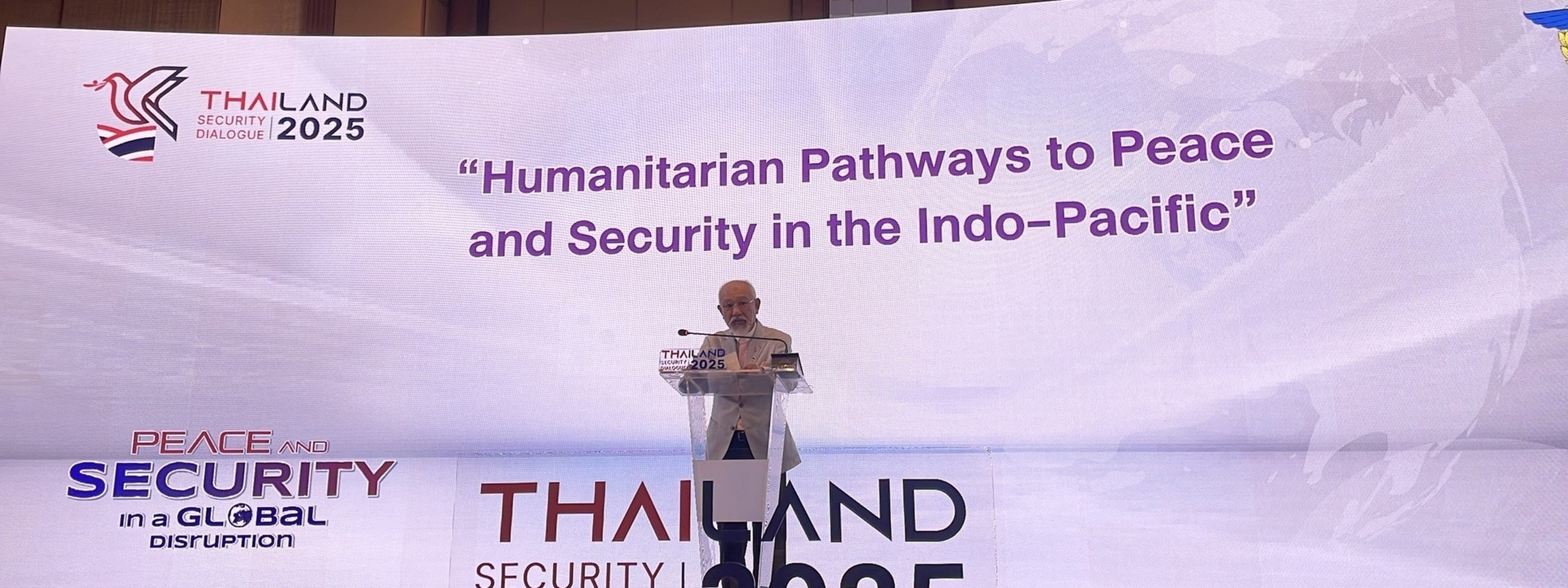
Invited by Leading Thai Think Tank to Speak About My Life-long Commitment to Help Build Lasting Peace in Myanmar (1)
Published on October 3, 2025

I was truly honored by an invitation by the National Defence Studies Institute (NDSI) of Thailand to speak about The Nippon Foundation’s involvement in Myanmar over the last five decades and my lifelong commitment to helping realize a lasting peace in the conflict-stricken country.
In my keynote address at the “Thailand Security Dialogue 2025” on August 31 in Bangkok, I stated: “From my own experience, the people of Myanmar are proud people. So instead of giving patronizing lectures or advice, we must seek honest exchanges through dialogue.”
In my mandate as the Special Envoy of the Government of Japan for National Reconciliation in Myanmar, I have, to date, visited Myanmar, more than 150 times based on my philosophy that “both problems and solutions are found in the field.”
“I see my role not as a protagonist, but as a facilitator of dialogue among the parties themselves. A mediator must not be the main player; rather, it is our responsibility as third parties to create opportunities for direct exchange, without imposing our own solutions. Lecturing from above does not resonate in Asia,” I said.
Commanding General Pongtep Gaewchaiyo of NDSI said in his speech wrapping up the security dialogue: “Mr. Yohei Sasakawa drew on his lifelong commitment to peace, shaped by his childhood experience of war, to highlight the complexity of Myanmar’s conflict. His message was clear-that trust, dialogue, and ‘silent diplomacy’ are essential to building lasting peace. With hope for a democratic federal state in Myanmar, he pledged close cooperation with Thailand in advancing peace and stability.”
Except for publicly agreed outcomes, I have never disclosed the content of any negotiation, in line with my commitment to silent diplomacy. But my NDSI speech represented a long-held and deep-seated conviction of mine about Myanmar that I am willing to share with you.
Please see the text of my keynote speech at the “Thailand Security Dialogue 2025” organized by the National Defence Studies Institute (NDSI) of Thailand on August 31:
Thailand Security Dialogue Keynote Address
Yohei Sasakawa, Honorary Chair, The Nippon Foundation
August 31, 2025
Venue: Bangkok
“Excellencies, distinguished guests, and colleagues. I am deeply honored to be invited to this distinguished gathering. Allow me first to express my sincere respect to the Kingdom of Thailand, which, from a humanitarian perspective, has for decades received and hosted a large number of people living in Myanmar under extremely difficult circumstances, not only in refugee camps but also within its society. This is an achievement that deserves the highest recognition and appreciation from the international community.
The involvement of The Nippon Foundation in Myanmar extends to close to five decades starting in 1976 with medical support for persons affected by leprosy. Since then we have been engaged in humanitarian activities in the fields of public health, education, support for persons with disabilities and peacebuilding. The total commitment exceeds 200 million US dollars.
In my mandate as the Special Envoy of the Government of Japan for national Reconciliation in Myanmar I have, to date, visited Myanmar, more than 150 times based on my philosophy that “both problems and solutions are found in the field.” It includes the remote mountain regions where ethnic armed organizations, or EAOs are active. I am very privileged to be able to share some of these experiences with you today.
But before I continue, allow me to explain what drives my lifetime commitment to humanitarian assistance. The root is in my early childhood experience. I am now 86 years old, but 80 years ago during the Pacific War my city was devastated by an American air raid.
Only within two and a half hours, 108,000 people were killed and millions injured. Only my mother and I survived the blazing fire and burning ruins in our neighborhood which was totally reduced to ashes and no food to eat. I survived by eating grass along the roadside, always suffering from malnutrition.
Now for Myanmar. As you are all aware, internal conflict continues for nearly eight decades with the national army, or Tatmadaw and more than 20 currently active ethnic armed organizations or EAOs in Myanmar.
Yet, these more than 20 EAOs are not necessarily united in their political and strategic approaches to peace. Following the 2021 military coup, new forces such as the National Unity Government or NUG and People’s Defense Force or PDF have emerged to counter the military regime.
The nature of their relationships with the various EAOs has since become increasingly complex and diverse. In addition, despite the international community’s efforts toward peacebuilding, these initiatives have unfortunately made little progress. Also, Myanmar’s 2,000-kilometer border with China presents unique challenges: in these border regions Chinese language is being spoken, and the Chinese Yuan is the currency in circulation.
As you can see from the slide before you, the situation in Myanmar today is as complex as solving an extremely difficult problem in advanced mathematics.”
(To be continued)

|