
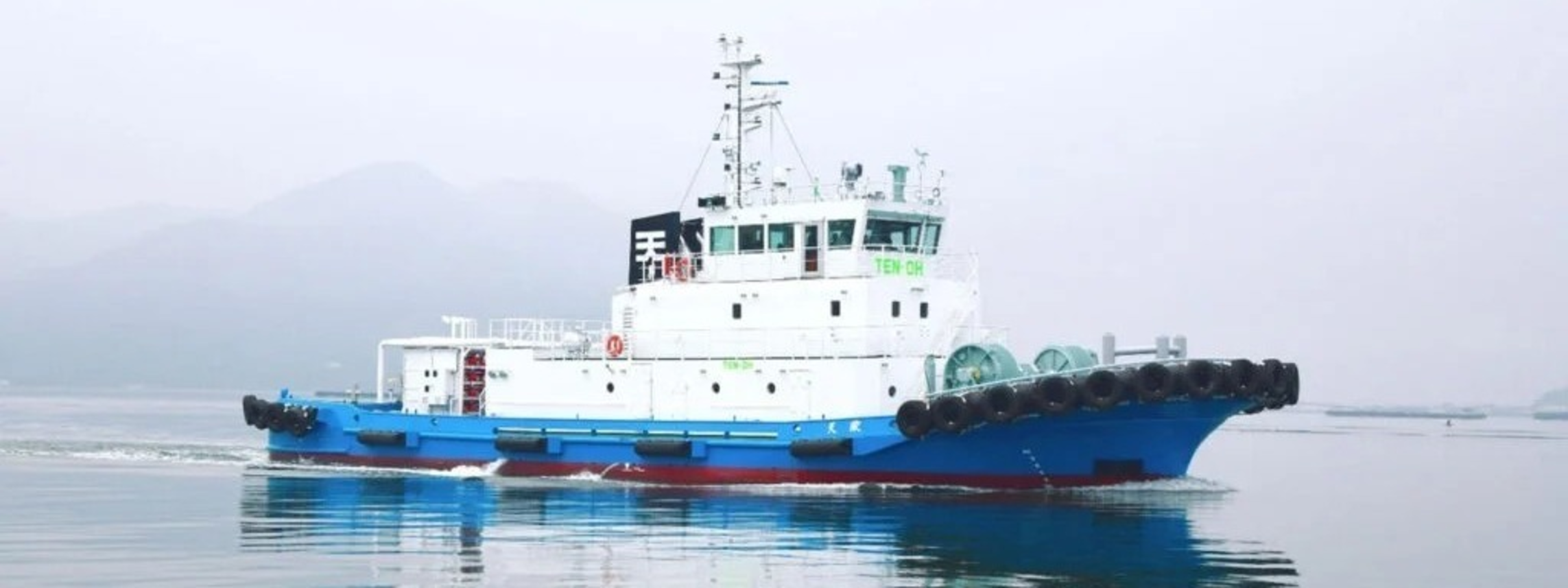
Japan’s First Hydrogen Dual-Fuel Tugboat Enters Service Under The Nippon Foundation’s “Zero Emission Ships Project”
Published on November 6, 2025

Tsuneishi Shipbuilding Co., a major Japanese shipbuilding company, has delivered Japan’s first hydrogen-powered dual-fuel tugboat at its Fukuyama factory in Hiroshima Prefecture, western Japan, on October 15.
The vessel, named Ten-Oh, is equipped with a BEH2YDRO hydrogen-fueled internal combustion engine (ICE) and a high-pressure hydrogen storage system, developed in collaboration with JPNH2YDRO, a joint venture between the Tsuneishi Group and CMB.TECH of Belgium.
This unique tug was developed and built under The Nippon Foundation’s “Zero Emission Ships Project,” launched in January 2022 with the aim of prioritizing the development of hydrogen-fueled ships as the driving force for Japan’s efforts to achieve carbon neutrality in its coastal shipping sector by 2050.
Tugboats play a pivotal role in assisting large vessels to maneuver safely and smoothly when entering or leaving port. For this reason, they must combine high maneuverability with strong engine output.
The new 38-meter-long tugboat with a gross tonnage of just under 300 tons is powered by twin 12-cylinder hydrogen-blended engines (4,400 horsepower class) and stores around 250 kilograms of hydrogen in high-pressure tanks.
This ensures operational performance equivalent to conventional fuel use, while enabling significant carbon dioxide (CO2) reductions. In the unlikely event of a hydrogen fuel system failure, the vessel can continue to operate solely on marine fuel, maintaining safety at the same standard as conventional vessels.
Tsuneishi said this will enable the vessel to operate with hydrogen in combination with traditional marine fuels such as heavy fuel oil, with the aim of reducing CO2 emissions by approximately 60 percent compared to conventional tugboats that use traditional marine fuels.
Mr. Sachio Okumura, representative director, president and executive officer of Tsuneishi Shipbuilding, commented: “It is a great honor to deliver Japan’s first hydrogen dual-fueled tugboat. Across our domestic and overseas operations, we are developing vessels powered by next-generation fuels such as methanol and liquefied natural gas (LNG). By building on the expertise gained through this project and leveraging the collective strength of the group, we will continue to drive innovation and contribute to a more sustainable future for the maritime industry.”
Tsuneishi Shipbuilding is a shipbuilding company headquartered in Fukuyama, Hiroshima Prefecture, western Japan. It operates as the core enterprise of the Tsuneishi Group, which engages in shipbuilding, marine transport, and related engineering services. The company maintains production bases in Japan, the Philippines and China, focusing on bulk carriers, container ships and tankers.
Earlier on October 9, ClassNK (Nippon Kaiji Kyokai), Japan’s non-governmental ship classification society, added the hydrogen-fueled tugboat Ten-Oh to its register.
Based on discussions among the parties involved during the planning stage of the vessel, ClassNK reviewed the safety requirements and countermeasures for hydrogen-fueled ships by applying a part of its “Rules and Guidance for the Survey and Construction of Steel Ships.”
These reviews focused on issues such as preventing explosions caused by the high ignitability of hydrogen and mitigating the potential impacts of hydrogen fuel leakage on crew members and the environment.
ClassNK is a non-profit classification society based in Tokyo. It develops and maintains technical standards for the design, construction and maintenance of ships and offshore structures, providing certification and inspection services to ensure compliance with international maritime safety and environmental regulations.
Under the Zero Emission Ships Project, Ten-Oh is scheduled to undergo demonstration voyages and bunkering operations between now and 2026.
I sincerely hope that the tugboat will overcome all the challenges involved and successfully conduct demonstration voyages as scheduled. For our part, the foundation is determined to support the nation’s fledgling fleet of zero emission ships for decades to come.