

IUC (Inter-University Center for Japanese Language Studies) - Chu-Wen Hsieh : Getting people more concern about "visible but invisible social problems”
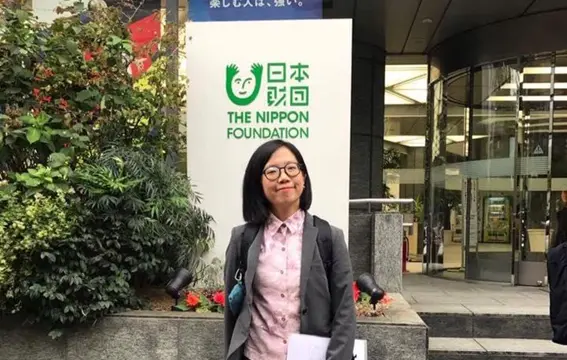
Ms. Chu-Wen Hsieh is an alumini of The Nippon Foundation Fellows Program at the Inter-University Center for Japanese Language Studies (external link), one of the scholarships programs developed by The Nippon Foundation. She is currently a Ph.D. candidate at the Department of Anthropology at the University of North Carolina at Chapel Hill to conduct research on U.S. military bases in Japan and the local communities around bases.
In this interview, we talked to Ms. Hsieh, who has been conducting research on bases in Okinawa as well in the so-called "Second Military Base Prefecture" Kanagawa, about her research and what she gained from her study abroad experience.
■Taiwanese, but working on research on U.S. military bases in Japan
Ms. Hsieh is currently doing an Anthropology doctoral course at the University of North Carolina at Chapel Hill. Although she have been awarded to do fieldwork in Japan in 2021, she has not been able to visit Japan due to the outbreak of Covid-19.
Ms. Hsieh initially studied U.S. military bases in Japan in Okinawa Prefecture. Although Okinawa Prefecture has three quarters of the U.S. military bases in Japan, she felt that it was necessary to have a perspective from the mainland as well as from Okinawa.
“I am studying the ‘extraordinary everyday life’ of the communities around the US military bases in Japan in order to regain a better understanding of Japanese nationalism and the "U.S. empire".
I wanted to find out about the daily lives of the people living around the base, the networks within and outside the local community, as well as the networks of those who accept(/tolerate) or reject the base, from the perspective of the mainland.”
The "extraordinary" or "extra-ordinary" everyday life refers to the unstable state where "safety and danger" and "peace and war" coexist, as local residents are affected by the actions and decisions made by the U.S. military.
Ms. Hsieh has focused on the U.S. military bases in Kanagawa Prefecture, home to the highest number of the U.S. military bases in the mainland.
“To better understand what the US empire is, I build upon historical anthropologist Ann Laura Stoler's notion of "imperial duress", which points out that people's lives continue to be affected by a series of imperial formations... Therefore, I not only decided to study more about the U.S. military presence in Japan from an anthropological perspective, but also tried to reconfigure the triangular composition of empire, nation-state, and civil society.”
Ms. Hsieh entered National Taiwan University (Taipei, Taiwan) in 2003. She pursued double majored* in both anthropology and political science and received her bachelor's degrees in 2008, and went on to pursue her master's degree at the Department of Anthropology, National Taiwan University.
In 2009, 2010, and 2011, she visited Okinawa for a short stay to conduct her fieldwork, and has written many papers on the relationship between Okinawa and U.S. military bases in Japan.
*Double major: pursuing two fields of study at the same time in university.
■Japanese Studies reveal the social problems which Taiwan will face in the future
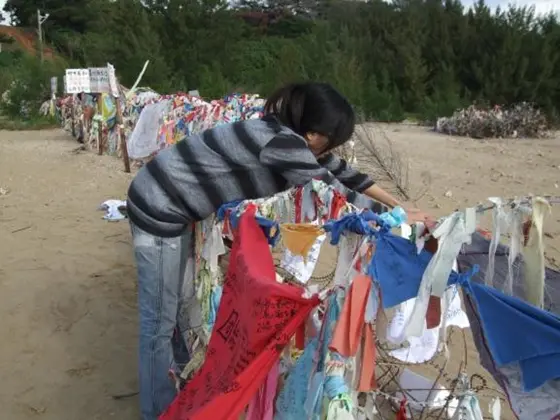
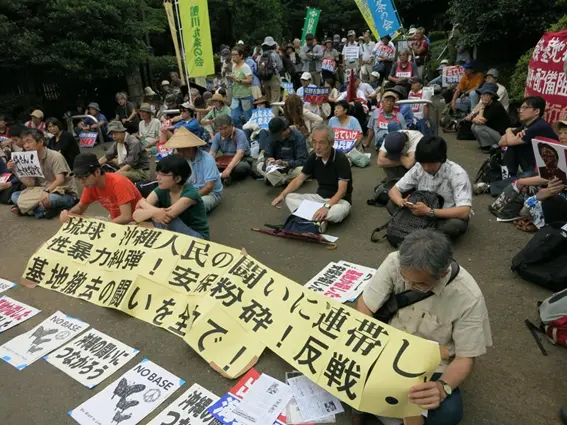
“I got involved in international affairs when I studied political science at university. Okinawa was a ‘tourist destination’ for Taiwan, but one day I was surprised that Okinawa was introduced as an 'island of bases' in the newspaper. I did some research, and found it very interesting and fascinating despite its dark theme. The U.S. military bases in Japan are an important issue with a "visible but invisible" aspect. Educating people about hidden social issues is also an important part of my life's work. ”
The awareness of the issue of U.S. military bases in Japan differs significantly between people living near bases and those living far from bases. Although they learned about it from the news and newspapers, many of them may not see it as their own problem. Ms. Hsieh refers to this situation as "visible but invisible”.
Taiwan and Okinawa have had a deep relationship for a long time and have similar cultural backgrounds. In addition, the distance of these two regions is also close, so the climate is relatively similar.
“Taiwan and Okinawa are quite close and alike, but of course there are differences. However, they have the similar social problems, such as declining birth rates and lonely deaths. On the other hand, the social problems in Japan came to light about 10 years before Taiwan. This "similar but different" is one of the fascinating aspects of studying Japan.”
In short, studying Japan makes her naturally see the social problems that Taiwan will face in the future.
■Encountering "Lifelong treasures" through the training of the scholarship program

In 2013, she graduated from the Department of Anthropology, National Taiwan University and obtained a master's degree. Then after she worked as a research assistant, she entered the Ph.D. program at the Department of Anthropology at the University of North Carolina at Chapel Hill in 2015.
“I specialize in cultural anthropology which originates mainly in Europe and the United States, so it is a typical career path to studying in our home country and then going to the United States or Europe to pursue a doctoral degree.
On average, it takes about seven to eight years to graduate from a doctoral program in anthropology. We go to the countries where we want to study, and conduct the fieldwork, then go back and write our dissertation. That is why it takes a lot of time to graduate.”
Ms. Hsieh is also a fellow of The Nippon Foundation Fellows Program at Inter-University Center for Japanese Language Studies (IUC) for one year from 2017 to 2018. She took a leave from the University of North Carolina at Chapel Hill to stay in Yokohama city, Kanagawa Prefecture. She learned Japanese language, Japanese culture, contemporary Japanese history and politics, cultural anthropology, and many other topics through Japanese at IUC.
64 researchers from around the world, including Taiwan, Korea, China, the United Kingdom, the United States, and Canada, etc., participated in the training. About 20 of them were recipients of The Nippon Foundation Fellowship Program at IUC.
“The IUC center is located in the beautiful Minato Mirai district in Yokohama city, Kanagawa Prefecture. I had so much homework and deadlines to meet that I didn't have much time to admire the view during the semester. However, I was able to have fulfilling days everyday. As I am from Taiwan, Kanji are familiar to me. On the other hand, I think it was more difficult for English speaking people. Moreover, it was very important for me to manage my time so that I could do my research and study in the training program at the same time. I was able to gain what I learnedbecause I .tried my best”
Besides, the Nippon Foundation Fellows participated in study sessions every month. They shared their research topics and received comments from instructors and each other . In addition to cultural anthropology, which is Ms. Hsieh's specialty, there were other Fellows who have amazing research works from a wide variety of research backgrounds such as literature, history, and art history, etc. It inspired her a lot.
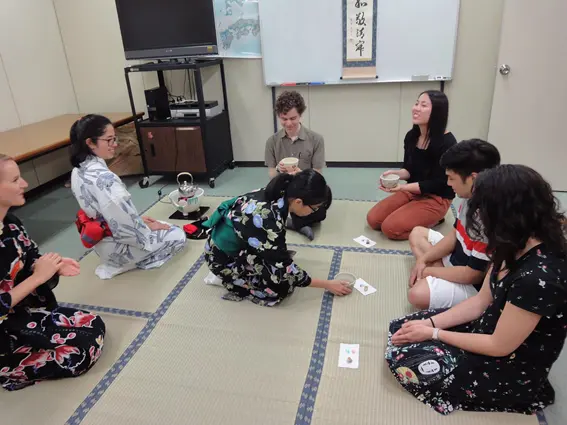
She also said it was a good experience to visit Wakayama and Nagano prefectures through guided tours.
“I participated in a guided tour for IUC students. In Wakayama Prefecture, one of the IUC alumni has been doing research on whales, so we went to those places where whales are caught, and listened to the thoughts of the locals and the opinions of those who oppose whaling. I also actually tried whale meat.
In Nagano Prefecture, we were invited by the local government to get acquainted with the local development efforts and learned about the mechanism for creating new products in the local area. It was a valuable experience that deepened my understanding of Japanese culture(s).”
For Ms. Hsieh, the year she spent in Japan, which is also her subject of research, was a precious and informative time.
“Thanks to the scholarship from the Nippon Foundation, I was able to build a network among researchers who study Japan. This is a ‘treasure for my life’.
The instructors at IUC were so helpful and kind and sometimes strict as well. I am still keeping in touch not only with some of my cohorts but also with my sensei!”
We asked Ms. Hsieh for some advice about the scholarship fellows.
“If you come to IUC as a scholarship fellow, make friends in Japan. Not only concentrate on your own research, but also get to know about social issues through your friends, newspapers and TV news while you are in Japan. On weekends, visit various places in Japan and participate in tours and training programs. I think it is important not only to study, but also to have personal experience. Moreover, you should manage your scholarship money wisely without wasting it.
By going out, meeting and listening to various people and things, we can gain irreplaceable experiences. As an anthropologist, in my opinion, it is essential to learn through going out and interacting with other people and experiencing different things, rather than just staying in one's own shell. ”
Profile Ms. Chu-Wen Hsieh
She graduated from National Taiwan University with a bachelor's degree of anthropology and political science in 2003. In 2009, 2010, and 2011 she visited Okinawa for a short stay to conduct her fieldwork. After receiving a master's degree in anthropology at the university, she worked as a research assistant at Institute of Taiwan History and Institute of Sociology. She went to Ph.D. program, Department of Anthropology, the University of North Carolina at Chapel Hill from 2015 to 2017 and then took a leave of absence. She was trained in the program in the Inter-University Center for Japanese Language Studies, Yokohama, Kanagawa, Japan in 2017 and 2018. Since 2018, she has returned to the University of North Carolina at Chapel Hill and is currently enrolled in the Ph.D. program at the Department of Anthropology.