

APS - Nakamura Toshihisa : Toward the Realization of Society Where Gender Inequality Does Not Limit One's Possibilities
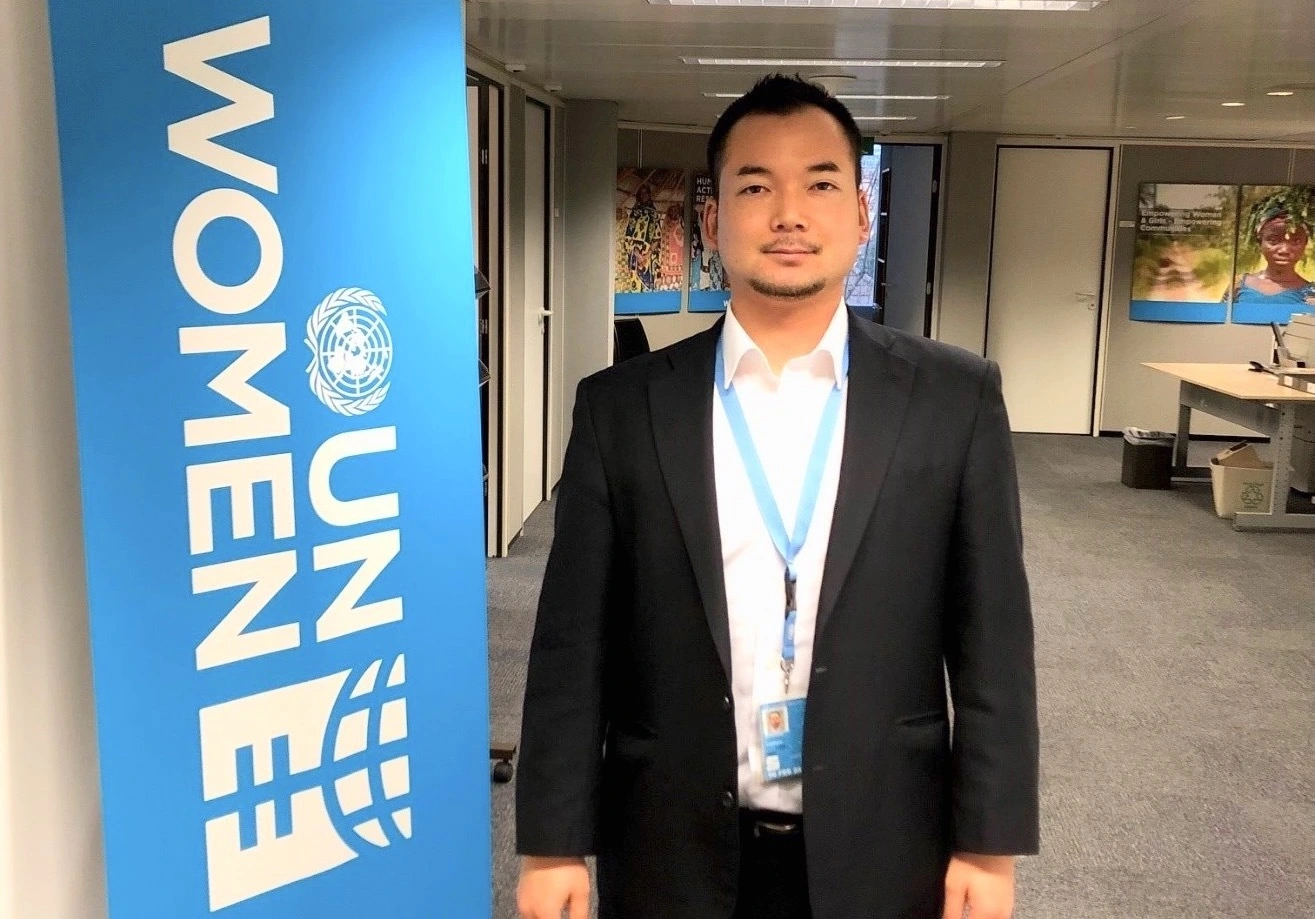
The Asian Peacebuilders Scholarship (APS) (external link), a full scholarship master's program in international peace studies supported by the Nippon Foundation, is being offered by The University for Peace (UPEACE, Costa Rica) and Ateneo de Manila University (AdMU, the Philippines). Mr. Toshihisa Nakamura, a graduate of the program, is working on gender equality and women's empowerment at UN Women (external link), a United Nations (UN) entity.
He is the manager of a project that supports women and children, mainly in Africa. He provides a wide range of support on a daily basis, aiming to eliminate discrimination based on gender and create a society where people can live safely and securely, making full use of their potential.
The term “gender equality” tends to be associated with women's issues, however, Mr. Nakamura says that men's participation is of great significance.
In this interview, he talks about the issues he is currently working on and what he has gained from his experience of studying abroad.
Aiming to work for international organization to help people in need around the world
Mr. Nakamura's desire to work for an international organization came from his experience in Niigata Prefecture, where he grew up.
“When I was in Niigata, there was a man who asked my family for directions. He was from the Republic of Sierra Leone*, and told us that he is not able to go back to his homeland because of a civil strife there, which left a strong impression on me. In addition, my sister, seven years older than me, has visited many countries for work and told me about overseas when she returned home. From these experiences, I got interested in international organizations.”
* A republic located on the Atlantic coast of western part of West Africa, and a member of the British Commonwealth.
He worked hard to become a professional tennis player in his junior high and high school, however his performance did not improve as much as he wanted. After giving up his dream to be a professional tennis player in the summer of his senior year of high school, he began to ask himself about his career path and came to realize that he loved tennis for sure, however, his wish was to “do something to help the world and work for people in need around the world”.
Aiming to work for an international organization, he enrolled in the Faculty of International Relations at International Christian University (ICU, Japan), which had many graduates working in that field. He was then exposed to a wide variety of classes on international politics and economics, as well as gender and religion that led him to his current work.
After graduating from university, he joined a private company but left to pursue his original ambition after three years, and started working as an intern at a Japanese NGO in 2011. He traveled to the areas affected by the Great East Japan Earthquake and facilitated the provision of legal aid to the affected people and was also involved in human rights issues. Through this experience, he aspired to study human rights in earnest at a graduate school abroad.
“There are several criteria that must meet in order to apply for a job at an international organization: a master's degree, a high level of English proficiency, living and working experience abroad (especially in developing countries), and several years of work experience in your field of expertise are the minimum requirements to get started. I wanted to meet these criteria as soon as possible because it was a late start of my career in the international cooperation industry due to working in the private sector.”
Graduate schools in the U.S. and the U.K. are famous when it comes to international relations, however, that would mean he is studying about developing countries living in a developed country. Therefore Mr. Nakamura considered studying at a graduate school in a so-called “developing country” where he can be exposed to the development issues on the ground and at the same time improve his English, which will help him to meet the criteria quickly.
In 2012, he decided to take advantage of the APS, a full scholarship program that aims to develop individuals who are equally knowledgeable with respect to Asia experiencing many conflicts and disputes and expertise in peace building.
Exposed to diversity during graduate school
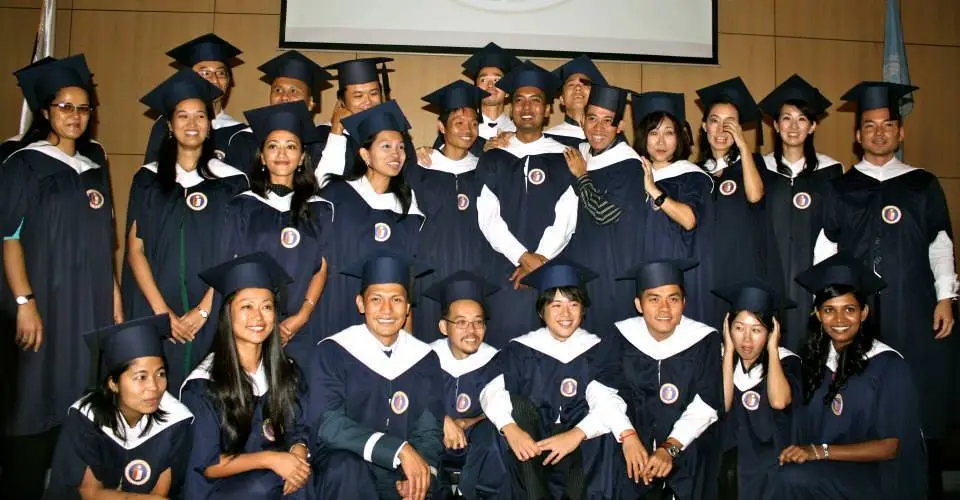
The APS is a 18.5-21.5 months program that offers English language training and a master's course at AdMU in the Philippines and a master's course at UPEACE in Costa Rica. Students from a number of Asian countries are enrolled in this program, and at UPEACE in Costa Rica they study together with students from Africa, South America, Europe and the U.S. The program features studying in an environment with international flavor, and the geographical location of Costa Rica and the Philippines makes it possible for students to participate in volunteer activities after school in the field near the campus.
“In the APS program, we first receive language training in the Philippines according to your level of English, and then study international peace in Costa Rica. In addition to improving my English skills, I was able to obtain a master's degree in International Law and Human Rights at UPEACE, which I wanted to study. It was also fascinating to have a professor who actually worked at the Inter-American Court of Human Rights in Costa Rica.”
Another great feature of this program is that living expenses and tuition were covered by scholarships. Mr. Nakamura recalls that it was reassuring for him to be able to focus on studies without worrying about finances.
“The APS offers a very intensive course of study. Because the contents of the course that normally takes a semester to learn is covered in about three weeks, we cannot miss a single day of class. There were also a lot of assignments, and I had to read about 100 pages of legal English everyday in order to participate in class discussions. I stayed up late until about 2 am every night......well, it was an overwhelming and fulfilling experience.”
Many of his classmates were lawyers or people who had worked for UN before. There were 30 students in the APS cohort, half of whom were Japanese, and the rest were from Thailand, Cambodia, Afghanistan, the Philippines, Myanmar, Nepal, Sri Lanka, and other Asian countries.
“We became very good friends through the intense experience we shared, and stayed in touch even after graduation. Since we all are working for international development and peace building, we basically work in the same industry and sometimes we work together. I will cherish the connection with them.”
Mr. Nakamura talks about what he has gained from his experience studying abroad in the APS.
“It was a great experience to get exposed to diversity. While the theoretical aspects can be learned from textbooks, I was able to learn about the realities of each country through discussions with students from various countries and regions, which I think is great and unique to the APS. In our industry, it is more important to figure out the way to solve a problem rather than just critique, which we have learned in the APS program, and is later applied to my work.”
Men's involvement may approach gender issues from different angles
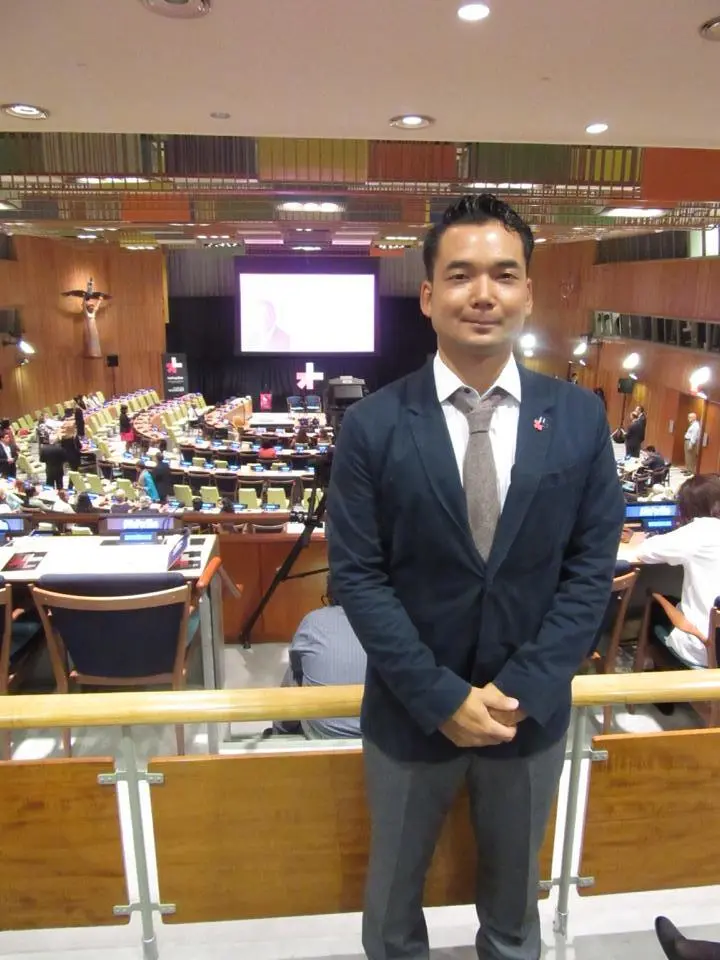
After returning to Japan from his studies, he worked for an international NGO and then for a ministry, covering human rights issues, where he had the opportunity to get involved in the right issues for LGBTIQ people. He learned that in Japan they are facing serious problems such as not being able to rent a house as a couple or possibly not being able to see their partner passing away.
When he visited Africa on his business trip, he had the opportunity to provide training on women's rights and gender to soldiers and police personnel dispatched to peacekeeping operations (PKO).
“At that time, sexual exploitation conducted by some PKO personnel, such as using the services of prostitutes, became a serious problem. Some of the participants in the training asked me 'Why not?', and discussion became heated and complicated. Even if they had such opinions, I was surprised by their culture that allowed them to openly speak such sensitive issues in the presence of women colleagues. On the other hand, I thought to myself that they may not have even shared their honest views, if I have not been there, as a male instructer. Probably the presence of very few “fellow man” instructer talking about gender issues had made them open up more. This is inherently undesirable, and regardless of gender of lecturers, an open and active discussion should be conducted, and some of their views expressed were absolutely inappropriate and unacceptable. At the same time, to know such views would be a first step to help address the reality of these issues. I found that I could approach on gender issues differently, leveraging my male gender figure. Until then, to some extent, gender had been a concept in my mind, not a reality, but this was the moment I realized that it had a huge impact on real life.”
Mr. Nakamura applied for the JPO Programs* and worked for UN Women for almost three years, becoming a UN Women international staff in October 2019.
*JPO: Junior Professional Officer, A program in which international organizations accept young people on the condition that their governments cover their expenses.
To realization of gender bias-free world
UN Women is a UN agency dedicated to gender equality and women's empowerment.
“I am currently working in a department that provides humanitarian assistance and disaster risk reduction, with a particular focus on the cases of natural hazards. There are refugees and internally displaced affected by conflicts and disasters in Lake Chad which straddles counties, including Nigeria and Cameroon in Africa. I am the manager of a project to support the women and children among those affected.”
Disasters and conflicts affect people differently by gender, age, and disability, says Mr. Nakamura.
“Some data in the past shows us that women are disproportionately affected by disasters. For instance, in some disaster cases of Asia and the Pacific, women account for over 70 percent of the deaths caused by a major flood and tsunami. Even during the recovery phase, there is some evidence that women find it more difficult to rebuild their means of livelihood once they are lost. Our job is not to provide uniform support to everyone, but to provide to meet the needs of the most affected, taking into account of the degree of impact, gender, age group, and disability.”
Mr. Nakamura and his team therefore provide a wide range of support.
“Since the number of violent incidents tends to increase in the aftermaths of conflicts and disasters, we provide the victims with psychological support and referrals to appropriate services, as well as vocational training for those who have lost their livelihood. Besides, we provide them with leadership training so that women's opinions will be reflected in the process of reconstruction and peace building. It is also our important role to advocate for gender-responsive laws and policies to ensure the development of the enabling environment for women’s participation and leadership and support the actions of stakeholders.”
We hope that each of these efforts will eventually bear fruit and lead to the promotion of gender equality in the true sense of the world.
“I would like to contribute to the realization of a society where individuals are not limited in their potential by gender. For example, when choosing a school bag, you would not buy a red one for boys, would you? However, essentially you should be free to choose the color, and it should be okay for boys to carry a red school bag. I would like to remove these stereotypes like gender bias* to create a society in which people are evaluated based on their individual abilities and efforts, rather than by those around them.”
* Stereotypes about gender roles
“Achieving gender equality” is one of the goals in SDGs17*. It is important to see the issue as your own, or as closely related to you, in order to achieve this goal in 2030.
* 17 goals for Sustainable Development in the 2030 Agenda adopted at General Assembly in 2015
With just a little more effort by each one of us, we can surely contribute to the realization of a “future where everyone can live comfortably regardless of gender”.
Profile Mr. Toshihisa Nakamura
Graduated from International Christian University (ICU) with a Bachelor's degree in International Relations in 2008, joined Recruit Co., Ltd. and left in 2011 to work as an intern at a Japanese NGO. In 2012, he studied abroad on the Asian Peacebuilders Scholarship and received a Master's degree in Public International Law and Human Rights from The University for Peace(UPEACE). After returning to Japan in 2013, he worked for World Vision Japan, an international NGO, and then worked for the Ministry of Foreign Affairs of Japan and the Cabinet office of Japan before joining UN Women through JPO Programs, becoming a UN Women international staff in 2019.