
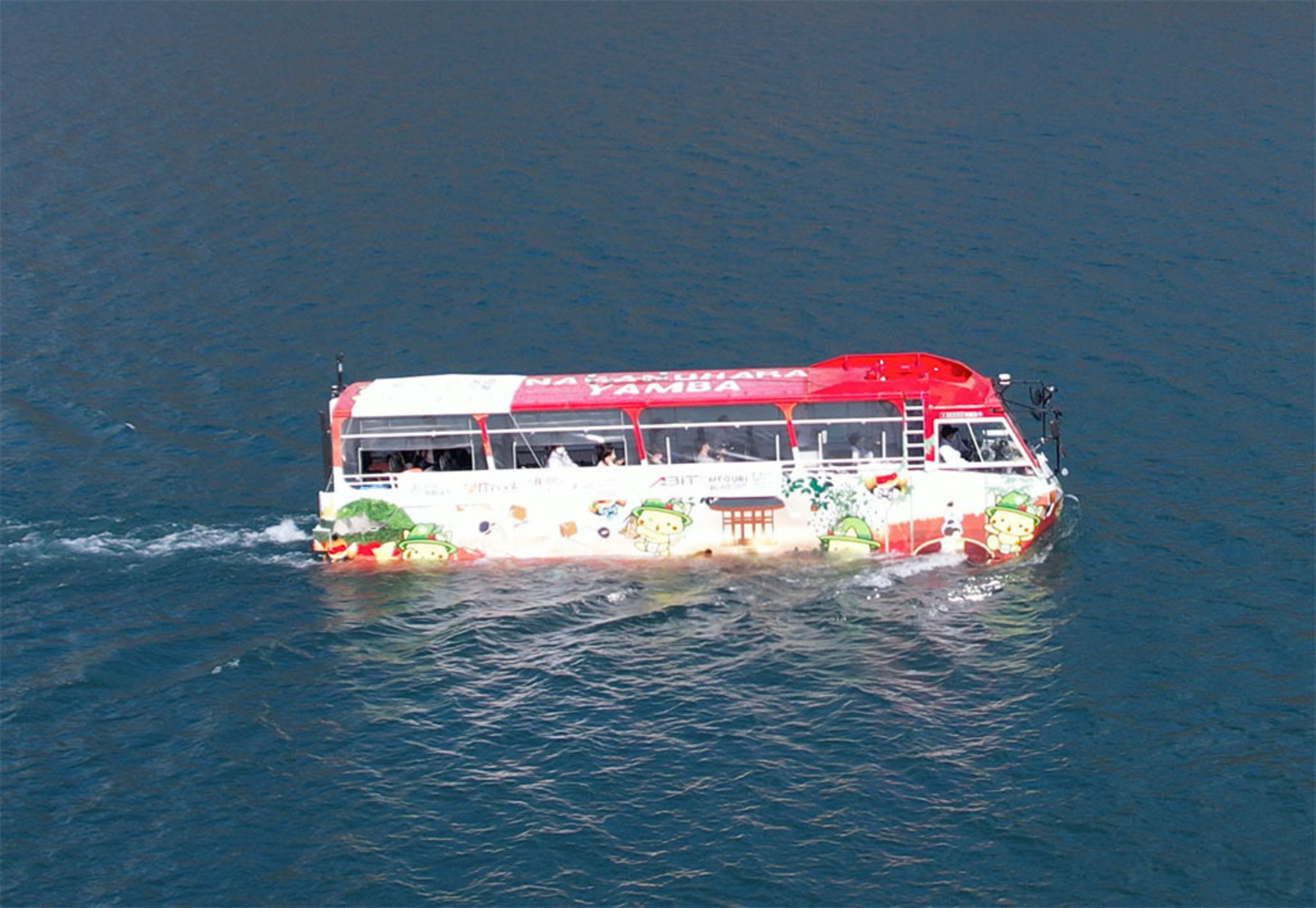
Japanese Consortium Conducts the World's First Demonstration of a Self-Driving Amphibious Vessel Supported by The Nippon Foundation

A five-member consortium, led by ITbook Holdings, has successfully conducted the world’s first demonstration of a fully autonomous amphibious vessel.
The group has thus become the fifth of five consortia to demonstrate the autonomous technologies under the Joint Technological Development Program for the Demonstration of Unmanned Ship, dubbed “MEGURI 2040,” sponsored by The Nippon Foundation.
The five consortia carried out demonstrations of their crewless navigation technologies, involving a total of six vessels-a tourist boat, two containerships, two car ferries and an amphibious tourist bus-between January and March 2022 and all came off well.
On March 14, the ITbook consortium, which also includes the town of Naganohara and Saitama Institute of Technology, had the 11.83-meter-long, 11-gross-ton amphibious tourist bus pilot itself on a roughly 2-kilometer route over about 30 minutes in the Yamba Dam lake in Gunma Prefecture, north of Tokyo. The bus, nicknamed the Yamba Nyagaten and owned by Naganohara Town, started the journey on land, entered the water and came back ashore entirely autonomously.
To navigate with high precision along the planned route, the bus was outfitted with a fully autonomous navigation system, featuring quasi-zenith satellites and a fiber-optic gyroscope as a sensor for position correction. It was also equipped with multiple sensors such as visible light cameras, light detection and ranging (lidar), and sonar that uses underwater sound waves for automatic detection and avoidance of obstacles.
The positioning information and information from the sensors is fed to Autoware, an improved automated operation system for ships, and artificial intelligence learning is applied to realize the automated navigation technology. The system was developed to handle the controls needed for land and water operations and switch automatically between the two.
While amphibious vessels are currently used primarily for sightseeing at locations around Japan, a growing number of local governments have begun to introduce them for search and rescue operations in case of torrential rains that have become increasingly frequent in Japan in recent years.
Japan’s domestic coastal shipping industry is grappling with the problem of an aging population of seafarers, more than half of them aged 50 and older, as well as a declining number of crew members working in the industry.
Under the circumstances, autonomous ships are expected to go a long way in reducing workloads and trimming operating costs. Besides, crewless navigation can also contribute to safety by reducing human errors, which account for about 80% of marine accidents.
The successful demonstrations by all the five consortia mark an important step in “MEGURI 2040” initiative, launched by The Nippon Founation in February 2020 with an eye to putting unmanned ships into commercial service in 2025 and making half of Japan’s domestic coastal ships crewless by 2040.
I believe the project now needs to make further progress in addressing technical issues identified through these demonstrations, including those related to berthing and unberthing, stability of telecommunications environments, image recognition and use of artificial intelligence, as well as legal issues related to the practical implementation of fully autonomous ship navigation.
The Nippon Foundation will analyze the results of this series of demonstrations and oversee further technological development using the strengths of each consortium, so that autonomous vessels will be put into commercial service by 2025.
We will present a report on the demonstrations by the five consortia at Sea Japan 2022, the nation’s largest international maritime exhibition to be held on April 20, 2022, at Tokyo International Exhibition Center known as Tokyo Big Sight.
