
The Nippon Foundation, DeepStar Sign Third MOU to Promote Decarbonization in Offshore Oil, Natural Gas Development
Published on November 21, 2025

At a ceremony on September 25, 2025, to sign
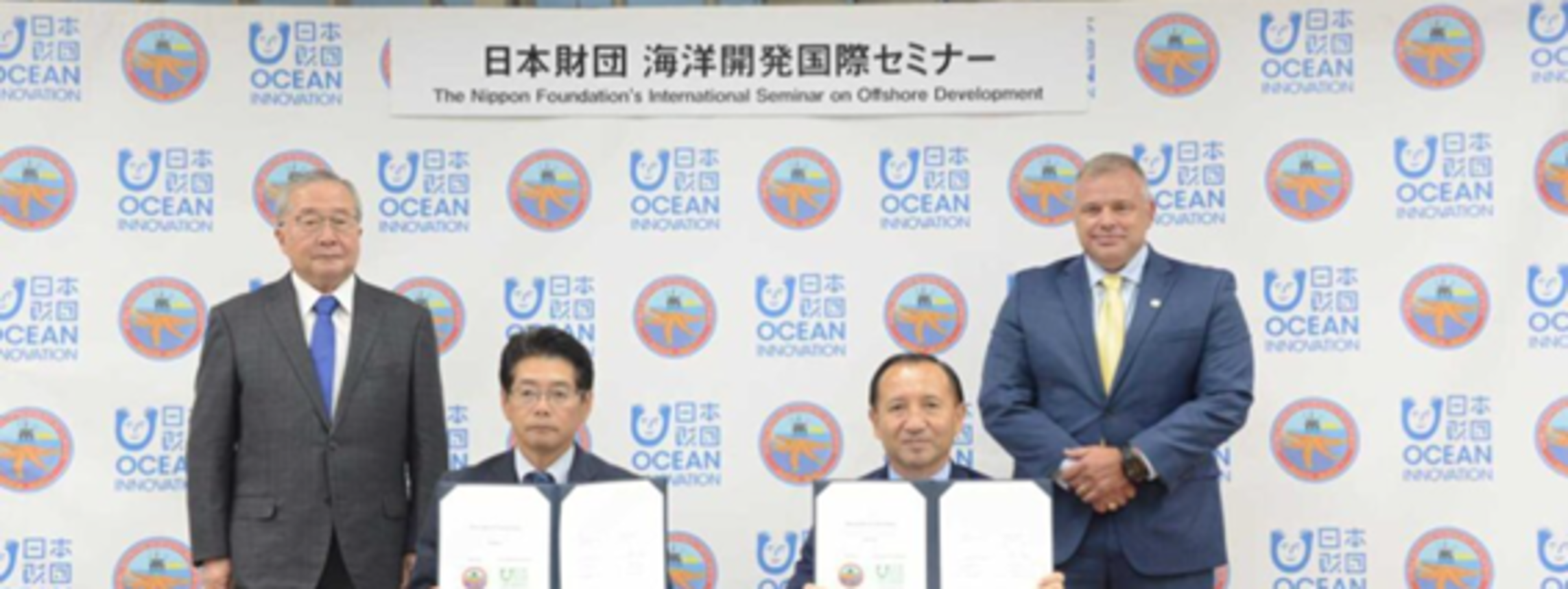
a Memorandum of Understanding (MoU) between The Nippon Foundation and DeepStar on the third phase of their joint offshore research and development program. From left, Chairman Takeju Ogata and Executive Director Mitsuyuki Unno of the foundation, and DeepStar Board Chairman Shakir Shamshy and Board Member Clay Thompson.
The Nippon Foundation and the global offshore technological development consortium DeepStar have signed a Memorandum of Understanding (MoU) on the third four-year phase of their joint research and development program.
The signing took place at a ceremony in Tokyo on September 25 involving The Nippon Foundation Executive Director Mitsuyuki Unno and DeepStar Director and Board Chairman Shakir Shamshy in the presence of Chairman Takeju Ogata of the foundation and Mr. Clay Thompson, a DeepStar board member and Oxy’s director for Gulf of America Operations.
During the first two phases of the joint project launched in 2018, the foundation supported a variety of activities focusing on safety enhancement and development of decarbonization technologies with financial assistance totaling roughly 2 billion yen (about $12.9 million).
The technological themes pursued included breakdown prediction models using artificial intelligence, autonomous submergible robots and drone inspection systems. They are beginning to yield results expected to lead to commercialization.
Chairman Ogata told the ceremony that under the third MOU, the two sides would further enhance and implement decarbonization and safety technologies in the offshore development of petroleum and natural gas in response to heightened global awareness of carbon neutrality and other environmental issues.
Noting that “what we value most is the fusion between Japan’s advanced technology and energy majors,” Mr. Unno said he hoped to promote offshore technological development by creating a mechanism for Japanese companies and organizations with advanced technologies to play a leading role on the world stage.
Based in Houston, Texas, DeepStar comprises such “supermajors” as Chevron (U.S.) and Shell (U.K., the Netherlands) and other “upstream” oil companies around the world that are engaged in the exploration, development and production of offshore oil and natural gas as well as companies, universities, research institutes and other organizations that provide products and services to these upstream companies.
The ceremony was followed by an international seminar on offshore development organized by The Nippon Foundation and DeepStar and joined by Japanese companies taking part in the joint project.
Mr. Hiroyuki Mori, executive vice president of the Japan Organization for Metals and Energy Security (JOGMEC), gave a keynote address on the subject of “Unlocking the Energy Industry’s Potential for a Sustainable Future.”
He was followed by Mr. Shakir Shamshy of DeepStar, who spoke on the topic of “DeepStar Briefing and Expectations for Japanese Partners.”
Next, representatives of four Japanese companies gave presentations on the current status of ongoing projects with Deepstar. They were:
・Hakusan Corporation-development of Seabed Permanent CCS (Carbon Capture and Storage) reservoir monitoring system with optical hybrid ocean bottom cable;
・Omega Simulation Co., Ltd.-optimization of compression performance of CCUS (Carbon dioxide Capture, Utilization and Storage) using process model-based control technology;
・Terra Drone Corporation-mini drone for offshore inspection; and
・HiBot Corporation-robotic intervention during outages NUF (Normally Unattended Facilities).
The seminar concluded with a briefing by Mr. Tetsuya Kikyo, director of The Nippon Foundation, on the third phase of the joint R&D program, with a call for proactive submission of suggestions from Japanese companies and organizations.
The ideas received through this call will be shared with DeepStar to see whether they can be applied to the needs of major upstream energy companies.