
Only 16% of Japanese Youths Say They Will Definitely Marry, a Mere 10% of Females Sure They Will Have Children: Poll
|

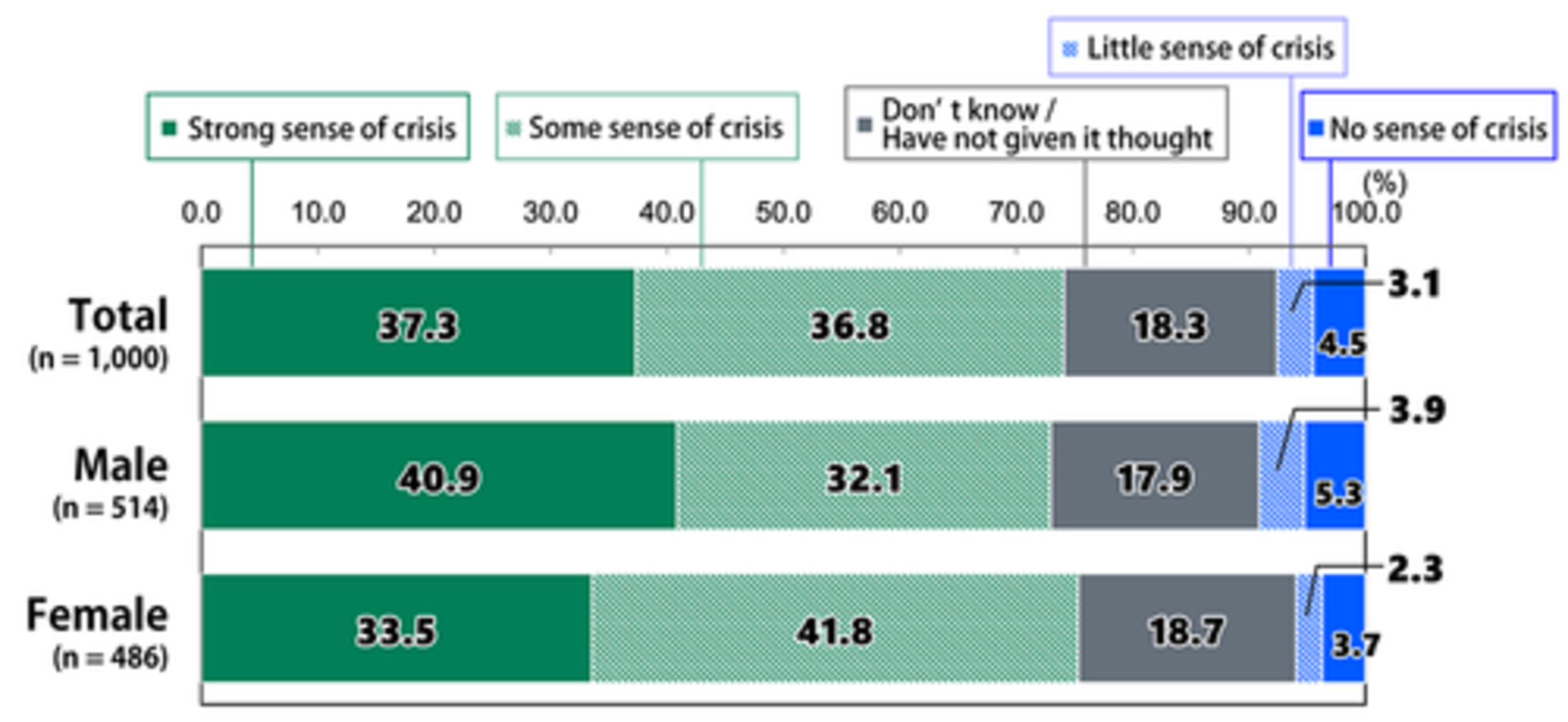
To find out young Japanese people’s values and thinking regarding marriage/partnership and child-rearing, The Nippon Foundation conducted a nationwide online survey on the subject of “Values and Life Design” from December 2 to 5, 2022, covering 1,000 people aged between 17 and 19. When asked, “Do you want to get married in the future?”, 43.8% of respondents said “yes,” and another 21.7% said they would “rather” marry, while 17.4% said they have no such desire. However, when asked, “Do you believe you will actually get married in the future?”, only 16.5% said “definitely”. By sex, only a little over one in 10 females (13.7%) replied thus, considerably fewer than males (19.2%). Asked about why they do not expect to marry (multiple answers accepted), 45.7% said they do not have a partner or think they will not find one, whereas 22.4% cited financial difficulties. There were wide disparities by gender, with far more females giving the following reasons for not wanting to marry than males-it is psychologically less burdensome to be single (52.3% for females versus 39.3% for males), they do not want to raise children (36.9% vs. 18.8%), and they do not want to lose their freedom (35.1% vs 26.8%). When asked whether they want to have children in the future, almost 60% (58.6%) responded “yes” and 21.2% said “no.” But to the question, “Do you think you will actually have children,” 14.7% of males and a mere 10.0% of females responded “definitely yes,” while 31.9% of men and 34.6% of women said “probably yes.” Asked about obstacles to having children, financial burdens topped the list at 69.0%, followed by balancing work with child-rearing (54.3%), time pressure (41.2%), psychological burdens (29.8%) and physical burdens (27.8%). Regarding Japan’s aging population and declining birthrate, roughly three in four of the respondents (74.1%) view the situation with a sense of crisis. Asked about the government’s measures to address the graying population and falling birthrate, more than four in five (82.0%) think they are “insufficient.” Queried about what they want the government to do to tackle declining births, free education (39.3%) was cited most, followed by more financial support for child-rearing families (32.9%), more maternity subsidies (23.8%), and promotion of maternity and paternity leaves (23.2%). As for resources to finance government measures to tackle the declining birthrate, 29.5% support increasing the corporate tax rate, followed by a reduction in pension payments to the elderly (22.2%), and cutbacks in international assistance to developing countries (21.5%). In his policy speech opening the current ordinary Diet (Parliament) session on January 23, Japanese Prime Minister Fumio Kishida pledged to take unprecedented steps to reverse the country's declining birthrate, stating the government will draw up a framework by June for doubling budgets for supporting families raising children. The estimated number of newborns in 2022 was fewer than 800,000, a figure that came eight years earlier than the government’s projection. Mr. Kishida said the government will establish the Children and Families Agency in April to unify policies across multiple government ministries and entities to better deal with imminent issues concerning children, including declining birthrate. The results of the latest survey seem to indicate that Japan’s birthrate will continue the downward trend unless the government works out really effective measures to lift it. I sincerely hope that Mr. Kishida and his bureaucrats, particularly some 430 officials at the newly formed agency, will humbly analyze and grasp young people’s values and thinking as shown in our survey and elsewhere so as to make a real difference. 
|