
The Sasakawa Peace Foundation Launches New Center for Peace Mediation in Asia
Published on June 22, 2026
The Sasakawa Peace Foundation (SPF) has established a new organization aimed at helping resolve regional conflicts and promote post-conflict activities in Asia.
Drawing on Japan’s unique historical experience, values distinct from those of Western countries and the trust cultivated through the foundation’s decades of development assistance, the Center for Mediation Support (CMS) will focus its mediation efforts on regions beset by conflicts in Southeast, South and West Asia.
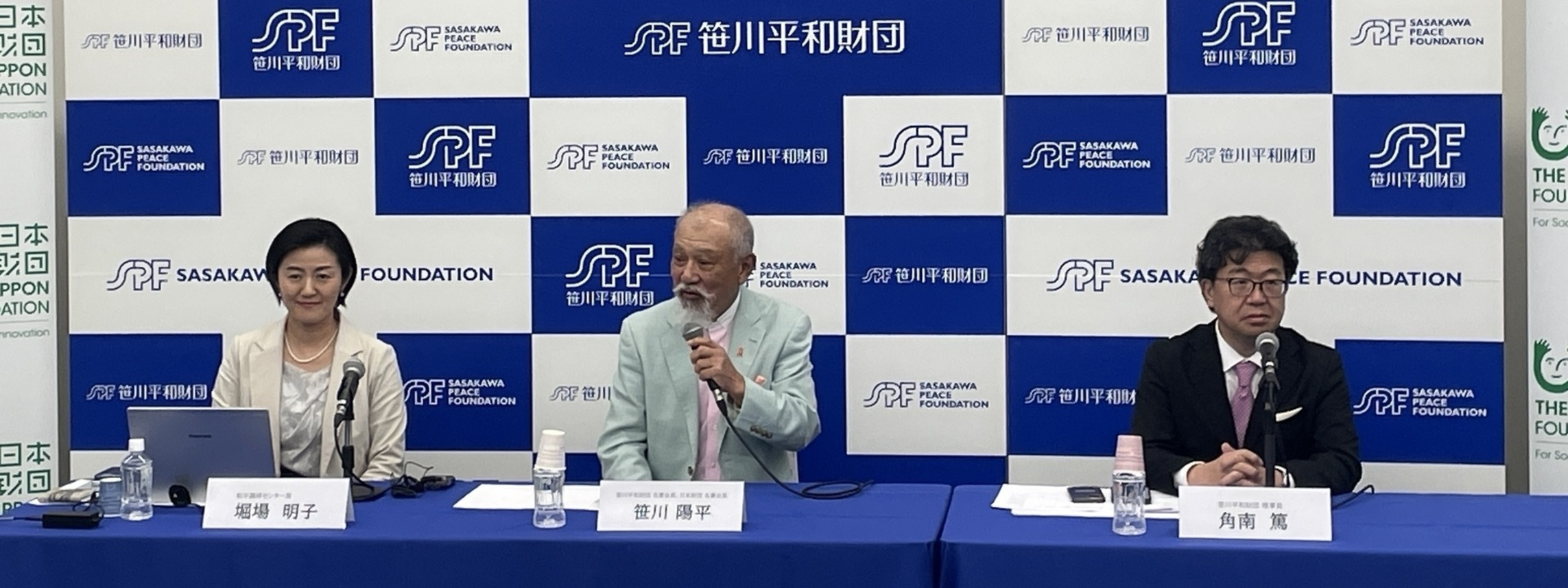
I announced this at a press conference on April 1 alongside SPF President Atsushi Sunami and Ms. Akiko Horiba, a Southeast Asia specialist and senior program officer who was chosen as the first CMS director.
In the past, Japan’s involvement in peacebuilding has largely consisted of reconstruction support in the post-conflict phases.
The new entity has around 10 specialists in conflict mediation and is charged with getting involved earlier and helping to craft peaceful settlements before the fighting on the ground has finished. It will stand alongside people affected by armed conflict and expand pathways toward sustainable peace that do not depend on violence.
By sharing experience and knowledge, the center will also help communities recognize alternatives to violence and strengthen their own capacity to pursue peace and stability.
Sustainable peace requires trust. For this reason, the CMS places the highest priority on building long-term relationships through continuous dialogue with conflict parties and affected communities.
Its work begins with listening carefully to the perspectives of diverse stakeholders and valuing knowledge from the field.
The CMS also draws on the expertise of Japanese scholars and specialists in area studies and international politics. Its work incorporates the historical, cultural and social contexts of each region, while respecting the values, religions and customs of the parties involved.
As a private organization, it leverages its neutrality, flexibility and networks to seek practical and creative approaches to conflict resolution rooted in the realities on the ground.
The CMS serves as a hub connecting the expertise of Japanese area-studies scholars to form a network of specialists researching conflict regions and surrounding areas. Through academic analysis, it seeks to deepen understanding of the structures and background of conflicts and apply this knowledge to mediation support.
The center will aim at facilitating dialogue and creating opportunities for discussion among conflict parties and stakeholders; providing capacity-building training for actors involved in peace processes; sharing experience and knowledge through exchanges and visits among stakeholders; and implementing practical mediation support tailored to the circumstances of each region
Speaking at the press conference as honorary chair of the SPF and The Nippon Foundation, I stated: “We want to build a network of specialists from around the world in the realm of conflict mediation, and to make Japan’s presence felt in it. We hope to see the new center display its capabilities as a private-sector actor that can speak freely without governmental restrictions.”
SPF President Sunami noted that there had been no prior discussion with the Japanese Ministry of Foreign Affairs regarding relations with its own International Peace Mediation Unit, established on March 17 this year. The CMS would advance its activities while making the most of its private-sector position, he added.
CMS Director Horiba said: “One advantage Japan enjoys in this realm is its neutral position, which can be recognized by both parties to a conflict. I hope to see our organization make the most of this in pursuing its activities in peace mediation and support for peacebuilding. In terms of fostering human resources in the peace field, too, we want to develop a quintessentially Asian approach to the craft, rather than simply going with what has been established in the West to date.”