
One Third of Japanese Youths Foresee Their Country Could Be Involved in Armed Conflict with Another Nation in Five Years: Poll

In December 2022, Japanese Prime Minister Fumio Kishida adopted a new national security strategy that features a determination to possess "counterstrike capabilities” to preempt enemy attacks and to double the nation’s defense spending to the equivalent of 2% of gross domestic product (GDP) within five years. The budget increase is aimed at procuring ammunition and long-range missiles, among other things.
In what he described as “one of the most historically critical milestones for strengthening the alliance” with the United States, the new strategy aims to strengthen Japan’s resilience to protect itself from growing threats from China, North Korea and Russia.
Against this background, The Nippon Foundation conducted an online survey from January 11 to 16 on “National Security”, covering 1,000 Japanese aged between 17 and 19 across the country to look into their attitudes and opinions about peace and the country’s national security policy and increasing defense budget.
When asked to choose up to three of the biggest threats to Japan over the next five years, the top response was war or the effects of conflicts between countries neighboring Japan at 51.7%, followed by an armed attack by another country against Japan (47.2%) and a strike against U.S. bases in Japan (31.6%).
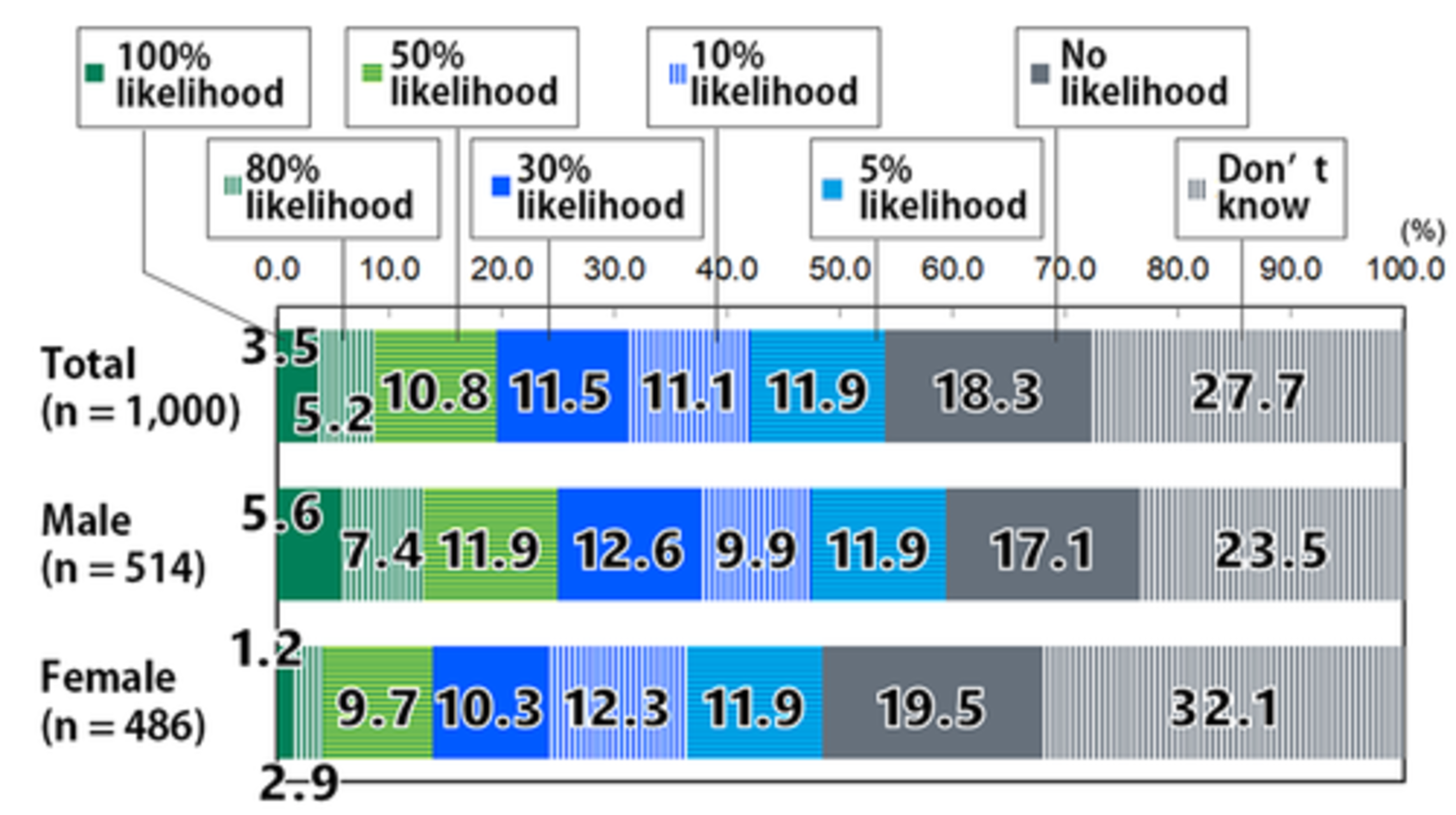
Regarding the likelihood of Japan becoming involved in an armed conflict with another country, roughly one third of respondents (32.4%) said “50% or higher.”
Queried about what countries they see as a military threat to Japan (multiple answers accepted), two thirds (66.8%) cited North Korea, followed by Russia (54.6%) and China (48.8%). This seemed to reflect their growing concern about North Korea’s repeated missile tests, Russia’s invasion of Ukraine and China’s rapid military buildup and more assertive behavior in the South and East China Sea as well as the prospect of a contingency involving Taiwan.
Regarding the government’s policy of increasing defense spending, nearly half of males (44.5%) were in favor with 30.7% being against and 24.7% answering “I don’t know.” But females were almost evenly divided between support (32.9%) and opposition (33.8%) with 33.3% saying “I don’t know.”
As to what national security policies should be pursued to maintain peace for Japan, answers varied widely with the stability of the Japanese economy topping the list at 26.2%, followed by the Three Non-Nuclear Principles of not possessing, not producing and not permitting the introduction of nuclear weapons (20.4%), social stability (18.3%), promotion of international dialogues and exchanges (18.1%), adherence to the war-renouncing Constitution (16.7%), strengthening the security alliance with the United States (16.0%) and bolstering the Self-Defense Forces (14.1%).
Asked what support Japan should provide to another country in the event that country is attacked by a third country, notwithstanding existing treaties and the Constitution, 22.8% were in favor of nonmilitary support and military support (defensive only), 21.3% were for nonmilitary support and military support (defensive and offensive), and 15.8% backed nonmilitary support, military support (defensive and offensive) and military intervention.
With regard to Japan’s possible introduction of conscription, 76.2% of males and 85.0% of females were against the idea. Queried about the likelihood of Japanese citizens, including themselves, fighting as combatants in a war zone should conscription be instituted, 24.9% of males and 13.8% of females replied “50% or higher.”
The findings of the survey seem to indicate that young Japanese, especially females, are divided over the government’s policy of doubling defense spending under the current national security circumstances.
I sincerely hope that Prime Minister Kishida and his officials will do as much as they can to explain why the larger defense budget is necessary especially as they start debating how to finance such spending, including possible tax hikes.

