
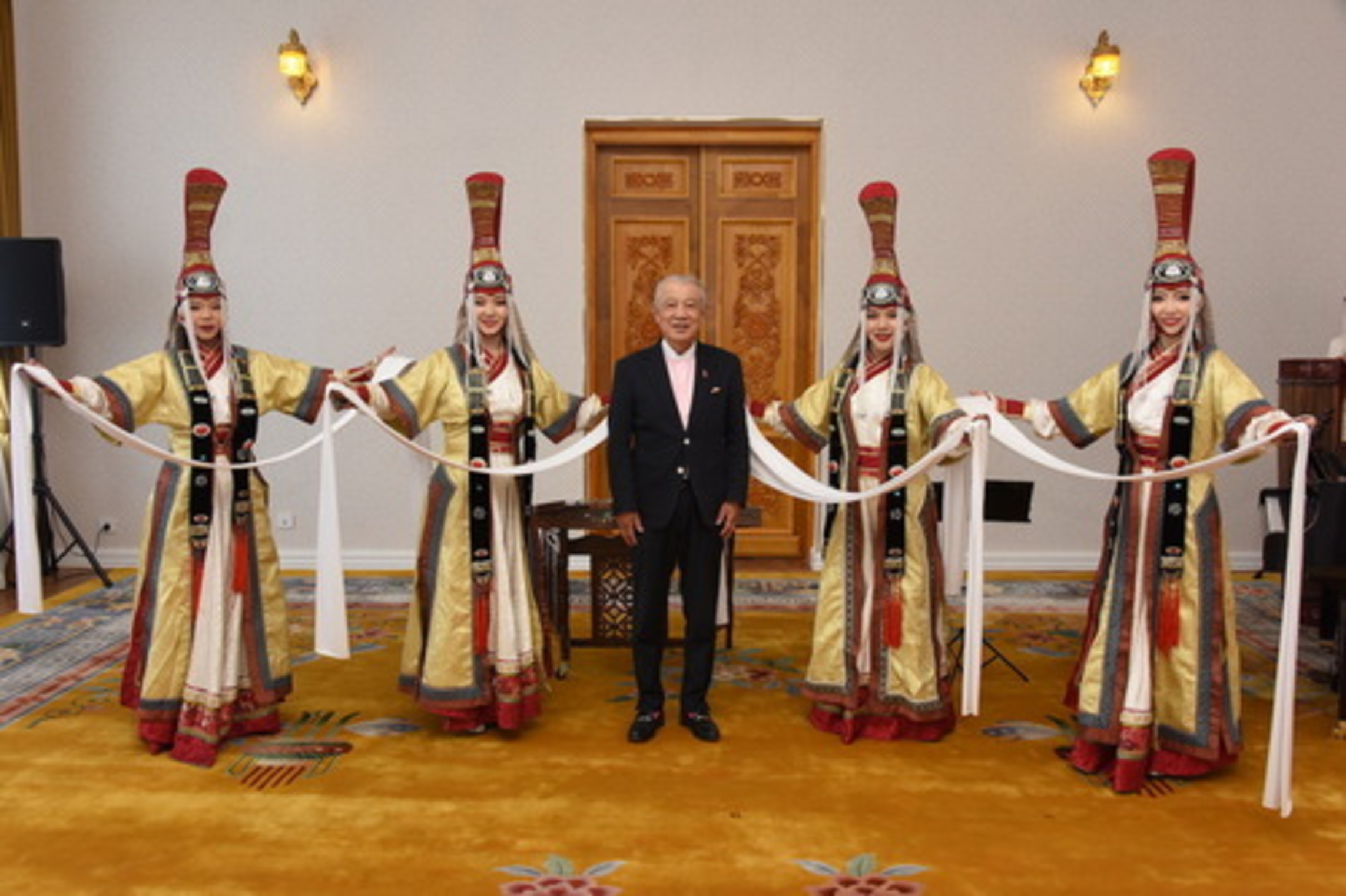
Visit to Mongolia at the Invitation of President Khurelsukh

I visited Mongolia from July 6 to 8 as chairman of The Nippon Foundation at the invitation of President Ukhnaa Khurelsukh. Mongolia is a landlocked country in East Asia, bordered by Russia to the north and China to the south. The area of the country is about four times as large as Japan, while its population is 3.4 million with almost half (1.6 million) residing in the capital of Ulaanbaatar. On July 6, I left Narita International Airport east of Tokyo at 2:40 p.m. aboard a Mongolian Airlines (MIAT) jetliner for a 5-hour, 35-minute direct flight to Ulaanbaatar, arriving at Chinggis Khaan International Airport at 7:15 p.m. local time. Due to a massive traffic jam caused by flooding, it took 3 hours to reach our hotel. We arrived at 11:30 p.m. and although hungry went immediately to bed. In my experience of travelling to some 120 countries, Jakarta in Indonesia has the worst traffic congestion, but on this occasion Ulaanbaatar was even worse. This prompted me to call off planned meetings with the Mongolian education and health ministers to focus on a luncheon with President Ukhnaa Khurelsukh. The president made ample preparations for my visit. He checked not only my CV, but also my wife’s former occupation (flight attendant). He was also gracious enough to instruct the country’s ambassador to the United States Batbayar Ulziidelger to come home to sit in on at our luncheon. The ambassador is an old friend of mine and once served as executive director of Vansemberuu-Mongolia, an NGO that spearheaded a project to promote the use of traditional medicines by distributing “family pharmacy kits” to rural, nomadic families through a pay-as-you-use system with the financial and technical support of The Nippon Foundation.It was an extraordinary honor for a private citizen like me to be shown such hospitality by the president. Entertainment for the luncheon featured traditional Mongolian song and dance as well as taiko (Japanese traditional drum) and harp performances. I almost cried when I heard performers sing Hana wa Saku, or Flowers Will Bloom, a Japanese song written to support reconstruction efforts in the areas hardest hit by the March 2011 earthquake and tsunami that devastated northeastern Japan. The luncheon lasted 45 minutes longer than originally planned even though President Khurelsukh had scheduled a meeting with the speaker of the Indian parliament immediately afterward. Besides the family pharmacy kit program, The Nippon Foundation has cooperated with Mongolia on education, including through the Ryoichi Sasakawa Young Leaders Fellowship Fund (Sylff) program, which over the past 30 years has bestowed fellowships on students pursuing masters and doctoral degrees to nurture future leaders of the country. The foundation has also helped to establish three Kosen colleges of technology to train top-level engineers. The Kosen colleges were modeled on some 50 such institutions in Japan that feature a unique and successful higher-education system involving a five-year engineering course and an additional two-year advanced course. Geo-strategically, Mongolia is situated between Russia and China, but its people have an affinity for Japan with which Mongolia shares some basic values. At 7:00 p.m., we joined a dinner hosted by Japanese Ambassador to Mongolia Hiroyuki Kobayashi, returning to the hotel at around 10:00 p.m. On July 8, we got up at 4:00 a.m. and left for the airport at 5:00 a.m. to return to Japan. 
|