
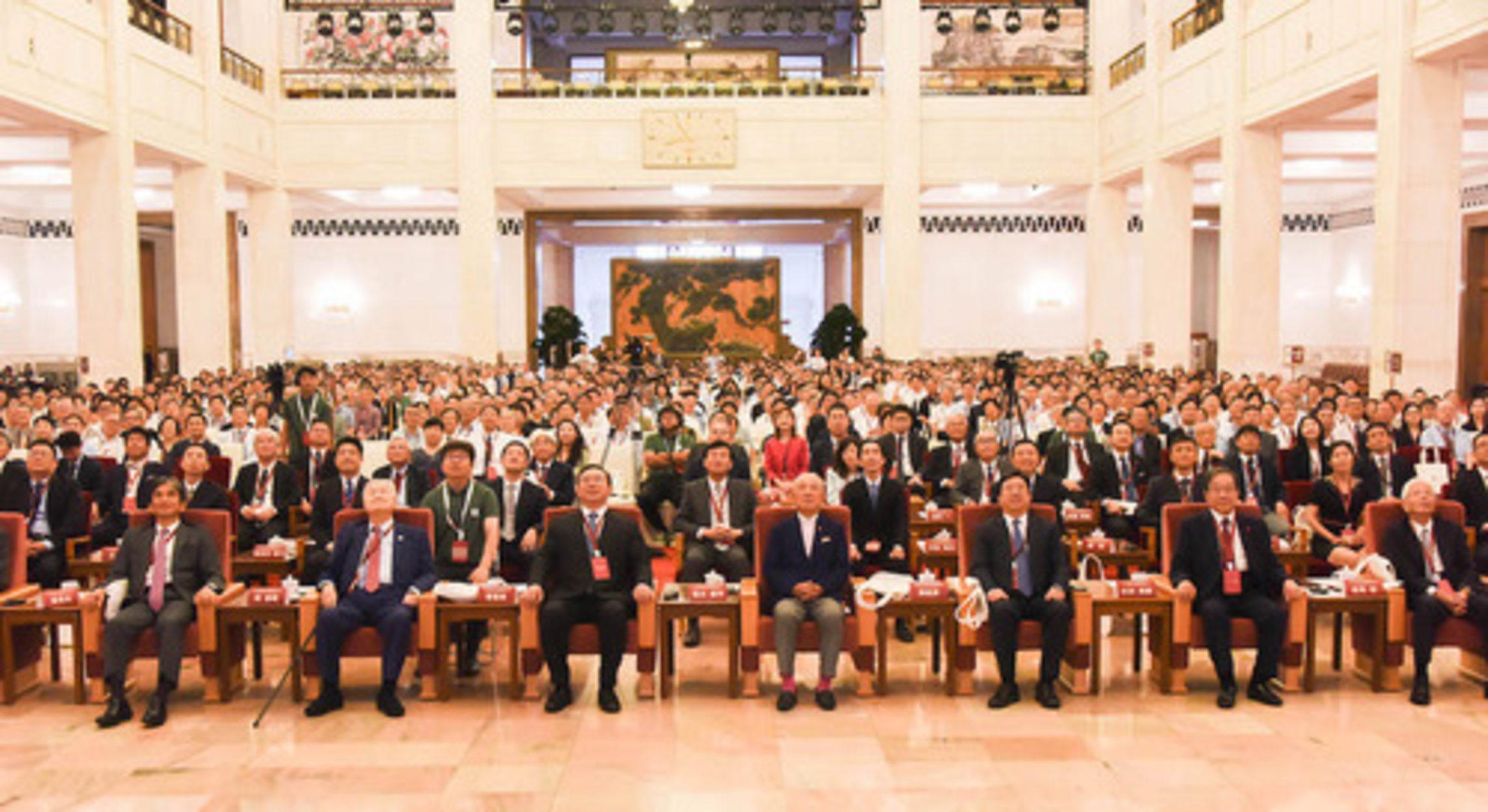
Gala Event Celebrates 35th Anniversary of the Japan-China Sasakawa Medical Fellowship Program at the Great Hall of the People

I visited Beijing in late July to attend a ceremony to celebrate the 35th anniversary of the Japan-China Sasakawa Medical Fellowship program at the Great Hall of the People following a two-year delay due to the coronavirus pandemic.
Organized by The Nippon Foundation and China’s National Health Commission (NHC), the July 28 event brought together a total of some 1,000 participants, including such dignitaries as former Japanese Prime Minister Yoshiro Mori and NHC Vice Minister Cao Xuetao as well as hundreds of members of the Sasakawa Medical Scholarship Alumni Association who took part in the program and about 140 Japanese professors and instructors who taught and worked with them.
This was the first gala held at the Great Hall of the People with as many as 1,000 participants since China eased its stringent COVID-19 restrictions late last year.
The Nippon Foundation started the fellowship program in 1986 as a humanitarian initiative to help China, which was then still a developing country, take care of the health of its people.
Initially, we invited some 100 Chinese doctors, pharmacists and nurses every year to study at Japanese universities, hospitals and other institutes across the country. But with the advance in Chinese medical research capabilities over the years, we later invited some 30 health professionals for doctoral courses and joint research programs with their Japanese counterparts.
So far, more than 2,400 Chinese medical students and professionals have studied and conducted joint research in Japan under the program. These fellows now serve at the heart of the Chinese medical establishment: among them are 18 presidents or vice presidents of universities and medical schools, 30 directors or assistant directors of hospitals, and 1,250 professors across the nation.
At the outset of the ceremony, NHC Vice Minister Cao Xuetao said that private-sector exchanges are the pivot of Sino-Japanese friendship, underscoring his willingness to make every effort to support the medical fellowship program.
Former Prime Minister Mori, calling himself a cheerleader for the program said: “The program has grown into a large flower,” expressing his high hopes for its further development.
In my remarks, I looked back at how the program has evolved since its launch in 1986 and said: “The relationship between Japan and China has shifted from an era of instruction to an era of joint research, and we aim for this fellowship program to be a model for joint research between Japan and China.”
At the ceremony, I signed an agreement on the sixth phase of the fellowship program with NHC Vice Minister Cao and Dr. Hideoki Ogawa, president of the Japan-China Medical Association.
Under the new agreement, we will invite 30 Chinese medical students and professionals to Japan every year over five years starting in 2024. On top of the existing doctoral courses and joint research programs, we will newly support postdoctoral research for those with a PhD for two years. The aim is to contribute to the medical advancement of Japanese institutions and see these researchers become leaders of noted Chinese medical schools in the future.
The agreement came in the year that marks the 45th anniversary of the signing of the Treaty of Peace and Friendship between Japan and China. Since then, the two countries have from time to time undergone periods of political tension.
But regardless of the state of political relations at any given time, I believe we should spare no effort to understand each other. The Nippon Foundation will continue to engage in this fellowship program and other exchanges with China in the decades to come.


