
Nearly 70% of Japanese Youths Support the 2025 World Expo in Osaka: The Nippon Foundation Poll

Support for the Osaka Expo in 2025.The Nippon Foundation has conducted a nationwide survey on how Japanese young people see three issues that became hot topics in 2023-the World Expo scheduled to be held in Osaka, western Japan, in 2025, the release of treated water stored at the Fukushima Daiichi nuclear power plant, and illegal drugs and other unlawful activities.
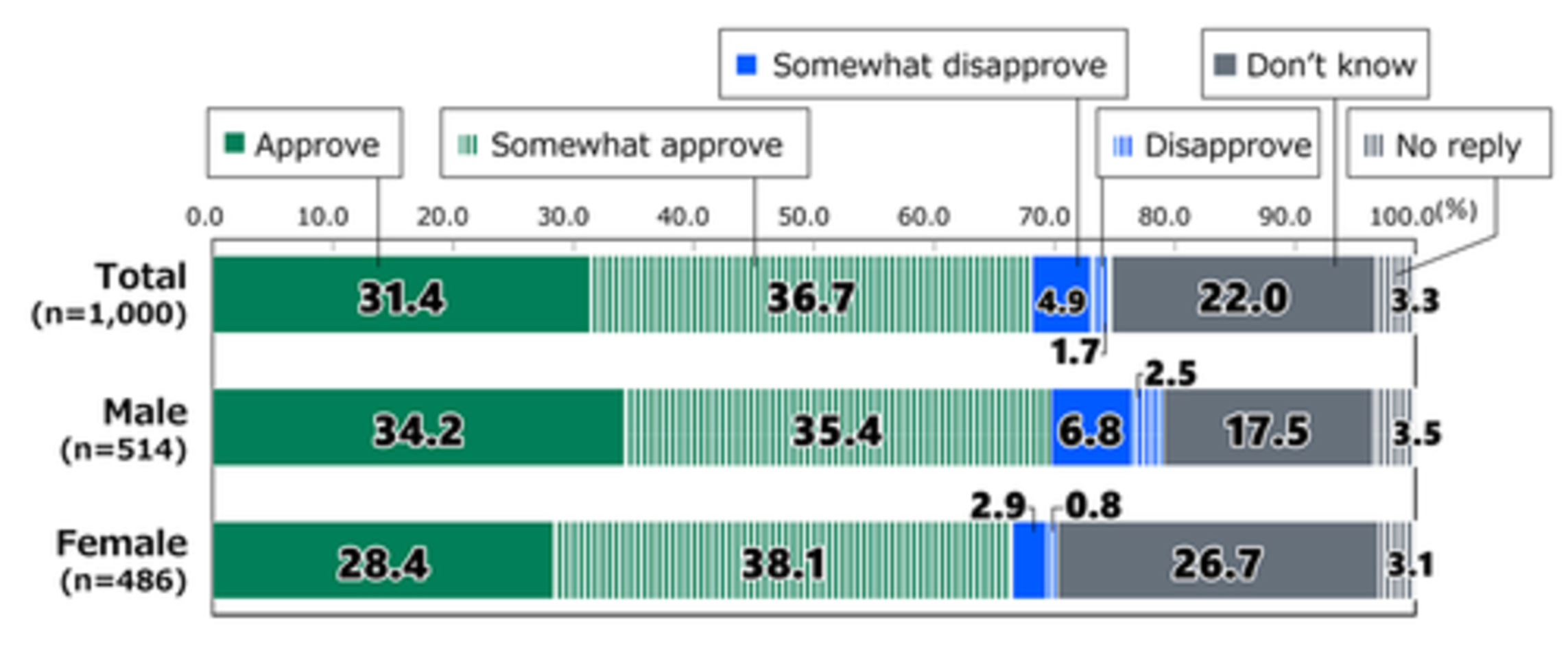
The online poll, which was carried out on October 30 and 31 among 1,000 people aged between 17 and 19, found that nearly 70% of the respondents (68.1%) were in favor of holding the World Expo in Osaka while a mere 6.6% were against it. One in five (22.0%) said they didn’t know and 3.3% didn’t answer.
The Japan Association for the 2025 World Exposition began advance ticket sales on November 30, 500 days prior to the event, which will be held from April 13 to October 13, 2025, on the man-made island of Yumeshima in Osaka Bay.
The association expects 28 million people to visit the expo, which takes as its theme “Designing Future Society for Our Lives”, and generate economic benefits totaling 1.9 trillion yen (about $12.8 billion).
When asked about the reasons for their support, more than half of respondents expected the event to bring economic benefits (55.9%) and an opportunity to promote Japan and Japanese culture (53.2%).
The findings of the survey were in stark contrast to several other polls done by Japanese media organizations which showed flagging support for the event against a backdrop of construction delays and massive cost overruns.
The Nippon Foundation poll showed that less than a third (28.6%) said they wanted to visit the expo, 22.5% didn’t and almost half (48.9%) said they didn’t know yet.
The Osaka Expo is facing a budget overrun-it has already had to increase its budget twice. In the latest revision on November 2, or after the poll was taken, the budget was raised to 235 billion yen (about $1.58 billion), more than 90% higher than the first estimate.
Regarding the release of treated water from the Fukushima Daiichi Nuclear Power Plant, the survey found that close to 60% (58.5%) of the respondents approved of the discharge and 17.0 % disapproved. One in five (21.5%) said they didn’t know and 3.0% didn’t answer. By gender, two thirds of males (67.2%) supported the release, a much higher figure than for females (49.4%).
Asked whether the Japanese government had been doing enough to explain why and how it was releasing the treated water, the respondents were divided, with 41.9% saying it had done enough and 37.1% saying it had done too little. 18.2% said they didn’t know and 2.8% didn’t answer.
Regarding the dissemination of information on the discharge to the international community, more than half of females (50.6%) considered it to be insufficient, compared to 46.1% for males.
Japan began releasing water from the crippled Fukushima nuclear complex in northeastern Japan, operated by Tokyo Electric Power Company, in late August after the International Atomic Energy Agency (IAEA) concluded based on a two-year review that the release of the treated water would have a negligible radiological impact on people and the environment.
But China has sharply reacted to the discharge by imposing a blanket ban on Japanese seafood imports.
The water release is seen as a key step to advance the decommissioning of the Fukushima Daiichi plant, which suffered reactor fuel meltdowns triggered by a catastrophic earthquake and tsunami in 2011.
On the topic of illegal drugs, almost 80% (79.0%) replied they had never sensed being around drugs. But 7.3% said that they “know someone who uses or possesses drugs” or “know someone who knows someone who has possessed drugs.”
When asked about so-called “dark” part-time jobs involving scams or robberies, with the perpetrators recruited via social media, 5.9% replied that they “have seen people who appear to have been recruiting” for these jobs, indicating that some young people feel these things are close at hand in their daily lives.

