
60% of Japanese Youths Favor Free University Education, Half Support More Online Universities: Poll

The Nippon Foundation has conducted a survey to look into how young Japanese regard a range of issues related to education, including government spending on education, new initiatives being taken in response to the nation’s declining birthrate, and their experience in compulsory education.
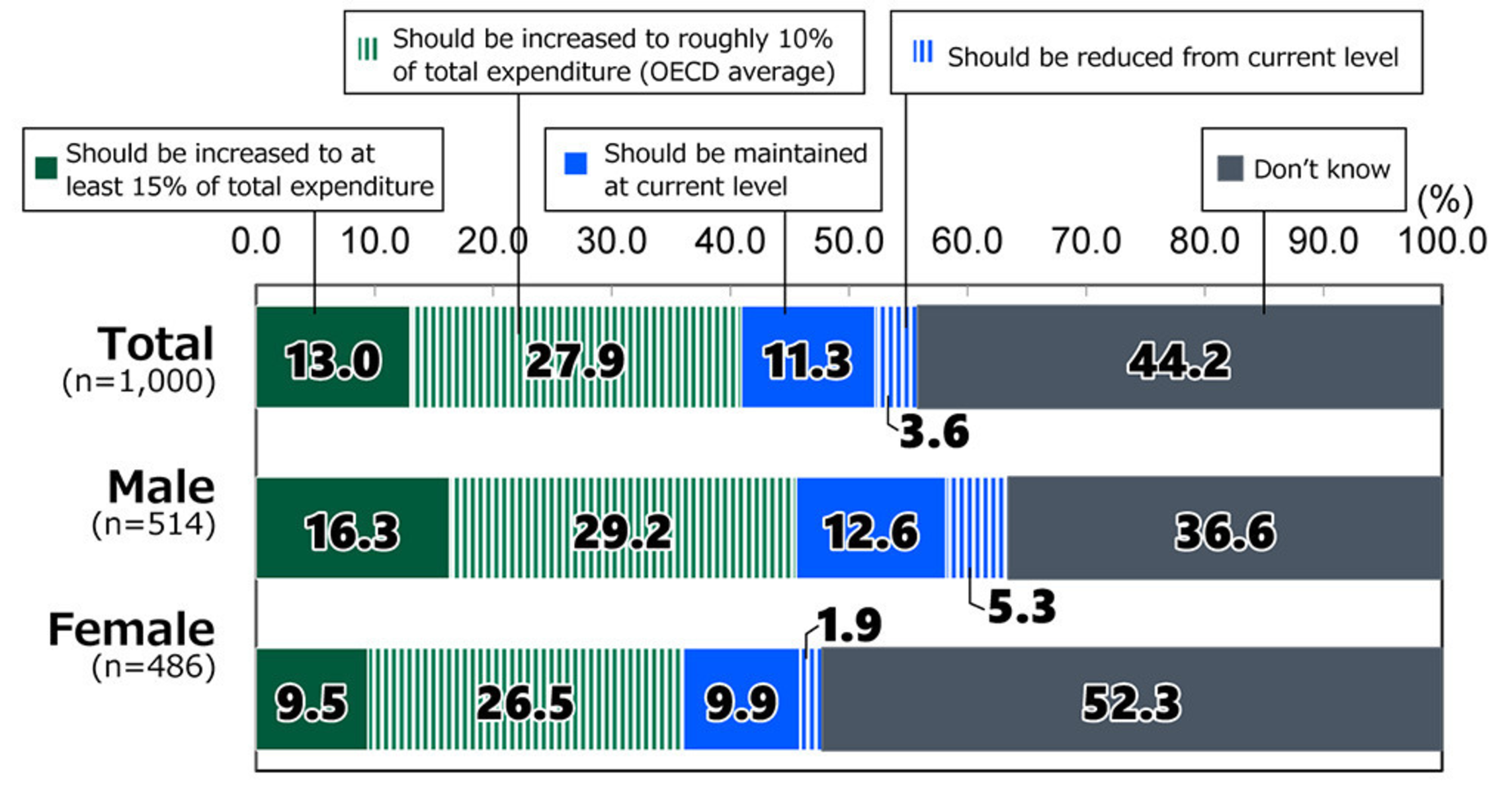
The online poll was conducted from January 19 to 22 covering 1,000 men and women aged between 17 and 19 across the country. It showed that roughly 40% of the respondents (40.9%) favored increasing the government’s spending on primary through tertiary education, which currently accounts for 7.8% of its total general account expenditures, to either over 15% (favored by 13.0%) or to at least 10.6% (27.9%), the average for 38 member countries of the Organization for Economic Cooperation and Development (OECD). Japan ranked 34th among the member countries, according to the 2022 OECD data.
About one in ten (11.3%) supported maintaining the current level and only 3.6% were in favor of reducing it, while 44.2% said they didn’t know.
By gender, more than 40% of males (42.2%) want more government spending on education, compared with 36.0% for females.
Asked whether the government should make university education free, more than half (57.9%) were in favor of the idea and a little more than one in 10 (12.1%) were against, with one third (30.0%) responding they didn’t know. More males (62.8%) wanted to see free university education than females (52.6%).
With regard to the initiatives being taken by universities in response to the nation’s declining birthrate, a majority of the respondents (50.7%) supported establishing more online universities that do not require commuting and 22.2% did not, with 27.1% saying they didn’t know.
The Nippon Foundation and Dwango Co., a major information technology and media company, have agreed to establish a correspondence university in April 2025 that will provide classes entirely online, enrolling 5,000 students a year.
Tuition will cost 380,000 yen (about $2,500) per year, a level designed to help potential students cope with widening income and regional disparities, an increasingly serious problem for higher education in Japan.
The poll also showed that a little over half (51.5%) of respondents said more efforts should be made to invite international students to Japanese universities while 18.1% were against, with almost one third (30.4%) saying they didn’t know. Similarly, almost half (49.2%) wanted more public schools to be established and 17.9% did not, with 27.1% answering they had no idea.
On the other hand, 43.0% disapproved of reducing universities’ enrollment quotas, or the government-set limits on the number of students a university may accept, with less than one in four (24.3%) approving and 32.7% having no opinion.
When asked to rank aspects of compulsory education, which in Japan lasts for nine years from elementary through junior high school, in order of importance, they ranked acquiring basic knowledge first (30.6%), followed by learning ways to communicate with people around them (23.8%), learning rules to follow in communities (23.7%) and preparing to go on to high school and university (20.9%).
Asked what they wished they had learned more about during compulsory education, the top answer was “financial literacy” (20.5%) to acquire the basic knowledge and skills required to manage their personal finances, followed by the ability to communicate with people around them (17.7%), and the awareness, approach, knowledge and ability to live in international society (17.7%). By gender, more females (23.7%) cited financial literacy than males (17.5%).
In terms of confidence in their teachers, 22.4% replied that they had confidence in fewer than half of their teachers while 14.8% said they had confidence in almost none of their teachers.
