
The Nippon Foundation Presents “MEGURI2040” Fully Autonomous Ship Program to IMO’s Maritime Safety Committee (1)
Published on January 14, 2025
Happy New Year!
All of us at The Nippon Foundation wish you a healthy, safe and happy 2025.
*******************

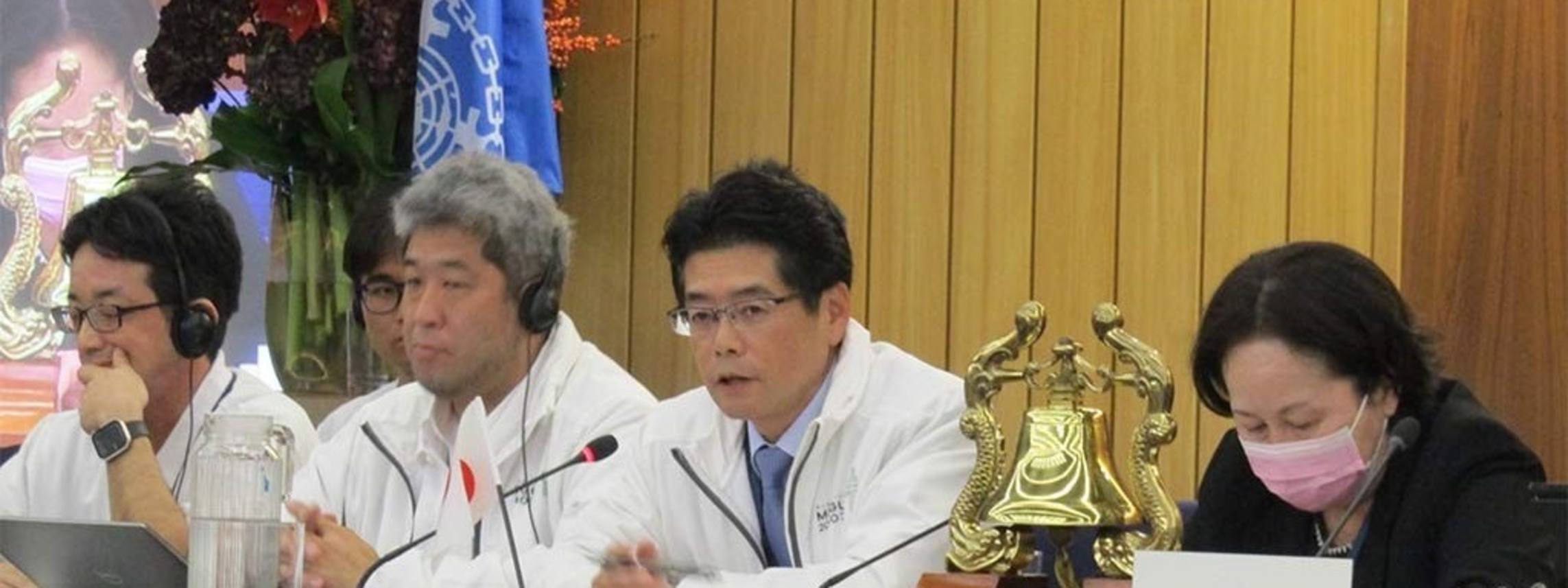
The Nippon Foundation has presented the “MEGURI2040” fully autonomous ship project to some 250 delegates from around the world at meeting of the Maritime Safety Committee (MSC) of the International Maritime Organization (IMO).
The general presentation was made at a lunchtime meeting during the 109th MSC session from December 2 to 6, 2024, at the IMO headquarters in London by the foundation’s Executive Director Mitsuyuki Unno. It was followed by updates from representatives of partner companies and institutions on the project’s current status, technological development and initiatives for ongoing implementation.
Launched in 2020, the Joint Technological Development Program for the Demonstration of Unmanned Ship, dubbed “MEGURI2040,” is financed and administered by The Nippon Foundation. The project aims at putting autonomous ships into commercial service in 2025 and eventually making half of Japan’s domestic coastal shipping fleet crewless by 2040.
In the first stage of the program, five consortia, comprising more than 50 Japanese companies, successfully conducted the world’s first demonstration tests of fully autonomous navigation using six vessels between January and March in 2022. These involved a mix of car ferries and container ships, large and small, as well as tourist boats, in a bid to maximize their applications to commercial shipping.
In one of the voyages by DFFAS (Designing the Future of Fully Autonomous Ships), the largest of the consortia, the 749 gross-ton containership Suzaku piloted itself on a 790-kilometer round trip between Tokyo Bay and Ise, a coastal city in Mie Prefecture, central Japan, achieving impressive autonomous system operation rates of 97.4% on the onward journey and 99.7% on the return trip.
This was another world-first, despite the fact that Tokyo Bay is one of the world’s busiest maritime areas, with up to 500 vessels passing through daily. (DFFAS, which started with 30 Japanese companies in 2020, has since doubled in size and now consists of 60 entities, both domestic and international.)
In the second stage, building on the progress made in the first stage, we are currently planning to put the technology into practice using passenger ships that serve remote islands in the Seto Inland Sea in western Japan as well as Roll-on/Roll-off (RORO) cargo ships carrying raw milk and agricultural and livestock products. Four vessels are scheduled to commence demonstration trials from the summer of 2025.
The presentation to the MSC was followed by a Q&A session that was marked by lively exchanges of opinions, demonstrating the degree of attention being placed on autonomous navigation in global maritime transport and the high level of interest in the MEGURI2024 project specifically.
The preparation of rules to ensure safety is indispensable for the widespread adoption of fully autonomous navigation. The Maritime Autonomous Surface Ships (MASS) international regulatory framework, known as the “MASS Code,” is also being deliberated at the IMO.
The IMO is a specialist UN organization established in 1958 to promote international cooperation related to maritime issues including navigation safety and the prevention of marine pollution from ships. As of July 2024, the IMO’s membership comprised 176 member states and three associate members.
Comprising IMO member states, the MSC meets three times every two years to consider: (1) navigation assistance; (2) ship construction and equipment; (3) staffing from the perspective of safety; (4) collision prevention; (5) handling of dangerous cargo; (6) procedures and requirements related to maritime safety; (7) channel information; (8) investigations of accidents at sea; and (9) other items at particular meetings having a direct impact on safety.
(To be continued)


Presentation materials at the IMO’s Maritime Safety Committee can be seen here.
Stage 1: To 2022; the world’s first demonstration of fully autonomous navigation using six vessels:
Stage 2: To 2025; MEGURI2040 initiatives toward social implementation