
The Nippon Foundation Presents “MEGURI2040” Fully Autonomous Ship Program to IMO’s Maritime Safety Committee (2)
Published on January 14, 2025

Even before The Nippon Foundation presented the “MEGURI2040” fully autonomous ship program to the Maritime Safety Committee (MSC) of the International Maritime Organization (IMO) in December 2024, the project has been providing information to the IMO member states to contribute to national and international rulemaking, using the results from the fully autonomous navigation development process and demonstration testing.
The Japanese Ministry of Land, Infrastructure, Transport and Tourism (MLIT) also provided data from the world’s first demonstration tests of fully autonomous navigation involving six vessels in 2022 at the 106th meeting of the MSC in 2022. Japan is currently taking the lead in rulemaking of the “navigation chapter,” the most important part of fully autonomous navigation technology.
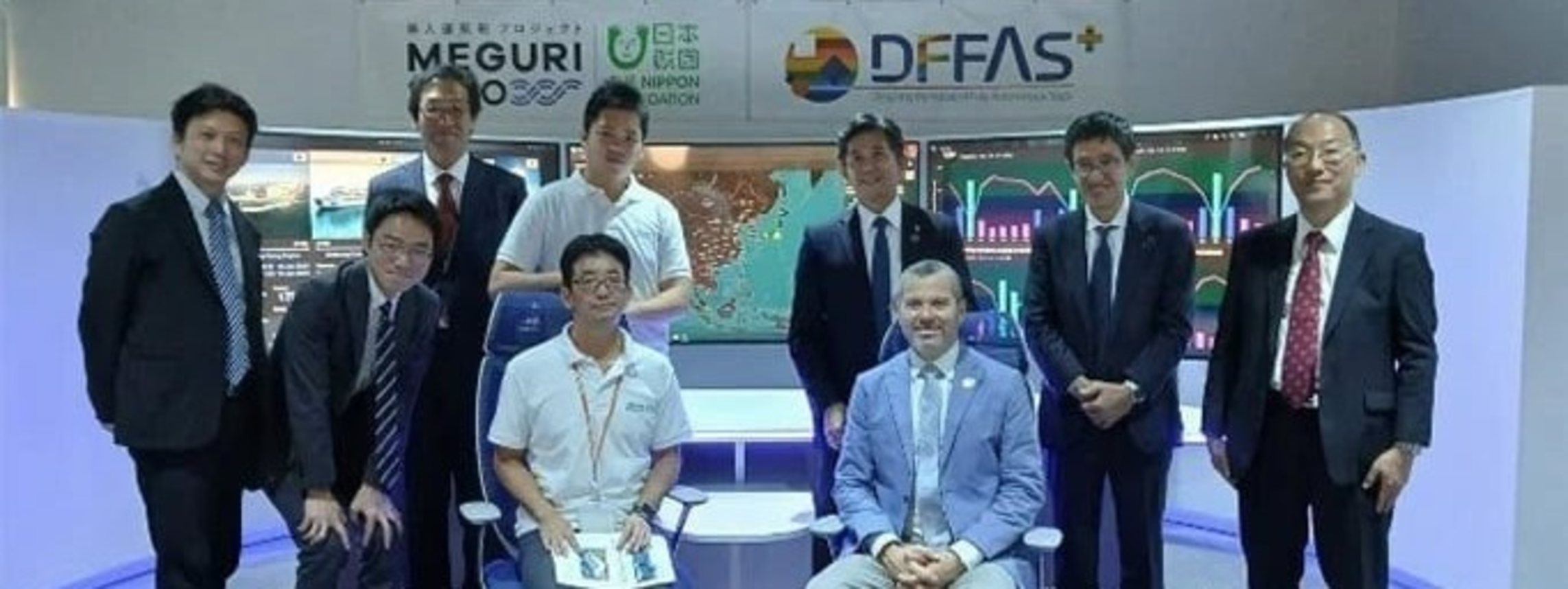
On October 17, 2024, IMO Secretary-General Arsenio Dominguez visited the Fleet Operation Center in Nishinomiya City, Hyogo Prefecture, western Japan, where he was briefed on the project.
The center, set up in the headquarters of Furuno Electric Co., a major manufacturer of maritime and industrial electronic products, is the world’s first to be capable of providing remote navigation support to multiple fully autonomous ships simultaneously from ashore.
Currently, Japan’s domestic coastal shipping industry is grappling with the issue of an aging population of seafarers, more than half of them aged 50 and older, as well as a declining number of crew members working in the industry.
Under the circumstances, autonomous ships are expected to go a long way in reducing workloads and trimming operating costs. Besides, crewless sailing can also address safety issues by reducing human errors, which account for about 80% of marine accidents.
Using information and communications technologies (ICT) and artificial intelligence (AI), Japan has been using its globally advanced technologies to promote research and development in fully autonomous shipping.
Expectations are particularly high in the Japanese marine transport sector, where autonomous shipping is seen as a way to solve the “2024 problem” in logistics, caused by the Japanese government’s introduction of new limits on overtime, with the new technology expected to alleviate the shortage of ship’s crews in supply chains.
The Nippon Foundation will continue to support the development and implementation of fully autonomous navigation technologies and promote greater social understanding in Japan to address issues in coastal shipping, which accounts for about 40 percent of the nation’s total domestic logistics, according to the 2023 MLIT statistics.
(End)
