
More Than Two in Three Ukrainian Evacuees in Japan Want to Become Long-Term Residents With Many Seeking Support for Employment, Language Training (1)
Published on April 10, 2025

A survey by The Nippon Foundation has found that more than 70% of Ukrainian evacuees in Japan wish to become long-term residents three years after Russia invaded Ukraine on February 24, 2022.
The poll was conducted from October 16 to December 10, 2024, covering 887 Ukrainians aged 18 and older who have been recipients of humanitarian assistance from the foundation since they fled the war-torn country to Japan.
As of the end of February 28, 2025, Japan was home to 1,980 Ukrainian evacuees, according to the Immigration Services Agency of Japan.
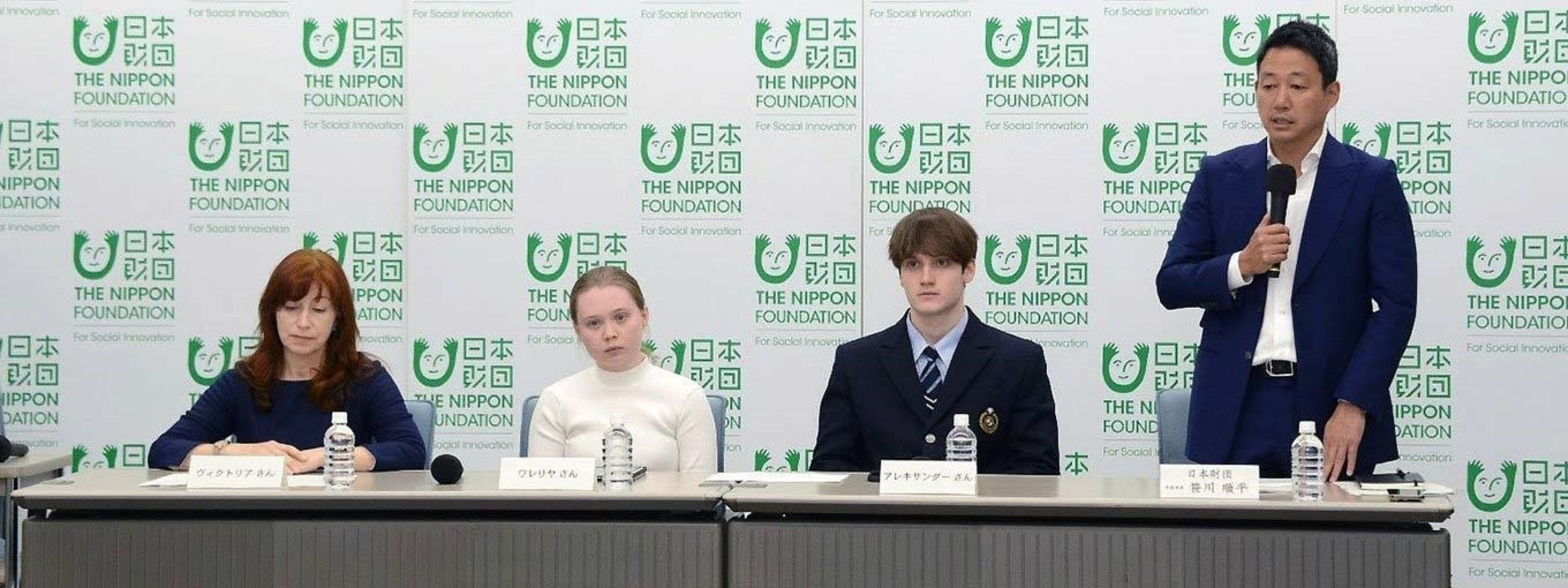
The findings of the survey were announced at a press conference on February 19 by Mr. Jumpei Sasakawa, vice president of the foundation. The press conference was also joined by three Ukrainian evacuees-Ms. Viktoriia Shetliez-Virich, Ms. Valeriia Lipina, and Mr. Oleksandr Samarukha.
The survey respondents were among approximately 2,000 evacuees to whom the foundation has provided a total of 5.29 billion yen (about $35 million) worth of humanitarian assistance, including air tickets to Japan, 1 million yen (about $6,650) per year for living expenses for up to three years, and 500,000 yen (about $3,325) one-time furnishing expenses. We also supported consultation on their daily living, social interaction and employment support through NPOs and local governments.
Asked when they want to return to Ukraine, 44.4% of the respondents said they “want to stay in Japan as long as possible” and 27.1% said they “want to stay until the situation in Ukraine settles down.” Combining the responses shows that more than two in three Ukrainian evacuees (71.5%) want to become long-term residents in Japan.
On the other hand, 19.4% “want to decide depending on the situation in Japan,” including how much support they receive or whether they can ask their family members to join them in this country.
7.7% said they “have not decided or didn’t know” while a scant 0.6% said they “want to return to Ukraine as soon as possible or go to another country.”
As for their employment status, the poll showed that 53.9% were employed, up 7 percentage points over the previous survey a year earlier. Of these, those working full time accounted for 26.6% and those working part time for 73.4%. The percentage of those not working totaled 46%, with 27% of them seeking employment.
Many evacuees are seeking stable jobs as a basis for staying in Japan over the long term. The most common form of support mentioned by 45.9% of those surveyed (apart from material or financial assistance) is job placement services and vocational training.
When parents were asked where they would like their children to be educated, 65.6% preferred their children to continue their education in Japan, while less than 20% wanted their children to be educated outside Japan, either in Ukraine (14.3%) or another country (4.5%).
Regarding their children’s Japanese language proficiency, 46.1% of their children “fully understand” or “basically understand” Japanese, a significant improvement compared to less than 10% (8.3%) at the time of their initial arrival in Japan.
When Ukrainian children first arrived in Japan, 82.9% either understood almost no Japanese or could only recognize a few words, as compared to just 17.1% currently. By steadily acquiring Japanese language skills, Ukrainians are overcoming one of the main barriers to pursuing employment and education in Japan, the survey found.
Speaking at the press conference, Vice President Sasakawa said the foundation’s three-year support for daily living will be phased out, depending on when the evacuees arrived.
“Many Ukrainian evacuees are adapting to Japan, and it seems to me that our support up to now has been effective. Moving forward, we would like to continue providing support for Japanese language education and employment in tandem with NPOs and local governments,” he added.
(To be continued)

