
Copy Infectious Disease Research Center, Financed by The Nippon Foundation, Completed in Osaka to Prepare Japan, the World to Tackle Future Pandemics
Published on May 12, 2025

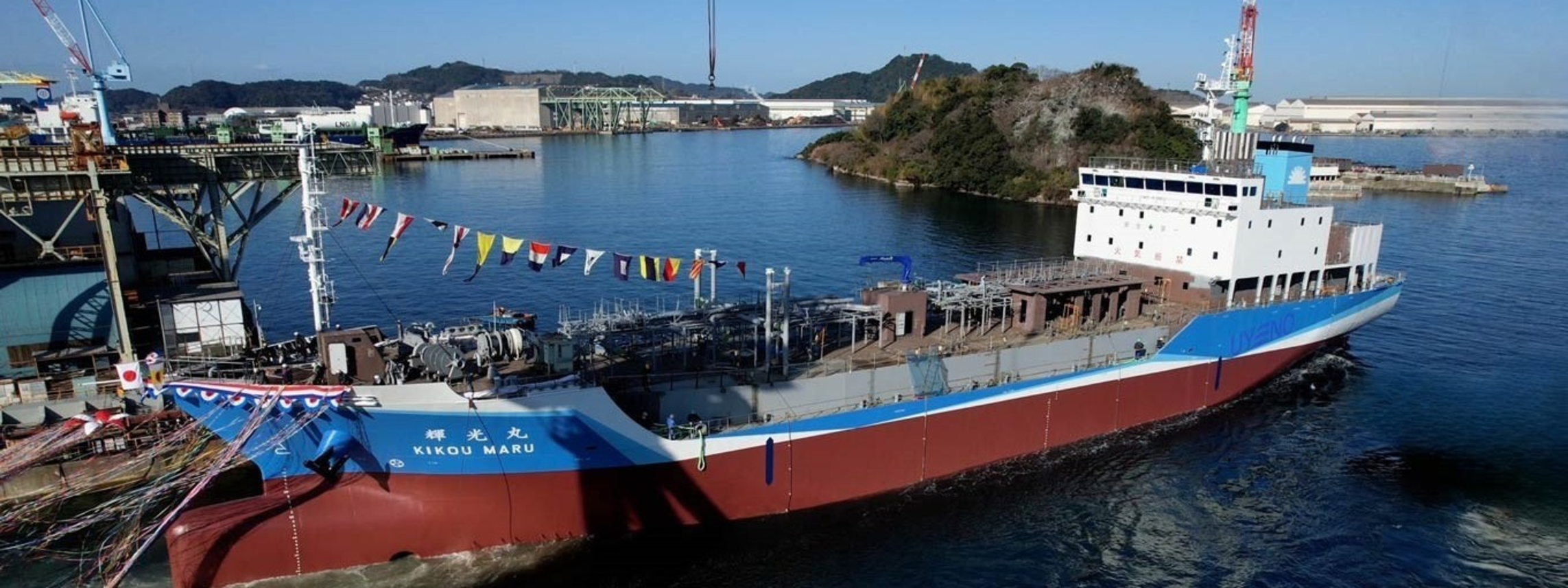
Japan has launched an oil tanker to be equipped with a hydrogen four-stroke high-speed engine under The Nippon Foundation’s “Zero Emission Ships Project.”
The 4,500 gross-ton vessel, the largest hydrogen-powered tanker for domestic coastal shipping, was built by Uyeno Transtech Ltd. and launched on February 14 from Fukuoka Shipbuilding Co.’s Nagasaki shipyard in western Japan.
Uyeno Transtech and Fukuoka Shipping are members of a six-company consortium along with Yanmar Power Technology Co. and Mitsui E&S Shipbuilding Co. The consortium has joined the project the foundation launched in January 2022 with the aim of prioritizing the development of hydrogen-fueled ships as the driving force for Japan’s efforts to achieve carbon neutrality in its coastal shipping sector by 2050.
Named Kikou Maru, which can be translated as dazzling light, the 105-meter tanker with cargo capacity of approximately 5,000 kiloliters features a hydrogen four-stroke high-speed engine that uses hydrogen fuel to generate electricity to power the engine as well as boil-off gas from liquid hydrogen to power lithium ion fuel cells to supply electricity for onboard operations.
The tanker’s hydrogen capacity is equivalent to around 2,500 standard hydrogen fuel cell vehicles, and the vessel is expected to reduce carbon dioxide (CO2) emissions by about 6,000 tons per year compared to a ship using heavy fuel, according to Uyeno Transtech.
Construction of the tanker is ongoing with completion scheduled by the end of 2025. A zero-emission demonstration voyage is slated for 2026 using hydrogen fuel and hydrotreated vegetable oil (HVO), and is expected to make a significant contribution to the promotion of zero emissions in Japan’s coastal shipping industry.
On March 28, Tsuneishi Shipbuilding Co., a major shipbuilder based in Fukuyama, western Japan, launched Japan’s first hydrogen-powered dual-fuel tugboat, also as part of The Nippon Foundation’s “Zero Emission Ships Project.”
Tsuneishi said that one of the challenges for tugboats is the need to be highly maneuverable and have high engine output to assist in berthing and operations of large vessels. The new 38-meter-long 300 gross-ton tugboat features twin 12-cylinder hydrogen-blended internal combustion engines (4,400 horsepower class), which will give it the needed capabilities.
The vessel is designed to operate with hydrogen in combination with traditional marine fuels such as heavy fuel oil, with the aim of reducing CO2 emissions by approximately 60 percent compared to conventional tugboats that use traditional marine fuels.
The tug is also equipped with facilities to store approximately 250 kilograms of high-pressure hydrogen gas to maintain the same operational performance as when using conventional fuel.
In the unlikely event of failure of the hydrogen fuel system, the vessel can operate on traditional marine fuels only, ensuring the same level of safety as conventional vessels, the company said.
To further enhance the project’s overall sustainability, all of the vessel’s hull was constructed using “JGreeX,” a green steel material produced by JFE Steel Corp., which significantly reduces CO2 emissions during steelmaking.
Tsuneishi Shipbuilding plans to conduct demonstration voyages, including bunkering, with the tugboat by the end of fiscal 2026 (March 2027).
The hydrogen dual-fueled engine to be installed on the tugboat is being developed by the Hydrogen Engine R&D Center established in September 2024 by the Tsuneishi Shipbuilding Group and operated by JPN H₂YDRO CO., its joint venture with the Belgian shipbuilding and logistics company CMB.
I sincerely hope that both the hydrogen-powered tanker and the tugboat will overcome all the challenges involved and successfully conduct demonstration voyages as scheduled, leading the global campaign to make the world’s shipping industry carbon neutral in the fight against climate change.
For our part, the foundation is resolved to support the nation’s fledgling fleet of zero emission ships for decades to come.

