
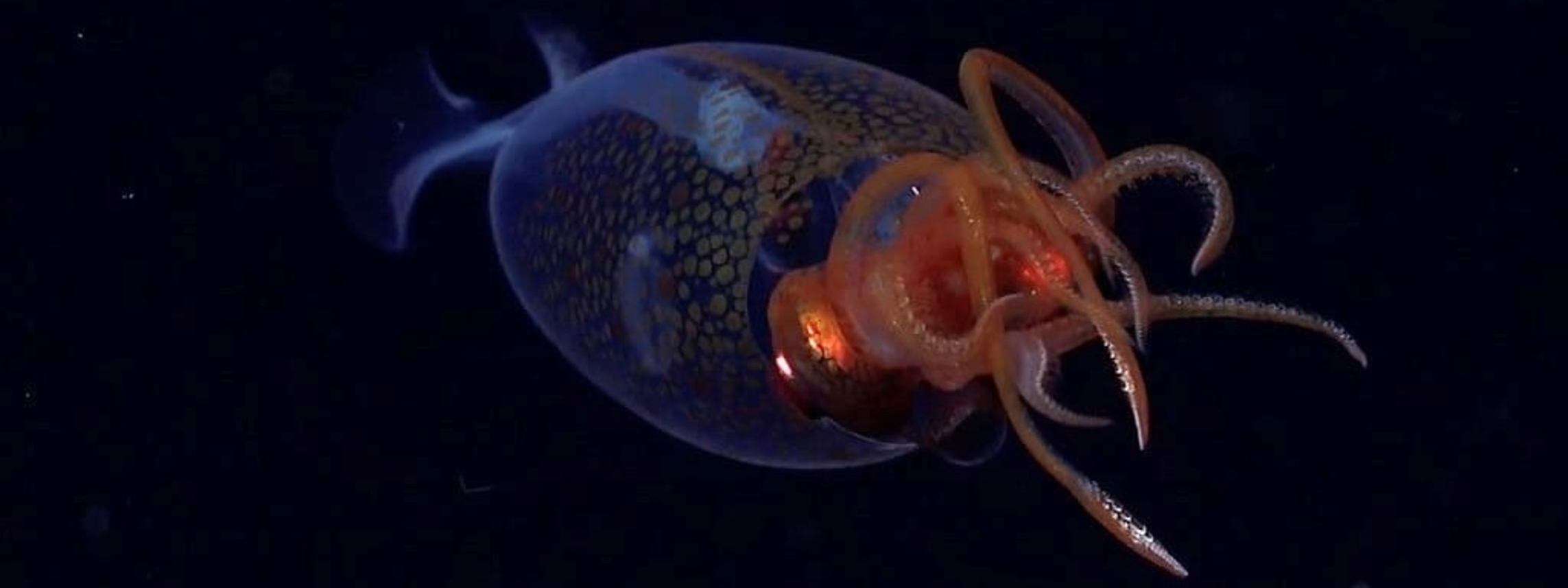
A Century After Its Discovery, First Confirmed Footage of Living Colossal Squid Captured Under The Nippon Foundation-Nekton Ocean Census Project (1)
Published on May 23, 2025

An international team of scientists have captured the first-ever footage of a live colossal squid, Mesonychoteuthis hamiltoni, in its natural deep-sea habitat. This coincides with the 100th anniversary of identification and formal naming of the species, a member of the glass squid family, Cranchiidae, in 1925.
The groundbreaking achievement for marine biology was made during a 35-day Ocean Census flagship expedition searching for new marine life-a collaboration between The Nippon Foundation-Nekton Ocean Census, Schmidt Ocean Institute and GoSouth, a joint project between the University of Plymouth (UK), GEOMAR Helmholtz Centre for Ocean Research (Germany), and the British Antarctic Survey.
The team on Schmidt Ocean Institute’s research vessel Falkor (too) captured footage of the juvenile 30-centimeter-long squid at a depth of 600 meters, using their state-of-the-art remotely operated vehicle (ROV) SuBastian during the Ocean Census flagship expedition.
The sighting occurred on March 9 roughly 600 meters beneath the icy waves near the South Sandwich Islands in the South Atlantic Ocean.
Colossal squid are estimated to grow up to seven meters in length and can weigh as much as 500 kilograms, making them the heaviest invertebrate on the planet. Little is known about the colossal squid’s life cycle, but eventually, they lose the see-through appearance of the juveniles. Dying adults have previously been filmed by fishermen, but have never been seen alive at depth.
“It’s exciting to see the first in situ footage of a juvenile colossal and humbling to think that they have no idea that humans exist,” said Dr. Kat Bolstad of the Auckland University of Technology, one of the independent scientific experts the team consulted to verify the footage. “For 100 years, we have mainly encountered them as prey remains in whale and seabird stomachs and as predators of harvested toothfish.”
The crew sent the footage to leading squid experts, including Dr. Bolstad and Dr. Aaron Evans, another specialist in the elusive glass squid family, to verify the footage. Both confirmed the identity of the animal by spotting a telltale feature: hooks along the middle of its eight arms, a unique hallmark of the colossal squid.
“This is honestly one of the most exciting observations we’ve had,” Dr. Bolstad said, during a press conference, adding: “We get to introduce the live colossal squid to the world as this beautiful, little, delicate animal.”
The colossal squid was first identified in 1925, based on remains found in the stomach of a sperm whale. In the 100 years since, nearly everything we’ve learned about it has come from carcasses-most of them half-digested.
“Even to this day, the enormous invertebrates still straddle the line between legend and reality,” noted the Natural History Museum in 2022.
Unlike its better-known cousin, the giant squid, the colossal squid lives deeper, swims slower, and is built like a tank. Its eyes are the largest in the animal kingdom, up to 27 centimeters across-wider than a basketball.
These eyes aren’t just for finding prey in the dark. They may have evolved to detect predators like sperm whales, which routinely dive into the squid’s abyssal domain. Some whales have been found with scars likely inflicted by a squid’s defensive hooks.
This live juvenile, she said, now offers a “starting place” to understand the creature’s life cycle-an enormous gap in marine science, said Dr. Bolstad.
(To be continued)
The first-ever footage of the live Colossal Squid can be seen here: