
A Century After Its Discovery, First Confirmed Footage of Living Colossal Squid Captured Under The Nippon Foundation-Nekton Ocean Census Project (2)
Published on May 23, 2025

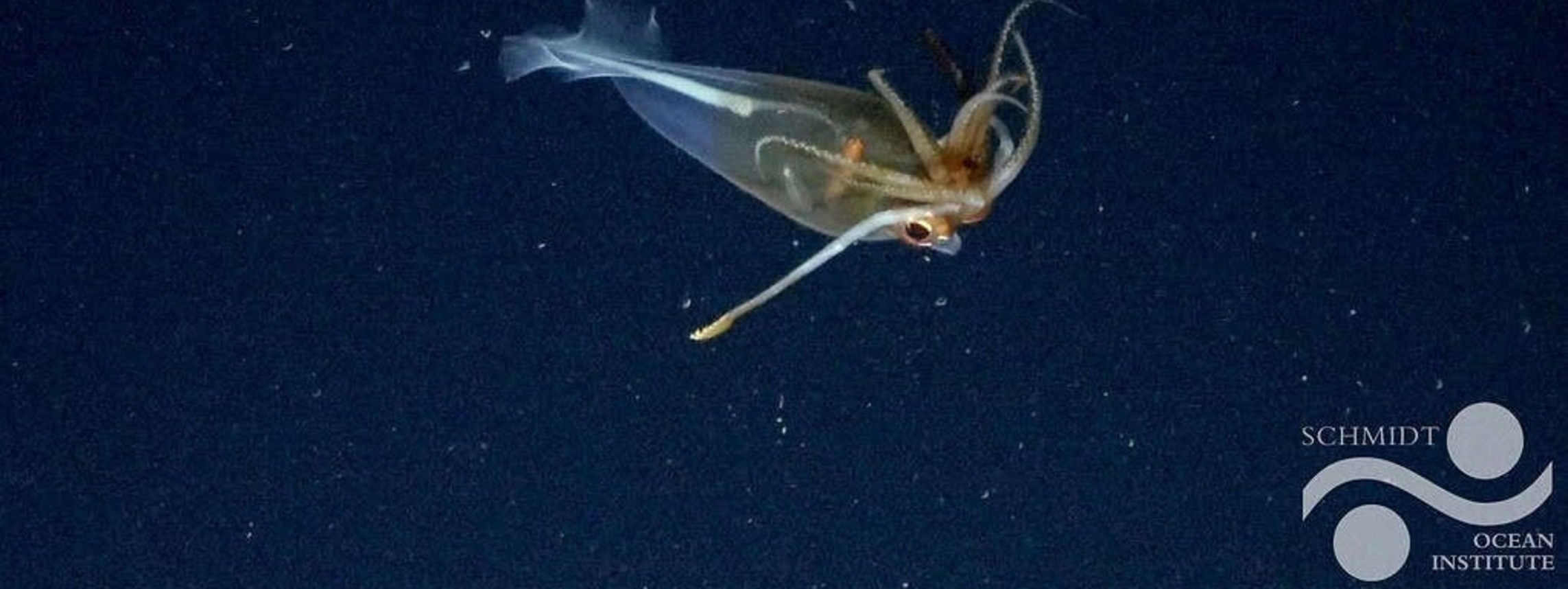
Weeks before international scientists captured the first-ever footage of a live colossal squid, Mesonychoteuthis hamiltoni, in its natural deep-sea habitat, another team aboard the research vessel Falkor (too) filmed the first confirmed footage of the glacial glass squid, Galiteuthis glacialis, near Antarctica. G. glacialis is another glass squid species that has never been seen alive in its natural environment before.
The two species were documented during the 35-day Ocean Census flagship expedition searching for new marine life-a collaboration between The Nippon Foundation-Nekton Ocean Census, Schmidt Ocean Institute and GoSouth, a joint project between the University of Plymouth (UK), GEOMAR Helmholtz Centre for Ocean Research (Germany), and the British Antarctic Survey.
The first confirmed footage of the living glacial glass squid was filmed on January 25 in the Bellingshausen Sea near Antarctica during the Schmidt Ocean Institute’s expedition, which examined the seafloor after an iceberg the size of Chicago calved from the George VI ice shelf. In the footage, taken at 687 meters deep, the transparent G. glacialis positions its arms loosely above its head, similar to the cockatoo pose commonly observed in other glass squids. G. glacialis is a glass squid species that, before now, had never been seen alive in its natural environment.
Dr. Kat Bolstad of the Auckland University of Technology and Dr. Aaron Evans, another independent expert on the glass squid family, who were consulted to verify the footage, also confirmed the footage of both squids.
Dr. Michelle Taylor of the University of Essex, who led The Nippon Foundation-Nekton Ocean Census team on the South Sandwich Islands expedition, said: “It’s incredible that we can leverage the power of the taxonomic community through R/V Falkor (too) telepresence while we are out at sea. The Ocean Census international science network is proud to work together with Schmidt Ocean Institute to accelerate species discovery and expand our knowledge of ocean life, live online with the world’s science community.”
“The first sighting of two different squids on back-to-back expeditions is remarkable and shows how little we have seen of the magnificent inhabitants of the Southern Ocean,” said Schmidt Ocean Institute’s executive director, Dr. Jyotika Virmani, adding: “Fortunately, we caught enough high-resolution imagery of these creatures to allow the global experts, who were not on the vessel, to identify both species.”
To date, the Schmidt Ocean Institute’s ROV SuBastian has captured the first confirmed footage of at least four squid species in the wild, including the Spirula spirula (Ram’s Horn Squid) in 2020 and the Promachoteuthis in 2024, with one more first sighting yet to be confirmed. “These unforgettable moments continue to remind us that the Ocean is brimming with mysteries yet to be solved,” Virmani said.
The Ocean Census project was launched by The Nippon Foundation and Nekton, a U.K.-based marine research institute, in April 2023 with the ambitious target of finding at least 100,000 new marine species in the first decade.
I am thrilled to see many more unknown deep-sea marine species to be discovered under this ambitious project.
(End)