
Third Japanese Consortium Successfully Demonstrates Autonomous Ship Navigation Supported by The Nippon Foundation (1)

A consortium of eight Japanese companies, led by Mitsui O.S.K. Lines, Ltd. (MOL), a major shipping company, has successfully demonstrated fully autonomous navigation systems on two different types of vessel-a coastal containership and a large car ferry.
The group has thus become the third to demonstrate the autonomous technologies among the five consortia participating in the Joint Technological Development Program for the Demonstration of Unmanned Ship, dubbed “MEGURI 2040,” sponsored by The Nippon Foundation.
On January 24-25, the MOL consortium demonstrated the world’s first crewless navigation of a containership in service-the Mikage-on a 270-kilometer route from Tsuruga, Fukui Prefecture, to Sakai Minato, Tottori Prefecture, on the Sea of Japan coast.
The demonstration also marked the first use of drones for mooring operations, with the drones used to haul the heaving lines that secured the unmanned ship to the wharf. The autonomous berthing was one of the most challenging parts of the voyage, requiring especially delicate handling.
Normally there are crew members aboard the ship to provide visual confirmation during the docking operation and also to pass the ship’s lines to the longshoremen to tie up the vessel. For the autonomous voyage, the seven-year-old containership was outfitted with mooring support technology using drones to carry the lines to the pier.
Containerships of roughly the Mikage’s size (749 gross tons) play an important role in coastal transport in Japan, accounting for roughly 10% of coastal vessels in operation.
The length of their voyages combined with crew shortages places a significant burden on seafarers. This successful demonstration of fully autonomous operation of the containership paves the way for future technological applications that will address the issues of crew shortages and workloads, and also contribute to the reduction of operating costs.
For this demonstration, the Mikage was equipped with a system featuring artificial intelligence (AI) to “teach” the ship to detect other vessels with an automatic identification system (AIS) and radar, as well as visible light cameras and infrared cameras for use at night.
A fully automated navigation system was also developed to avoid collisions based on the movements of other ships, and this was successfully demonstrated as well.
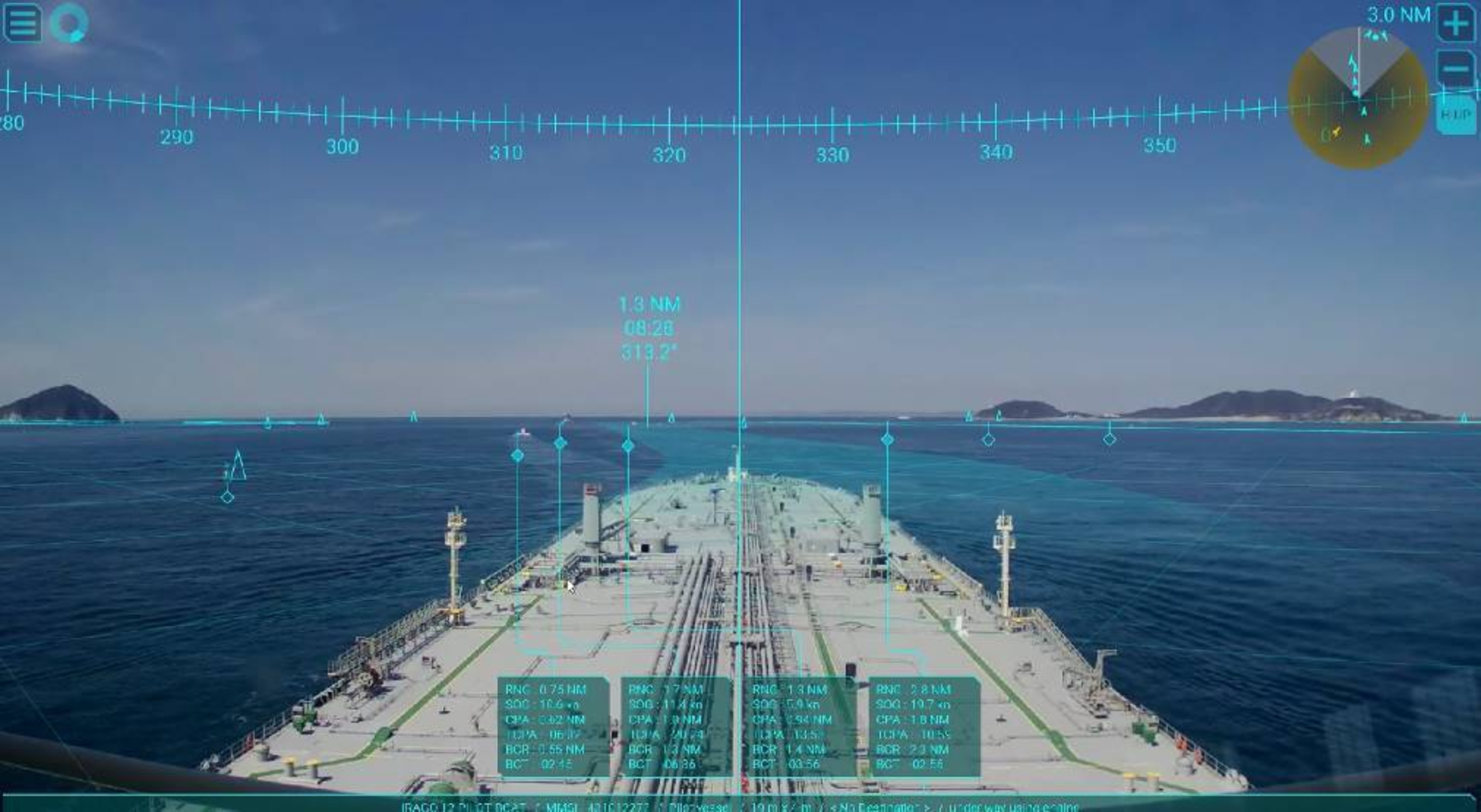
The crewless voyage requires monitoring from land, and this was done with a system that used augmented reality (AR) technology to superimpose information sent from the ship onto a screen.
Mr. Mitsuyuki Unno, executive director of The Nippon Foundation, said that the test voyage was conducted smoothly despite the ship having to deal with overnight wind and waves in the Sea of Japan.
(To be continued)

