
Japanese Young People Believe Men Need to Know More About Menstruation

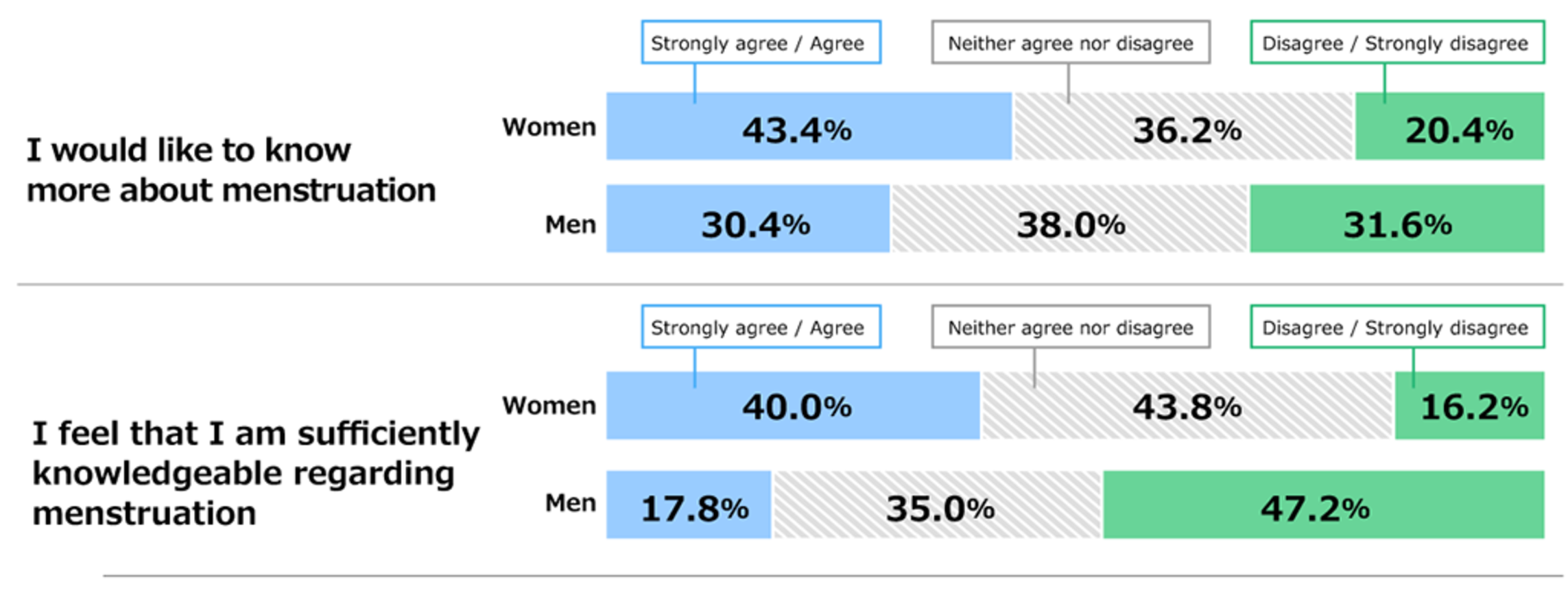
How much do young Japanese understand issues surrounding menstruation, from inconveniences in daily life to the economic effects? A poll by The Nippon Foundation, the latest in our “Awareness Survey of 18-Year-Olds” series, found that only 40.0% of women and 17.8% of men think they had sufficient knowledge of menstruation, with 43.4% of women and 30.4% of men replying “they would like to know more.”
The online survey on “Menstrual Issues” also showed that when it comes to men’s knowledge of the subject, a majority of women (74.4%) and men (61.0%) agreed that “men need to know more.”
The survey was carried out between December 10 and 15, 2021, covering 1,000 Japanese aged between 17 and 19 across the nation.
Roughly half of men (49.8%) and women (53.8%) replied that classes in school were their main source of information on the subject, but less than 30% of all respondents (29.3%) were satisfied with the quantity (number/frequency) and content of those classes.
When asked what they wanted schools to teach about periods, more than two thirds of women (70.0%) cited information about menstrual products and more than half of men (56.0%) mentioned appropriate consideration for women while they are menstruating.
Regarding inconveniences in daily life for women while having their periods, almost half of them (44.4%) experienced an insufficient availability of sanitary products in public places and one in three (32.4%) said that even though they wanted to miss or leave school classes or extracurricular activities early, they could not do so and just put up with it.
The survey also found that there is a psychological burden from insufficient understanding or consideration by others, including not being able to tell teachers or other persons in authority that one does not feel well (10.6%), or having those persons not understand that one does not feel well (9.4%).
In addition, 15.1% of women replied that in the past year, for economic reasons, they could not afford to purchase sanitary products, or replaced them less frequently, or used substitute items or items they borrowed from others or were given.
The economic burden caused by menstruation was also highlighted, with 71.6% of women and 51.6% of men replying that sanitary products should be subject to a reduced consumption tax rate, and 63.4% of women and 45.8% of men answering that sanitary products should be made available for free in such places as public restrooms.

