
80% of Japanese Youths Expect First Female Prime Minister to Bring About Change
Published on January 29, 2026

On October 21, 2025, Ms. Sanae Takaichi was elected Japan’s 104th prime minister by its Diet (Parliament), making her the first woman in the nation’s history to hold the office.
To look into how young Japanese feel about the new leader, The Nippon Foundation conducted an online survey from November 7 to 10, covering 1,000 people aged between 17 and 19 across the country.
Asked about their views on the nation’s politics in the wake of Ms. Takaichi’s inauguration, more than 60% (60.6%) viewed it as a “positive change,” whereas a mere 2.0% saw it as a “negative change.” Meanwhile, 33.5% said they did not see any particular change.
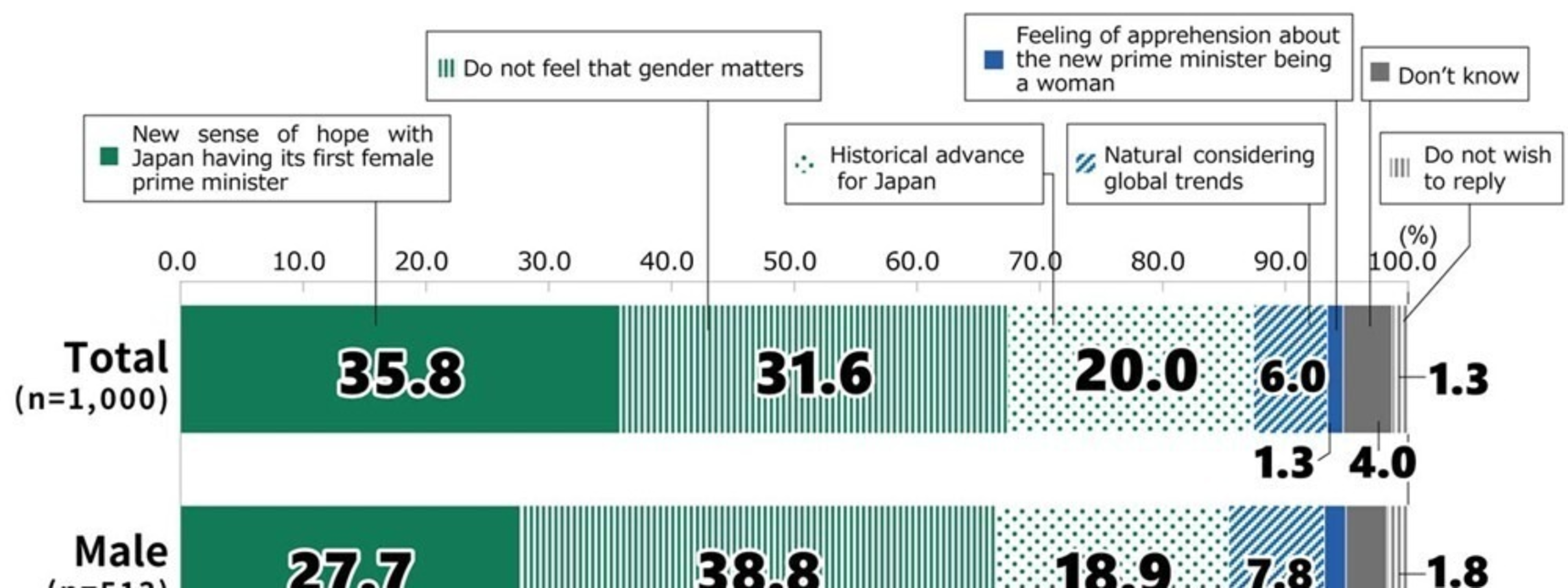
Asked what best describes their impression of Japan having its first female prime minister, a little more than a third (35.8%) said they had a “sense of new hope.” A much higher proportion of females (44.4%) than men (27.7%) had that impression.
In addition, 31.6% said they did not feel that gender matters, while one fifth (20.0%) said the country has made a historic advance and 6.0% said her selection is only natural in view of global trends,
On the other hand, a mere 1.3% said they had a feeling of apprehension about the new prime minister being a woman.
With regard to their expectations for possible change in Japan from Ms. Takaichi based on her actions during her first three weeks in the job, a great majority (82.9%) expected her to bring about change in Japan, while only 5.1% foresaw no change.
Regarding the breakup of the 26-year-old coalition between the ruling Liberal Democratic Party (LDP) and the centrist Komeito, days before Ms. Takaichi’s election as prime minister, more than half (54.1%) said it would “have a positive effect on Japan’s politics,” while only 4.8% said it would have a negative effect.
More males (61.7%) than females (46.0%) gave the former response, while almost half of the women (47.8%) said they “don’t know,” as compared to 31.0% of men.
Concerning the new coalition the LDP formed with the right-wing Japan Innovation Party, known as Ishin, which in effect enabled Takaichi to take the helm of the government, more than half of respondents (52.3%) said it would “have an effect on my own life going forward,” while 15.6% said it would “have little or no effect.” But 30.3% of all respondents, and almost 40% of females (39.8%), replied they “don’t know.”
Asked to pick up three things they expected of her, the top reply was “having conviction that Japan will become better” (30.5%), followed by an “ability to build relationships with other countries and an international perspective” (23.7%), “being clean” (22.7%), policies that “prioritize revitalizing the economy” (21.3%), the power to carry out policies (19.5%) and policies that take account of young people’s opinions (17.7%).
As to what issues they would like to see emphasized going forward, the top reply was economic policy (38.1%), followed by the declining birthrate and support for childcare (35.4%), tax reform (26.5%), education (22.2%), immigration and refugee policies (20.3%), and social security, including pensions and insurance (18.5%).
In terms of reducing the number of members of the House of Representatives and pursuing the so-called “Secondary Capital Concept” for developing a hub that can substitute for Tokyo in case of disasters-the preconditions Ishin made for entering into the coalition with the LDP-support was limited to single digits (6.1% and 1.0%, respectively).
Asked what is needed for securing political stability in Japan, the list was topped by “leadership from Prime Minister Takaichi” (20.7%), responsible actions and words from opposition parties (15.1%), policy proposals backed by financial resources (11.4%), cementing the stability of the ruling coalition (8.3%), dissolution of the House of Representatives for a snap election (6.9%) and expanding the coalition by attracting other parties (4.4%).
Prime Minister Takaichi said on January 19 that she would dissolve the lower house at the beginning of the ordinary Diet session on January 23 for a snap general election on February 8.
