
The Nippon Foundation to Provide $2 Million to Relocate 40,000 Displaced Persons from Myanmar to Bhasan Char Island in Bangladesh (2)

The high birthrate among displaced persons from western Myanmar’s Rakhine state who have fled to the Cox’s Bazar refugee camp in Bangladesh, where 30,000 babies are born each year, has increased the camp’s population by 3.71% annually, causing growing friction with the surrounding community. In these circumstances, I support the Bangladesh government’s program to relocate another 40,000 refugees from Cox’s Bazar to the island of Bhasan Char, some 60 kilometers from the mainland.
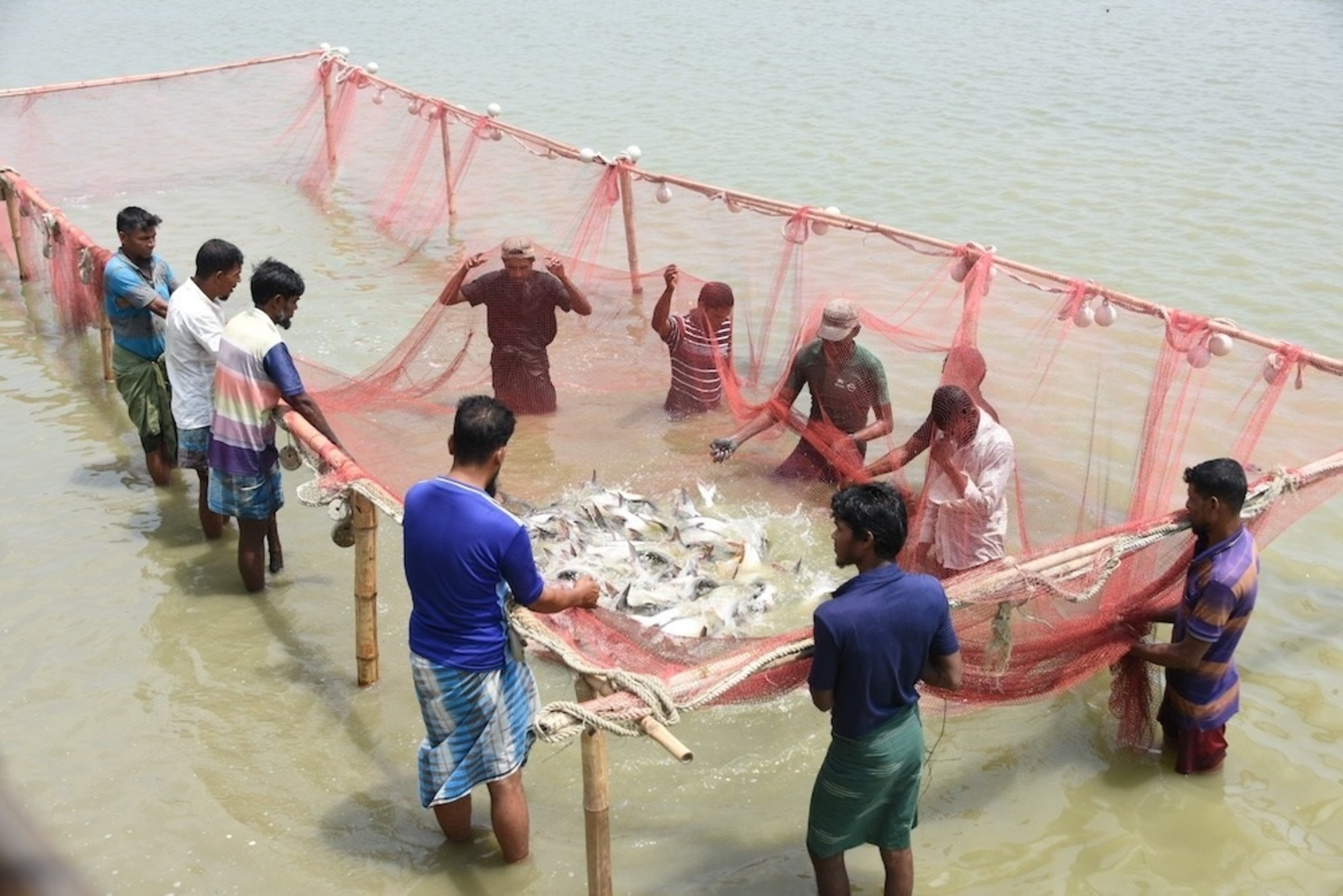
That is why I visited the island on April 6 to look firsthand at the situation of the refugee community there and how the humanitarian assistance The Nippon Foundation has provided in collaboration with BRAC (Bangladesh Rural Advancement Committee), a Dhaka-based international NGO, is helping them. The foundation has provided $3 million to help refugees on Bhasan Char to become self-sufficient through technical, agricultural and fish farming training.
For Myanmar refugees in the Cox’s Bazar camp, we donated $2 million to finance the construction of three two-story prefabricated movable steel structures and the building or repairing of 200 one-story structures to provide schooling for 16,000 displaced children (completed in 2023). In January 2024, the foundation offered a further $2 million to build more such facilities.
During my day-trip to Bhasan Char, I visited fish farms, agricultural, poultry and livestock facilities, vocational and skills training centers, as well as the WASH Sector Clean Water Laboratory to promote clean water, sanitation and hygiene, an education center and a child protection center, interacting with fishermen, farmers and other community members.
The Dhaka Tribune, UNB and other Bangladesh news organizations reported on my visit to the island, quoting me as saying: “Developing fisheries skills among the youth can enhance the community's quality of life in Bhasan Char. I can see numerous possibilities and opportunities for fish farming here on Bhasan Char. However, fishermen need to possess exceptional skills in fish-catching, boat operation, and the trade of fish, particularly in fishing techniques.”
The reports continued: “He further emphasized that the Nippon Foundation and BRAC (Bangladesh Rural Advancement Committee) will collaborate on enhancing these skills. He also highlighted that by developing these skills, fishermen will become valuable citizens, even upon their potential return to Myanmar.”
On my way back to Japan, I talked to international and Japanese media in Bangkok about what I had seen on the island and the role The Nippon Foundation is playing, including why we decided to provide $2 million to help move 40,000 more displaced persons from Cox’s Bazar to Bhasan Char.
In an interview with the Associated Press, I commended the skills training program for the refugees, stating: “After their return to Myanmar, if they have no skill whatsoever, then they would end up living poorly in the country. So having the skill training in Bhasan Char is going to help them greatly.”
I also commented: “I was quite impressed about how much support was given in Bhasan Char Island. And that support was being provided from the Bangladesh government, although the government itself is experiencing a very difficult fiscal state.”
I have visited a number of refugee camps around the world. Humanitarian assistance for refugees usually takes the form of food, shelter, safe drinking water, improved sanitation and hygiene, emergency healthcare services, child protection programs, and education, among other activities.
But the Bhasan Char camp uniquely provides refugees with skills and vocational training, creating numerous possibilities and opportunities for them when they go back to Myanmar in the future. I sincerely hope this will become a role model for refugee camps in other parts of the world.
(End)

