
Japanese Youths Most Pessimistic About Their Country’s Future Among Peers of 6 Major Countries: Poll

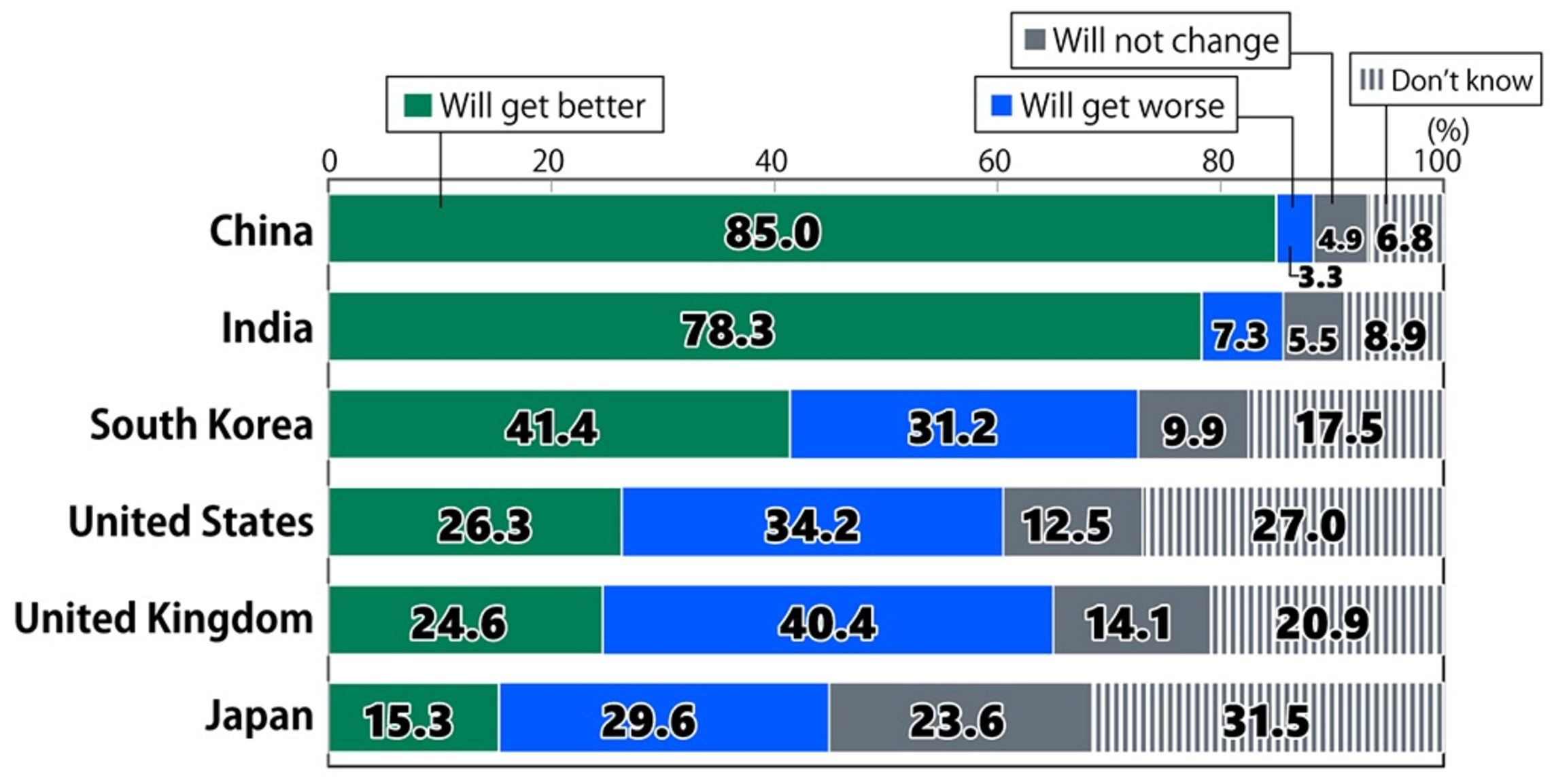
Only about 15% of young Japanese think their country will be better off in the future and only six in 10 have dreams for the future-the lowest among young people in six major countries. These were the findings of an online survey on “awareness of country and society” that The Nippon Foundation conducted between February 22 and March 5, covering 1,000 17- to 19-year-olds in Japan, the United States, the United Kingdom, China, South Korea and India. The survey showed that in virtually all areas, young people in Japan ranked below their peers in the five other countries. Asked about their country’s future, 85.0% of young people in China responded it would get better, followed by India (78.3%), South Korea (41.4%), the United States (26.3%), the United Kingdom (24.6%) and Japan (15.3%). The most common response given by the Japanese respondents regarding their country’s future was “no idea” (31.5%), followed by “will get worse” (29.6%) and “will not change” (23.6%). When asked if they have dreams for the future, young people in the world’s two most populous countries, India and China, topped the list at 88.4% and 88.2%, respectively, followed by the United States (84.7%), the United Kingdom (82.0%), South Korea (73.5%) and Japan (60.1%). Asked whether their country would be able to take on a leadership role in the international community, only 41.1% of Japanese respondents agreed, falling far behind the responses given by their peers in China (95.0%), India (85.4%), the United States (66.5%), South Korea (61.5%) and the United Kigdom (60.1%). When asked whether they would like to study or work abroad, Japanese again came last (52.8%), with the respondents from South Korea leading the way at 79.3%, followed by the United Kingdom (76.7%), India (76.1%), China (72.6%) and the United States (71.5%). When asked how well they felt older people and young people were supported by society, 64.5% of the Japanese respondents felt that support for seniors was adequate, while only 38.6% felt the same about support for young people. This percentage difference-25.9%-was the largest of the six countries, with the five other countries all showing differences of 10 percentage points or less: the United Kingdom (8.5%), the United States (7.2%), India (5.0%), China (2.5%) and South Korea (-1.4%, i.e., less support for older people than for young people). Asked whether they believed their own actions could change their country and society, less than half of respondents in Japan (45.8%) said yes, compared to China (83.7%), India (80.6%), the United States (65.6%), South Korea (60.8%) and the United Kingdom (56.1%). This may in part reflect lower levels of self-esteem and self-efficacy among Japanese respondents, according to the foundation. Similarly, when asked if they had a personality that they could be proud of, a little over a half of respondents in Japan (53.5%) answered yes, far lower than China (84.8%), India (83.9%), the United States (81.1%), the United Kingdom (75.4%) and South Korea (65.6%). Asked about major issues facing their country, Japanese respondents picked the declining birthrate (47.6%) and aging society (39.3%) as the two biggest issues, as did their peers in South Korea, where the responses were 51.0% and 38.4%, respectively. 

|