
Hydrogen Fuel Cell Vessel Demonstrated Successfully Under The Nippon Foundation’s Zero Emission Ship Project (1)

A consortium of five Japanese companies, led by MOTENA-Sea, Ltd. under the aegis of Mitsui O.S.K. Lines, Ltd., has successfully conducted a demonstration test of a hydrogen fuel cell ship system that emits no carbon dioxide (CO2) during combustion.
The test was part of the Zero Emission Ship Project that The Nippon Foundation launched in January 2022 with the aim of prioritizing the development of hydrogen-fueled ships as the driving force for Japan’s efforts to achieve carbon neutrality in its coastal shipping sector by 2050.
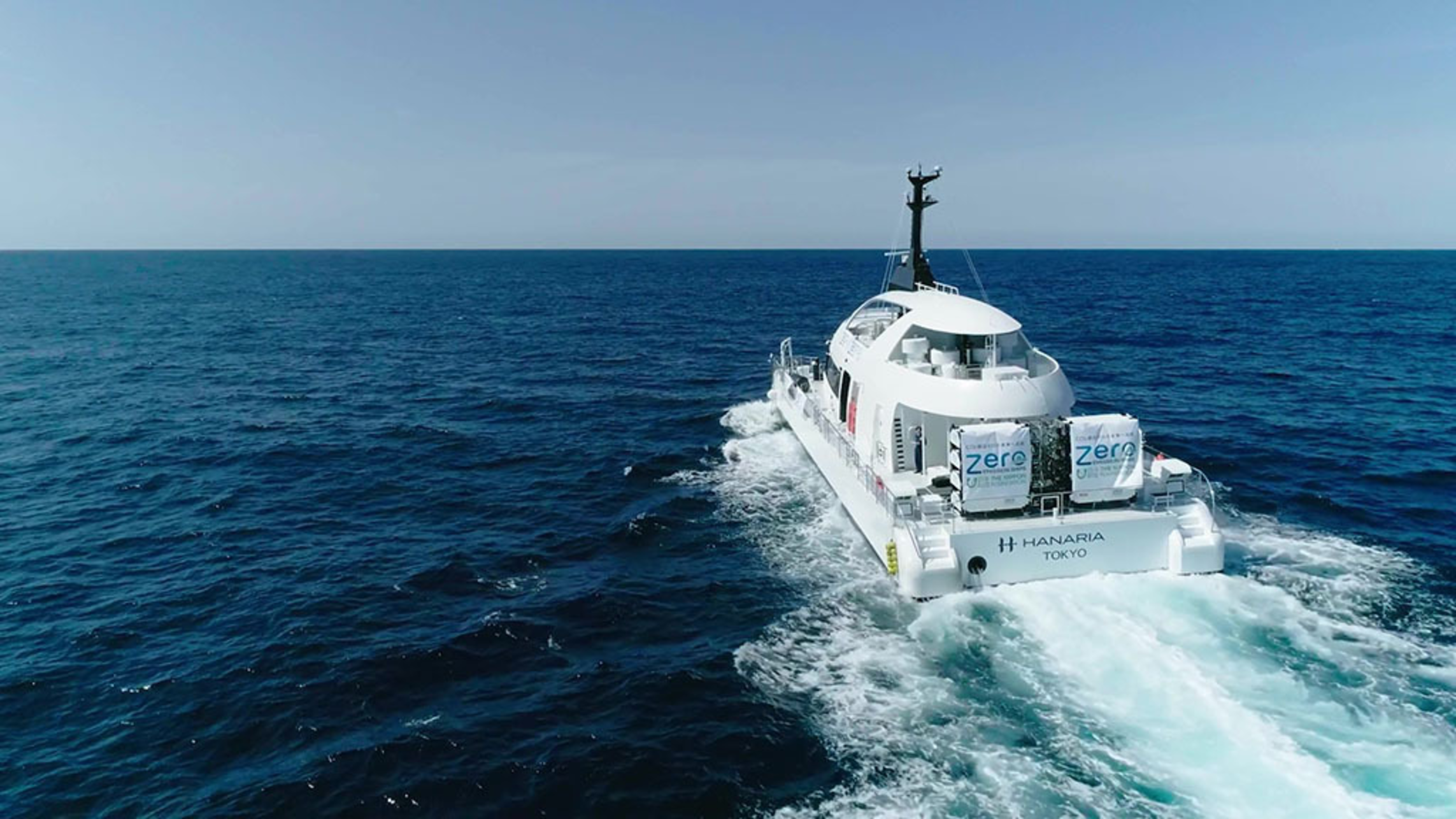
The MOTENA-Sea consortium carried out the demonstration test from March 26 to April 4 using the hybrid passenger ship HANARIA, which can select from hydrogen fuel cells, lithium-ion batteries, and biodiesel fuel as its propulsion source.
Using only hydrogen as fuel, the 33-meter-long, 248 gross-ton ship took about three hours to complete a CO2 emission-free round-trip voyage of around 30 kilometers between the port of Kokura in the city of Kitakyushu, southwestern Japan, and an offshore wind farm off Shirashima Island.
HANARIA is Japan’s first hydrogen fuel cell ship of 20 gross tons or more. It will be used as a crew transfer vessel (CTV) for transporting personnel to offshore wind farms as well as for sightseeing tours. This was the first time in the world that a hydrogen fuel cell ship that emits zero CO2 has been used as a CTV for an offshore wind turbine.
The MOTENA-Sea consortium also includes Mitsui O.S.K. Techno-Trade (business development), Hongawara Shipyard (vessel design and building), Kanmon Line (operation), and Taiyo Nippon Sanso Corp. (hydrogen supply/procurement).
Toyota Motor Corporation, now working hard to develop hydrogen-powered cars, also joined forces with the group to develop hydrogen tanks used for the vessel.
Speaking at a press conference on April 4 to announce the results of the demonstration test, Mr. Mitsuyuki Unno, executive director of The Nippon Foundation, commented: “Zero-emission ships that do not emit CO2 are the trump card for realizing a carbon-neutral society in 2050. With Japan’s advanced technological capabilities, we hope to lead the world’s ships to zero emissions.”
MOTENA-Sea President Kazutoshi Takao stated: “HANARIA is a pioneer in building zero-emission ships using hydrogen energy for realizing a carbon-neutral society in 2050. We hope that many people will enjoy the zero-emission experience with HANARIA.”
Mr. Yoshihiko Hamamura, chief project leader of Toyota Motor’s Hydrogen Factory, expressed his respect for the enthusiasm of all those involved in this project, who proactively took on the challenge of commercial operation as well as demonstration testing, adding: “The realization of a hydrogen society requires not only technological development, but also city and social design, and we look forward to moving ahead with all parties involved.”
On April 10, MOTENA-Sea started sightseeing cruise tours in Kitakyushu, using the 100-passenger HANARIA that uses hydrogen and biodiesel as fuels, achieving a greenhouse gas reduction rate of 53-100% compared to conventional fossil-fueled vessels of the same class.
This was designed to make more use of the ship, given that, as yet, there are not many offshore wind farms in the region and thus not much demand for crew transfer services.
(To be continued)


