
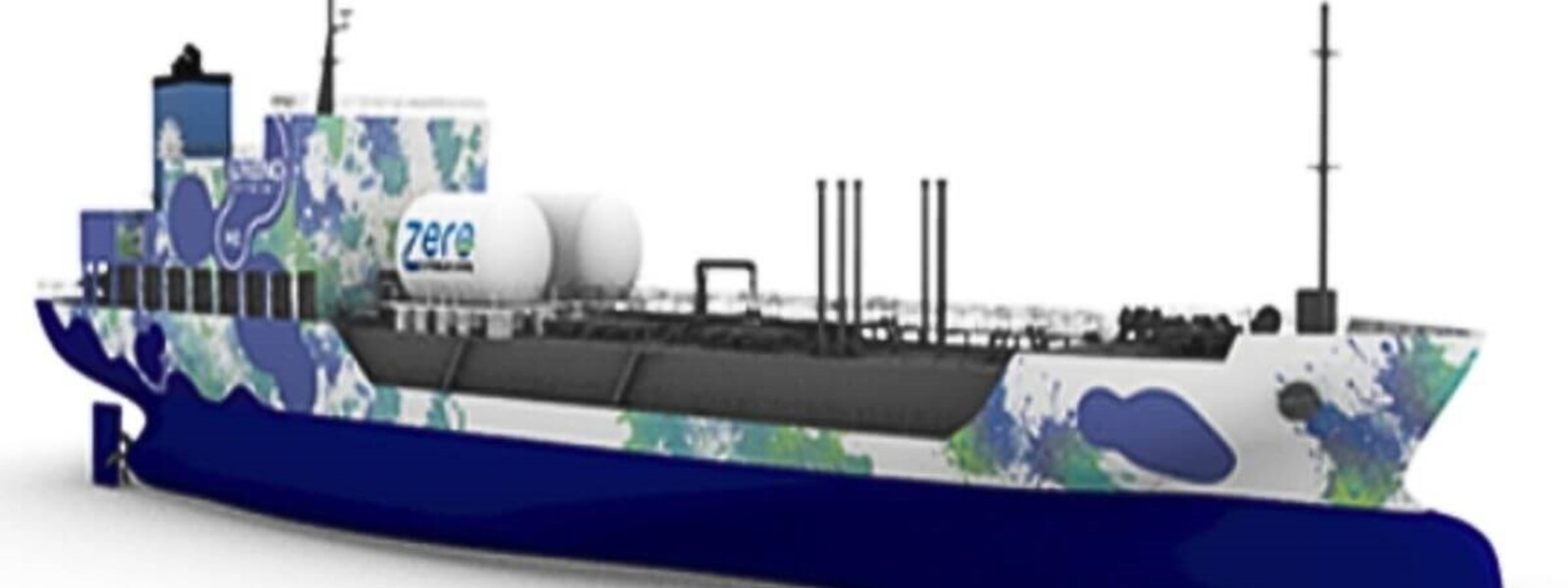
World’s First Liquid Hydrogen-Fueled Oil Tanker Design Awarded Approval in Principle (AiP) Under The Nippon Foundation Project

ClassNK (Nippon Kaiji Kyokai), Japan’s non-governmental ship classification society, has issued an Approval in Principle (AiP) for a design concept for a hydrogen-fueled oil tanker with an electric propulsion system.
The design for the 5,000-kiloliter oil tanker has been developed by Uyeno Transtech Ltd., Yanmar Power Technology Co., and Mitsui E&S Shipbuilding Co. as part of The Nippon Foundation’s project to develop a large-scale hydrogen-fueled domestic tanker and to demonstrate zero-emission ships.
This is the world’s first AiP certification for the design of an oil tanker using liquefied hydrogen as a fuel, ClassNK said in a press release issued on June 19.
ClassNK carried out a review of the design concept for the ship based on its “Rules and Guidance for the Survey and Construction of Steel Ships” incorporating the IGF Code, “Guidelines for Ships Using Alternative Fuels; Guidelines for Ships Using Hydrogen as Fuel (Edition 3.0.0)”, and other guidelines for ships using alternative fuels, hydrogen, and cell power systems.
The IGF Code is an abbreviation of the International Code of Safety for Ships Using Gases or Other Low-flashpoint Fuels, which was adopted in 2017 and put into force in 2019 by the International Maritime Organization (IMO) as its standard for the use of gases as a fuel in maritime transport.
ClassNK’s evaluation revealed that the design complied with all the prescribed safety and performance requirements, establishing a new standard in maritime engineering.
The ship’s design features a hydrogen fuel engine generator as the primary propulsion system and fuel cell power generation for onboard electricity via boil-off gas.
The 100-meter-long tanker’s hydrogen capacity is equivalent to around 2,500 standard hydrogen fuel cell vehicles, and the vessel is expected to reduce CO2 emissions by about 6,000 tons per year compared to a ship using heavy fuel, Uyeno Transtech said.
The company aims to complete the vessel in 2025 and conduct a demonstration test by 2026.
In making its evaluation, ClassNK examined the design based on existing regulations such as international conventions and ship classification rules, and issued the AiP as proof of conformity with requirements.
In July 2023, the IMO adopted a strategy to reach net-zero greenhouse gas (GHG) emissions from international shipping by or around 2050.
In Japan, then Prime Minister Yoshihide Suga in his policy speech in October 2020 declared that Japan was aiming to cut GHG emissions to zero on a net basis to make it a carbon-neutral society by 2050.
ClassNK said it will contribute to the further study of the hydrogen shipping project from a safety assessment standpoint and will strive to support the decarbonization of shipping.
Shipping hydrogen in liquid form presents some extra challenges, particularly related to safe storage, according to experts.
“To liquefy hydrogen, it must be cooled to -253 degrees Celsius,” Mr. Tom Klungseth Østvold, Principal Engineer, Structures at DNV Maritime Advisory, told Gasworld. “Once this is done, the liquefied hydrogen needs to be stored in tanks with the highest standards in vacuum insulation.”
The world’s first AiP for the design concept of the hydrogen-fueled oil tanker can be taken as a proof that the project is technologically feasible.
I sincerely hope that the Uyeno Transtech consortium will be able to overcome all the challenges involved and continue to lead the global campaign to make the world’s shipping industry carbon neutral in the fight against climate change.
For our part, the foundation is determined to support the nation’s fledgling fleet of zero emission ships for decades to come.
